" /> xenotropic.net: November 2002 Archives

« October 2002 | Main | December 2002 »

November 28, 2002

Madurai to Ooty

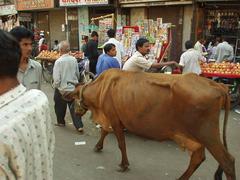
Bull walking down the street, Madurai.

From Kodaikanal I went to Madurai. I left one of my favorite pairs of pants in the United States, and after learning it was possible to get a tailor to make a pair of pants to your description, I was eager to get them recreated in India. I asked them to make me the pants, with a gusseted crotch (a “joint”, the Tamil tailors called it) pockets on the sides, velcro fly and a drawstring waist. They offered to make the pants, as well as a shirt that I wanted for my father, for thirty dollars. I walked away to the next place selling fabric, only to discover that it was a cartel: they worked for the same man, had the same fabric, and the tailor from the first store, a diminuative man who had just taken my measurements, patiently and quietly followed me. But my action had the intended effect; they brought the price down to 1100 rupees, twenty-two dollars. I agreed, and picked it up the next day, and by and large they had done a good job. The price was a bit high, but they spoke good English and now I could take the pants to any tailor and say, “Here, copy this!”, which is more straightforward than trying to describe what you want.

Madurai is famous for it’s temple, which has five towers that are covered with a riot of colorful statues. Hindu temples have lots of small temples inside of them, and the interior of the temple at Madurai was more of a compound, alternating courtyards with buildings holding the smaller temples that, in turn, housed the statues of the gods. Worshippers milled inside of the buildings, performing a wide variety of activities. Some sat or stood pensively in front of the idols; some were walking around one of the smaller temples in circles; a rambunctious crowd of young men, supporting a likeness of Ganesh on a litter, trotted through and beat drums, singing at the top of their lungs. In the courtyard areas and passageways between the buildings, people sat and talked, sometimes sitting down and eating food that they had brought. Some of the worshippers had their heads shaved, and then painted with a turmeric-yellow paste, although I couldn’t find the head-shaving place.

Other than the temple and the tailors, Madurai was unpleasant. It rained on the first day I was there, and the streets were muddy; it was impossible to walk around without getting filthy. Men approached me and always asked, “Have you been in the temple? Have you been up in the tower?” If I said “No” to the latter question, they would offer to take me up into the tower of a nearby business — which just happened to involve passing through four floors of tourist goods, and having people try to sell them to me on the way back down. It was a stupid ploy, and I couldn’t imagine that anyone who fell for it wouldn’t be sufficiently put out to walk out without buying anything. So I saw the temple, got my pants made, and got out of town.

I planned to practice my rusty French skills at Pondicherry, a former French enclave on the Bay of Bengal, but first I wanted to go to Ooty, another hill station in the Western Ghats. Although I had seen a side to Kodaikanal that most people didn’t get an opportunity to visit, I hadn’t really hiked around the hills at all. And more importantly, there was a narrow gauge “toy” train running up to Ooty. I had become slightly obsessed with trains since reading two Theroux books back to back, and I was fascinated to see what this tiny, ancient train was like. I caught the train from Madurai to Coimbatore, which was a five-hour ride that put me into Coimbatore at five in the morning.
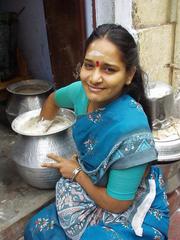
Woman making idli dough, Madurai.

I rode first class, which is a somewhat misleading name. “1AC” was real first class, the most expensive way to go; regular first class is “FC”, without air conditioning. Since it is being phased out, most of the cars are quite old. And when Indians say “AC” there is usually more than just air-conditioning involved. With hotels, where AC rooms were more than double the cost of non-AC rooms, it often implied a larger room, satellite TV, a telephone, running hot water and other such amenities. On trains, it meant starched white sheets, a thick wool blanket, and a waiter who would ask you what you would like for breakfast, lunch, and dinner, and then bring it to you, totalling the bill just before you left the train. Still, plain-vanilla first class was nice in that it was spacious and you got a metal door on your compartment. I shared it with one other man. I said “Hello” and got a grunt in response. It was eleven-thirty at night, so we went to sleep, and didn’t speak another word for the duration of the ride to Coimbatore.

My guidebook said that the train for Ooty left from Coimbatore at seven-thirty. But when I went to buy a ticket, the eyes of the man behind the counter opened wide and he said “Ooty!” and walked off. It was a pretty bizarre reaction to a simple request for a train ticket: did he not know where Ooty was? But the reason for his reaction was clear upon his return: the train had just left, and the next one was in twenty-three and a half hours. I got a hotel room; I napped.

Coimbatore was a university town and although it had no temples or any attractions whatsoever, my stay was very enjoyable. No one tried to sell me anything. The streets were clean for India. Since there was nothing to see, I ran errands. I got a haircut that I was quite happy with (sometimes in Berkeley I can’t get that for eighteen dollars, and here it was fifty cents), bought miconozole for what was looking like it might be athlete’s foot (seventy cents — and it worked, so all mothers, and doctor’s daughters, on the mailing list can remain calm), got four passport photographs for the next visa or permit (a dollar), got a tailor to sew more velcro on the side pockets of the new pants (another dollar) and wrote up a story on what was, for India, a blindingly fast connection (fifty cents an hour). At lunch at a thali place (fifty cents), a standard south Indian institution that is like an all-you-can-eat buffet, the man who served me took an interest in showing me a few nuances of how to eat: put the yogurt into the really spicy curries and they taste better.

In the predawn darkness of the next morning, I walked to the station and bought a ticket to Ooty at quarter before five. I walked to the platform the ticket agent had indicated and paused: this was not a narrow gauge train. It had twenty cars, and they were big. Walking down the length of the train, I kept saying “Ooty?” to anyone in a uniform, and they kept pointing towards the front of the train, until the next to last car, when a chai-wallah (chai is “tea” — actually in India it means “cheap tea with loads of sugar and milk” — and wallah is a suffix added to nouns to indicate a person who works with respect to that item. Hence, a chai-wallah is a tea-seller. An auto driver is an auto-wallah. Et cetera. It is also used to denote a resident; a Delhi-wallah is a person living in Delhi) told me to get on. I confirmed this with a more official looking man. Inside the car, I broke out the guidebook, and read the section on the Ooty train again: the narrow-gauge line started in Mettupalayam, and it was from there that the train left at seven-thirty. Oops. Had I known, I might have had a chance to sprint for this train the day before; but I was happy to have stayed in Coimbatore for a day.
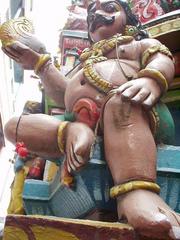
Dravidian temple sculpture, Madurai.

I was in one of two second-class cars from The Nilgiri Express, from Chennai, that continued from Coimbatore. The man across from me was sleeping and didn’t budge for the entire two-hour ride. Two women, flat-nosed and tribal looking, sat on the other side of the aisle; one wore a red scarf around her head and the other with a four year old sleeping boy in her arms. The Nilgiri hills are home to various cultures that, historically, have been fairly disconnected from Indian society as a whole. Indians regard them as being below the lowest of the castes, and refer to them as “tribals”. Don and Betchen’s daughter, who lives in the United States, had adopted a tribal girl, and Betchen had brought the girl from India to Minnesota; in the process, they had opportunity to run into some of those prejudices, although as foreigners they had little import for them. The train station in Mettupalayam had one broad-gauge track, which I arrived on, and on the other side of the station there was one narrow-gauge track, where the train to Ooty waited, the engine puffing little white bursts of steam.

I bought a ticket for second class, fought like mad to get my pack to fit in the space below one of the benches for five minutes, and then took a look around. There were three other caucasians on the train; a middle-aged but ruggedly attractive French couple and a blond man wearing grubby clothes and tortoise shell glasses who looked a lot like the picture of Theroux on the back cover of my copy of The Old Patagonian Express. There were two big groups of Indians who had each colonized one end of the train: behind me was a group of two or three families, and in front of me a group of what appeared to be Indian frat boys. The frat boys all wore baseball caps, seemed to have gotten a haircut in the last week, and they talked and joked loudly in Tamil. Ten minutes later the train lurched out of the station, and for several miles it kept lurching until it started to gather speed. At five miles per hour, it was quaint; at fifteen, I began to wonder if I might get seasick; but then again at thirty it smoothed out to a gentle pulse that seemed to come in groups of five: da-da-da-da-daaaah, da-da-da-da-daaaah. All of the windows were open, and many people were hanging their heads out of them and gawking at the train and the land passing by. In The Old Patagonian Express, Theroux describes a black Costa Rican woman who was riding in a train with him, who suddenly switches from Spanish to English to yell at her son: “Get yo’ haid otta de winda! Tree gonna lop it off!”, and every time I saw somebody doing that I resisted the urge to say that to them. But I did it too; I was facing the back of the train, so I always glanced over my shoulder first to make sure a tree wasn’t gonna lop my head off, and then looked at the engine.

The locomotive was at the back of the train, pushing us rather than pulling, and the reason was immediately evident. Twin columns of vapor rocketed up from it, one a white pillar of steam, and the other was a black smear of coal smoke that smothered the sky behind us. The smoke was coming out of the engine so quickly that it was like watching a movie with every other frame removed. There were thatched houses that looked like ones I had seen in the backwaters of Kerala. As we pulled through a train crossing in a town, a small crowd of vehicles waited for us to pass: two motorcycles, twenty people on bicycles, and a cart pulled by a Brahma bull with one horn painted blue and the other red. There were no cars, trucks, busses, or autorickshaws. The train went over a bridge, and below it was possible to see dhobi-wallahs, clothes washers, pounding the living hell out of shirts and sheets against rocks next to a narrow river. Traveling with a limited wardrobe was easy in India; at every hotel, right after checking in, I would drop my dirty laundry at the front desk, and the next evening it would show up thoroughly cleaned, if somewhat faded, and neatly folded.

I greeted the French couple in their own language, and was delighted to learn that they didn’t speak English better than I spoke French. After five years of study and two six-week stints in France, I had a good accent and passable vocabulary, but at least half the time traveling French people speak very good English and will switch to it after they have complimented me on how good my accent is. His name was Hervé, hers Catherine; they were a doctor and pharmacist respectively, and lived in Bretagne. Catherine was taciturn, and I never heard her utter a word of English, but throughout the train ride Hervé and I would swap between the two languages available to us. This suited me, because I was often jealous of Indians, who would frequently have several languages to choose from when speaking to each other, and would intermingle them; now I had my chance to do the same. Hervé had an outrageous French accent, which kept making me think of John Cleese in Monty Python and the Holy Grail calling down to King Arthur: “I’m Franch! Why do you think I have this outraaageous accent, you silly king-a?” Fortunately I managed not to laugh, and Hervé, who was quite well traveled, began to tell me of his favorite places in the world. One of the best events in Bretagne was to visit the Festival Interceltique de Lorient, which happened during the beginning of August.
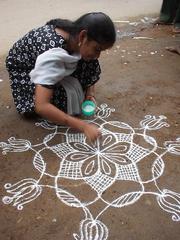
Woman drawing a Kolam outside of her business, Madurai.

“There is music performances of many kinds, and they get many international names as well. Lots of Celtic music and performances. There are usually like 25,000 people who are camping in tents right there. It’s really cool.”

He had an aversion to other tourists. I told him about my tentative plans for the next eight months.

“Myanmar is very cool, it is good that you are thinking of going there,” said Hervé. “It was very easy traveling around there, and the people are very friendly, but there were not so many other tourists around. You can see most of the country going north to south, from Rangoon to Mandalay.”

We had been climbing for a half an hour now, and the landscape was starting to change. The train passed through a gorge; all of the Indians hollered and screamed, and one gave a deafening whistle. For the next five or six tunnels and gorges, it was necessary to stop talking; after the third I started covering my ears. During one tunnel, the frat boys starting singing something that might have been a fight song, and then they picked up in ferocity and volume, and it was a fight song.
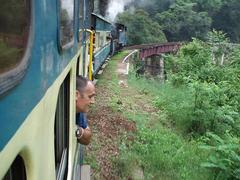
Herve yet again looking out the window of the Ooty train.

The train slowed to a halt in front of a tunnel, and the passengers all walked out onto the grass by the track. There was a small shelter, a set of bathrooms, and a water tank next to the track. The train workers hitched a hose from the water tank to the top of the locomotive and began to refill it. It hadn’t really occurred to me that a steam train would need to be refilled with water, but it seemed obvious now that it was happening. The hose leaked a prodigious amount of water along its length; it was amazing that anything was getting into the train. The man with the tortoiseshell glasses was now clearly not Paul Theroux, who was New England professor: he was wearing wildly patterened pants, a striped shirt, and a white kercheif around his neck. He smoked a bidi, and seemed very agitated and twitchy; I asked him his nationality — German — and then, as he didn’t seem terribly interested in conversing, I left him. Germans are usually conservative, industrial dressers: black suits, leather jackets, squinty rimless glasses. But when they decide to break out of the mold, they do it whole hog.

The steam whistle blew, a proper high-pitched steam whistle that unmistakably belonged to a train, unlike the deep bellowing foghorns of the broad gauge lines. The passengers flooded back into the train quickly, as if each of the doors was a vacuum. The train went from quaint lurch to seasickness lurch to da-da-da-da-daaaaa in a period of five minutes. The Indians thankfully started to lose interest in yelling in tunnels, and Hervé kept going on his highlights of the world.

I told him about my travel overland from Istanbul to Cairo, and after that I ran out of ammunition to counter his onslaught of destinations.

“Sweden was amazing. As Myanmar is to Asia, Sweden is to Europe. There is a boat you can take from Bretagne to the UK, and from there to Sweden. Once we were there, we drove around and stayed in these cabins; it’s hard to describe a glacier or a fjord until you’ve seen one.”
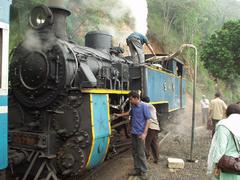
The locomotive of the Ooty miniature train.

We had been in clouds for a while, and then the train brought us above the cloud level after we passed through another tunnel. The guidebook had recommended the left hand side of the train, and little wonder: there was an enormous waterfall cascading down a brown rock face. The train passed over a bridge, and it was suddenly like being in flight: the ground was gone, and it was all train and waterfall. Looking back out the window, I could see the Romanesque arches that supported the span.

Hervé moved on to islands. He liked walking around islands. It was like having a Conde Nast Traveler magazine, but as personal narrative, and in French. He had perambulated the perimeter of San Antao in the Cape Verde Islands, and Reunion Island in Mauritius.

“Reunion Island was the only place I have seen active volcanoes — well, except Indonesia, but that was different. Walking around that island you can see so many climates. There is tropical sub-Saharan, and parts like Europe, depending on which side of the mountain you were on and the altitude.”

Did he camp?
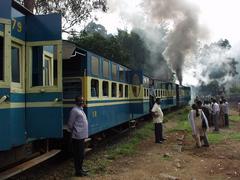
People waiting outside of the Ooty train at a watering stop.

“No, there are small villages, and you stay there at night. Reunion Island you can walk around in eight days, San Antao takes maybe eleven days.”

There were more bridges, and I was always thrilled by the sensation of flying. Several hundred feet below us, there was lush greenery: palm trees, bushes, plants with huge leaves like banana plants.

On steeper inclines, the train would slow, and the pulse of the steam became more palpable. Bushes went by, studded with little bursts of color like fireworks, flowers the size of a quarter that were actually comprised of many little tiny flowers, always two-toned, with the light color in the middle, dark on the outside. Sometimes it was pink and yellow, sometimes purple and orange. Hervé said they were called “vellipeuse” in French, but I couldn’t find any references or translations to English on the Internet. An Indian arm reached out of a window further up in the train and pulled one from a bush, and a flurry of little colored petals burst from the bush like confetti.

Hervé also pointed out a tree with long white flowers, that he said was Datura. The first two times he saw one, I missed it, but on the third try, there were several, in one of the passing valleys: a large, solid tree with the white flowers cascading down all throughout its leaves. Each flower was well over a foot long.

“Datura has alkaloids, it will stop your heart. Don’t eat those flowers.”

I told him I would make a point of not doing so. For Datura I was able to find a reference: it’s a close cousin of belladonna, and in the same genus as Datura inoxia, a hallucinogen used by Native Americans which was made famous by Carlos Castaneda in The Teachings of Don Juan.

A railway worker was standing beside the track, holding out a red flag. At this point I noticed that there was a man working at the back of each bogie, and they all held out red flags, and as the train ground almost to a halt, the man swung up onto one of the cars further forward. The train slowly picked back up to normal speed.

Conoor is the first of the hill stations on this train line. The town itself looked grubby, but the station was small, cute, and clean. There was a sign advertising for the “Hotel Beach”, which seemed a little misplaced at six thousand feet above sea level. A big Holstein cow with bloated udders nibbled at the grass on the far side of the track from the station.

Many people got on and off at Conoor, but at the next staton, Wellington, no one did so. Wellington had a cemetary next to the station, and it was a spectacular place to spend eternity: it faced a rocky mountain stream, and there was a broad valley below it, with a little village, consisting primarily of white houses and tile roofs, perched on one of the ridges, and a red-and-white striped Hindu temple. After Wellington was Aravankadu, another tiny place with a tea processing plant opposite the station, where we remained halted for ten minutes. After that, I started to fall asleep: the excitement of toy train travel had worn off, and the effects of getting up at the unnatural hour of four in the morning hit me.

When I woke up, I noticed that we were now being pushed by a larger, more modern diesel locomotive. It didn’t lurch, but it lacked the romantic appeal of the little huffing steam engine. I missed where the switch happened, although the lengthy stop at Aravankadu was a possibility, as was Arnak, where the train did a strange forward-and-back operation, switching tracks and possibly engines.

Ooty was the terminal station; everybody left the train. As I was slowly winning a game of tug-of-war with my pack, to get it out from under the seat, Hervé came back to say that it wasn’t actually Ooty. Then someone else outside the train said it was, and then it wasn’t. Outside, I could see the “Udhagamandalam” sign — which, understandably, was truncated to “Ooty” for convenience. I kept pulling, and eventually made my way out.

I stayed at the YWCA. Haunted by the lyrics of The Village People and my own memories of visiting the YMCA as a child — smell of chlorine, swimming lessons, weight rooms I wasn’t yet big enough to use — I was stunned by the Ooty YWCA. It had magnificent gardens, good food, and a quiet reading room with old Victorian furniture. I met two women on the way down who, staying in the “dormitory” (three beds to a room) had experienced a rat problem and attemped, unsuccessfully, to get a rat discount, but I went a little upscale and got my own cabin for all of four dollars a night.

Ooty town was unremarkable, except perhaps that, although a big tourist destination, it didn’t seem to have very many people pushing accomodation or trinkets. It was cold, and I was happy to sleep under my down sleeping bag. The men wrapped wool scarves around their heads, like miniature turbans, to keep their ears warm, and many had another scarf wrapped around their neck. There was a preponderance of liquor stores compared to the rest of India, and they were invariably called by some other name: “Brandy Shop” and “Wine Shop” were the most common, although they dealt primarily gin, whiskey, and vodka. But I wasn’t here for the gin or anything else in the town: I meant to head for the surrounding hills as soon as possible.son for his reaction was clear upon his return: the train had just left, and the next one was in twenty-three and a half hours. I got a hotel room; I napped.

Coimbatore was a university town and although it had no temples or any attractions whatsoever, my stay was very enjoyable. No one tried to sell me anything. The streets were clean for India. Since there was nothing to see, I ran errands. I got a haircut that I was quite happy with (sometimes in Berkeley I can’t get that for eighteen dollars, and here it was fifty cents), bought miconozole for what was looking like it might be athlete’s foot (seventy cents — and it worked, so all mothers, and doctor’s daughters, on the mailing list can remain calm), got four passport photographs for the next visa or permit (a dollar), got a tailor to sew more velcro on the side pockets of the new pants (another dollar) and wrote up a story on what was, for India, a blindingly fast connection (fifty cents an hour). At lunch at a thali place (fifty cents), a standard south Indian institution that is like an all-you-can-eat buffet, the man who served me took an interest in showing me a few nuances of how to eat: put the yogurt into the really spicy curries and they taste better.

In the predawn darkness of the next morning, I walked to the station and bought a ticket to Ooty at quarter before five. I walked to the platform the ticket agent had indicated and paused: this was not a narrow gauge train. It had twenty cars, and they were big. Walking down the length of the train, I kept saying “Ooty?” to anyone in a uniform, and they kept pointing towards the front of the train, until the next to last car, when a chai-wallah (chai is “tea” — actually in India it means “cheap tea with loads of sugar and milk” — and wallah is a suffix added to nouns to indicate a person who works with respect to that item. Hence, a chai-wallah is a tea-seller. An auto driver is an auto-wallah. Et cetera. It is also used to denote a resident; a Delhi-wallah is a person living in Delhi) told me to get on. I confirmed this with a more official looking man. Inside the car, I broke out the guidebook, and read the section on the Ooty train again: the narrow-gauge line started in Mettupalayam, and it was from there that the train left at seven-thirty. Oops. Had I known, I might have had a chance to sprint for this train the day before; but I was happy to have stayed in Coimbatore for a day.

The train I was on was one of two second-class cars from The Nilgiri Express, from Chennai, that continued from Coimbatore. The man across from me was sleeping and didn’t budge for the entire two-hour ride. Two women, flat-nosed and tribal looking, sat on the other side of the aisle; one wore a red scarf around her head and the other with a four year old sleeping boy in her arms. The Nilgiri hills are home to various cultures that, historically, have been fairly disconnected from Indian society as a whole. Indians regard them as being below the lowest of the castes, and refer to them as “tribals”. Don and Betchen’s daughter, who lives in the United States, had adopted a tribal girl, and Betchen had brought the girl from India to Minnesota; in the process, they had opportunity to run into some of those prejudices, although as foreigners they had little import for them. The train station in Mettupalayam had one broad-gauge track, which I arrived on, and on the other side of the station there was one narrow-gauge track, where the train to Ooty waited, the engine puffing little white bursts of steam.

I bought a ticket for second class, fought like mad to get my pack to fit in the space below one of the benches for five minutes, and then took a look around. There were three other caucasians on the train; a middle-aged but ruggedly attractive French couple and a blond man wearing grubby clothes and tortoise shell glasses who looked a lot like the picture of Theroux on the back cover of my copy of The Old Patagonian Express. There were two big groups of Indians who had each colonized one end of the train: behind me was a group of two or three families, and in front of me a group of what appeared to be Indian frat boys. The frat boys all wore baseball caps, seemed to have gotten a haircut in the last week, and they talked and joked loudly in Tamil. Ten minutes later the train lurched out of the station, and for several miles it kept lurching until it started to gather speed. At five miles per hour, it was quaint; at fifteen, I began to wonder if I might get seasick; but then again at thirty it smoothed out to a gentle pulse that seemed to come in groups of five: da-da-da-da-daaaah, da-da-da-da-daaaah. All of the windows were open, and many people were hanging their heads out of them and gawking at the train and the land passing by. In The Old Patagonian Express, Theroux describes a black Costa Rican woman who was riding in a train with him, who suddenly switches from Spanish to English to yell at her son: “Get yo’ haid otta de winda! Tree gonna lop it off!”, and every time I saw somebody doing that I resisted the urge to say that to them. But I did it too; I was facing the back of the train, so I always glanced over my shoulder first to make sure a tree wasn’t gonna lop my head off, and then looked at the engine.

The locomotive was at the back of the train, pushing us rather than pulling, and the reason was immediately evident. Twin columns of vapor rocketed up from it, one a white pillar of steam, and the other was a black smear of coal smoke that smothered the sky behind us. The smoke was coming out of the engine so quickly that it was like watching a movie with every other frame removed. There were thatched houses that looked like ones I had seen in the backwaters of Kerala. As we pulled through a train crossing in a town, a small crowd of vehicles waited for us to pass: two motorcycles, twenty people on bicycles, and a cart pulled by a Brahma bull with one horn painted blue and the other red. There were no cars, trucks, busses, or autorickshaws. The train went over a bridge, and below it was possible to see dhobi-wallahs, clothes washers, pounding the living hell out of shirts and sheets against rocks next to a narrow river. Traveling with a limited wardrobe was easy in India; at every hotel, right after checking in, I would drop my dirty laundry at the front desk, and the next evening it would show up thoroughly cleaned, if somewhat faded, and neatly folded.

I greeted the French couple in their own language, and was delighted to learn that they didn’t speak English better than I spoke French. After five years of study and two six-week stints in France, I had a good accent and passable vocabulary, but at least half the time traveling French people speak very good English and will switch to it after they have complimented me on how good my accent is. His name was Hervé, hers Catherine; they were a doctor and pharmacist respectively, and lived in Bretagne. Catherine was taciturn, and I never heard her utter a word of English, but throughout the train ride Hervé and I would swap between the two languages available to us. This suited me, because I was often jealous of Indians, who would frequently have several languages to choose from when speaking to each other, and would intermingle them; now I had my chance to do the same. Hervé had an outrageous French accent, which kept making me think of John Cleese in Monty Python and the Holy Grail calling down to King Arthur: “I’m Franch! Why do you think I have this outraaageous accent, you silly king-a?” Fortunately I managed not to laugh, and Hervé, who was quite well traveled, began to tell me of his favorite places in the world. One of the best events in Bretagne was to visit the Festival Interceltique de Lorient, which happened during the beginning of August.

“There is music performances of many kinds, and they get many international names as well. Lots of Celtic music and performances. There are usually like 25,000 people who are camping in tents right there. It’s really cool.”

He had an aversion to other tourists. I told him about my tentative plans for the next eight months.

“Myanmar is very cool, it is good that you are thinking of going there,” said Hervé. “It was very easy traveling around there, and the people are very friendly, but there were not so many other tourists around. You can see most of the country going north to south, from Rangoon to Mandalay.”

We had been climbing for a half an hour now, and the landscape was starting to change. The train passed through a gorge; all of the Indians hollered and screamed, and one gave a deafening whistle. For the next five or six tunnels and gorges, it was necessary to stop talking; after the third I started covering my ears. During one tunnel, the frat boys starting singing something that might have been a fight song, and then they picked up in ferocity and volume, and it was a fight song.

The train slowed to a halt in front of a tunnel, and the passengers all walked out onto the grass by the track. There was a small shelter, a set of bathrooms, and a water tank next to the track. The train workers hitched a hose from the water tank to the top of the locomotive and began to refill it. It hadn’t really occurred to me that a steam train would need to be refilled with water, but it seemed obvious now that it was happening. The hose leaked a prodigious amount of water along its length; it was amazing that anything was getting into the train. The man with the tortoiseshell glasses was now clearly not Paul Theroux, who was New England professor: he was wearing wildly patterened pants, a striped shirt, and a white kercheif around his neck. He smoked a bidi, and seemed very agitated and twitchy; I asked him his nationality — German — and then, as he didn’t seem terribly interested in conversing, I left him. Germans are usually conservative, industrial dressers: black suits, leather jackets, squinty rimless glasses. But when they decide to break out of the mold, they do it whole hog.

The steam whistle blew, a proper high-pitched steam whistle that unmistakably belonged to a train, unlike the deep bellowing foghorns of the broad gauge lines. The passengers flooded back into the train quickly, as if each of the doors was a vacuum. The train went from quaint lurch to seasickness lurch to da-da-da-da-daaaaa in a period of five minutes. The Indians thankfully started to lose interest in yelling in tunnels, and Hervé kept going on his highlights of the world.

I told him about my travel overland from Istanbul to Cairo, and after that I ran out of ammunition to counter his onslaught of destinations.

“Sweden was amazing. As Myanmar is to Asia, Sweden is to Europe. There is a boat you can take from Bretagne to the UK, and from there to Sweden. Once we were there, we drove around and stayed in these cabins; it’s hard to describe a glacier or a fjord until you’ve seen one.”

We had been in clouds for a while, and then the train brought us above the cloud level after we passed through another tunnel. The guidebook had recommended the left hand side of the train, and little wonder: there was an enormous waterfall cascading down a brown rock face. The train passed over a bridge, and it was suddenly like being in flight: the ground was gone, and it was all train and waterfall. Looking back out the window, I could see the Romanesque arches that supported the span.

Hervé moved on to islands. He liked walking around islands. It was like having a Conde Nast Traveler magazine, but as personal narrative, and in French. He had perambulated the perimeter of San Antao in the Cape Verde Islands, and Reunion Island in Mauritius.

“Reunion Island was the only place I have seen active volcanoes — well, except Indonesia, but that was different. Walking around that island you can see so many climates. There is tropical sub-Saharan, and parts like Europe, depending on which side of the mountain you were on and the altitude.”

Did he camp?

“No, there are small villages, and you stay there at night. Reunion Island you can walk around in eight days, San Antao takes maybe eleven days.”

There were more bridges, and I was always thrilled by the sensation of flying. Several hundred feet below us, there was lush greenery: palm trees, bushes, plants with huge leaves like banana plants.

On steeper inclines, the train would slow, and the pulse of the steam became more palpable. Bushes went by, studded with little bursts of color like fireworks, flowers the size of a quarter that were actually comprised of many little tiny flowers, always two-toned, with the light color in the middle, dark on the outside. Sometimes it was pink and yellow, sometimes purple and orange. Hervé said they were called “vellipeuse” in French, but I couldn’t find any references or translations to English on the Internet. An Indian arm reached out of a window further up in the train and pulled one from a bush, and a flurry of little colored petals burst from the bush like confetti.

Hervé also pointed out a tree with long white flowers, that he said was Datura. The first two times he saw one, I missed it, but on the third try, there were several, in one of the passing valleys: a large, solid tree with the white flowers cascading down all throughout its leaves. Each flower was well over a foot long.

“Datura has alkaloids, it will stop your heart. Don’t eat those flowers.”

I told him I would make a point of not doing so. For Datura I was able to find a reference: it’s a close cousin of belladonna, and in the same genus as Datura inoxia, a hallucinogen used by Native Americans which was made famous by Carlos Castaneda in The Teachings of Don Juan.

A railway worker was standing beside the track, holding out a red flag. At this point I noticed that there was a man working at the back of each bogie, and they all held out red flags, and as the train ground almost to a halt, the man swung up onto one of the cars further forward. The train slowly picked back up to normal speed.

Conoor is the first of the hill stations on this train line. The town itself looked grubby, but the station was small, cute, and clean. There was a sign advertising for the “Hotel Beach”, which seemed a little misplaced at six thousand feet above sea level. A big Holstein cow with bloated udders nibbled at the grass on the far side of the track from the station.

Many people got on and off at Conoor, but at the next staton, Wellington, no one did so. Wellington had a cemetary next to the station, and it was a spectacular place to spend eternity: it faced a rocky mountain stream, and there was a broad valley below it, with a little village, consisting primarily of white houses and tile roofs, perched on one of the ridges, and a red-and-white striped Hindu temple. After Wellington was Aravankadu, another tiny place with a tea processing plant opposite the station, where we remained halted for ten minutes. After that, I started to fall asleep: the excitement of toy train travel had worn off, and the effects of getting up at the unnatural hour of four in the morning hit me.

When I woke up, I noticed that we were now being pushed by a larger, more modern diesel locomotive. It didn’t lurch, but it lacked the romantic appeal of the little huffing steam engine. I missed where the switch happened, although the lengthy stop at Aravankadu was a possibility, as was Arnak, where the train did a strange forward-and-back operation, switching tracks and possibly engines.

Ooty was the terminal station; everybody left the train. As I was slowly winning a game of tug-of-war with my pack, to get it out from under the seat, Hervé came back to say that it wasn’t actually Ooty. Then someone else outside the train said it was, and then it wasn’t. Outside, I could see the “Udhagamandalam” sign — which, understandably, was truncated to “Ooty” for convenience. I kept pulling, and eventually made my way out.

I stayed at the YWCA. Haunted by the lyrics of The Village People and my own memories of visiting the YMCA as a child — smell of chlorine, swimming lessons, weight rooms I wasn’t yet big enough to use — I was stunned by the Ooty YWCA. It had magnificent gardens, good food, and a quiet reading room with old Victorian furniture. I met two women on the way down who, staying in the “dormitory” (three beds to a room) had experienced a rat problem and attemped, unsuccessfully, to get a rat discount, but I went a little upscale and got my own cabin for all of four dollars a night.

Ooty town was unremarkable, except perhaps that, although a big tourist destination, it didn’t seem to have very many people pushing accomodation or trinkets. It was cold, and I was happy to sleep under my down sleeping bag. The men wrapped wool scarves around their heads, like miniature turbans, to keep their ears warm, and many had another scarf wrapped around their neck. There was a preponderance of liquor stores compared to the rest of India, and they were invariably called by some other name: “Brandy Shop” and “Wine Shop” were the most common, although they dealt primarily gin, whiskey, and vodka. But I wasn’t here for the gin or anything else in the town: I meant to head for the surrounding hills as soon as possible.
November 22, 2002

Munnar

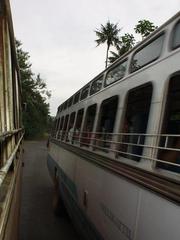
Busses passing each other on the way to Munnar

The bus ride from the plains of Kerala up to Munnar took my breath away: partly from awe at the view out the window, and partly from fear that the bus would drive off of the precipice that followed the right hand side of the road. Munnar in a town in the Western Ghats, the mountains that follow the southwestern coast of India, and is home to some of the highest tea growing estates in the world.

The road leading up to Munnar, like all of the roads in the Ghats that I have seen, was narrower than most American driveways and full of potholes. When it was necessary for two of the battered Kerala State Road Transportation busses to pass each other, their diesel engines would drop to a gutteral growl. The downhill bus would pull halfway off of the road and halt, and the uphill bus would slowly nuzzle past, less than a foot away. In some cases, there was no room on the shoulder for the downhill bus, so it would have to slowly, slowly back up, with the uphill bus following, until it could make way. Out the window the trunks of palm trees, less than a foot thick, rocketed up a hundred feet from the valley floor, exploding into a green burst of leafy fronds. Far below them short shrubby trees grew like oversized broccoli.

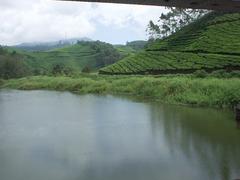
The last ten miles before arriving in Munnar, wisps of fog laced the hills, and the tea started. Tea grows on trees that are kept trimmed low, so that they look like bushes; in the Western Ghats, they grow those trees like Hoosiers grow corn. Unlike the Midwest, however, the topography of the Ghats gives vantage points that make it possible to more fully appreciate the magnitude of the agricultural enterprise taking place. The trees are organized into clusters just the right size for tea leaf pickers to be able to reach around them, leaving thin little pathways weaving between them. From on high, the effect is that of driving over an enormous green fish, its scaly side reaching out as far as the eye can see.

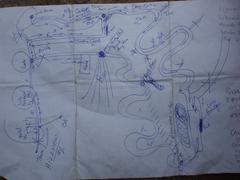
Upon arriving in Munnar, I stayed at the cottage of the garrulous and informative Joseph Iype. I asked him for a good walk around the area, and he drew out a map for me, leading from town to village and through the plantation of the stuttering Tata Tea Corporation. There was also cardamom, coffee, and a waterfall on the way. Joseph, like Jose on the Kanyakumari Express, explained his thoughts repetitively. As he drew the map, he explained each section of the path at least three times, and then had me recite it a fourth.

Tea with lake in foreground, Munnar.

The quality of his route was very good. The cardamom plantations have rows of banana plants, with enormous leaves that shelter the tiny cardamom plants below, which are little stalks lined with little spheres that hold the spice. The cardamom gave way to the village of Pothamedu. Kerala voted in the world’s first democratically elected communist government in 1956, and the peasants of Kothmanduy were a reflection of this: they were poor but well-educated; when I asked someone if I could take their picture, they would invariably say “yes” and then ask for a copy, writing down their address in impeccable handwriting.

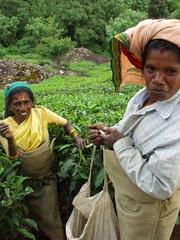
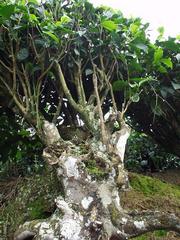
Next came tea country. The long winding path dove into the green scales of the tea trees, with “tea ladies” (as Joseph called them) navigating the lanes betwen them and plucking tea. Up close, it was possible to see the age of the trees: they had orange and white lichens growing on their trunks and on the gnarled roots fastening them to the sloped ground. High quality tea trees - Darjeeling or Assam are the most common varieties - do not start producing until at least five years after plucking, but they can live for up to one hundred and fifty years. Later, a guide who was leading me through a part of the Ghats further north pointed out quick growing plants, much more spindly and frail, that he said could be harvested in two years but died in sixty.

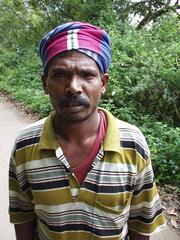
About a mile into the plantation, a man passed me. He was Indian, but he had an intensity to him, unlike the usual carefree Indian manner.

“What is your good name?” he asked. This is the Indian way of asking for someone’s first name.

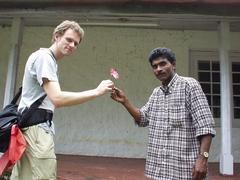
Rajan, the Assistant Manager's cook, hands me a flower.
Rajan, the Assistant Manager’s cook, hands me a flower.

I told him. We went through the usual traveling pleasantries; I was from San Francisco, a computer programmer. His name was Rajan.

“Are you bachelor?” he asked.

“Yes.”

“So you are not married.”

“That’s right, not married. Are you?”

“Yes, married with two children. Come, where are you heading?”

“Athukad falls,” I said. It was the next big stop on Joseph’s map. “Is it very far?”

“Yes, one kilometer you go down and then - Athukad waterfall. But first you must come to my house. Perhaps, have some tea, and then you can go on to Athukad waterfall, yes?”

“Um, sure, but where is your house?”

“Just here, behind Assistant Manager Bungalow.” He pointed to a building a hundred yards up the hill. “So you do not have a wife?”

Was this not yet clear?

“NO I DO NOT HAVE A WIFE,” I said. “But how long does it take to walk to your house?” I had been led on one of these wild goose chases before in Mumbai and followed a fellow for almost an hour before we got to where we were going.

Tea picking ladies, Tata tea plantation, Munnar.

“Less than five minutes, no problem.”

Which probably means less than fifteen minutes if I’m lucky, I thought. But Rajan was honest; we were there in two minutes. On the way, he explained his occupation.

“I am Chinese cook. I went to Cochin to learn to be a Chinese cook. I make chop suey, egg foo young, vegetable stir fry, kung pow chicken, egg fried rice. I cook this for the Assistant Manager. This is his bungalow.”

We had arrived. Rajan led me past the Assistant Manager’s Bungalow sign and across the well-tended garden and over the immaculately manicured lawn, where there was a lawn manicurist hard at work. Rajan tried two doors on the bungalow, which were both bolted from inside. He asked something of the gardener in Tamil, who replied in kind; Rajan started to walk around the building, thought better of it, and jumped through a low window and unbolted the door. He gave me the tour: here is the dining room, with Chinese placemats; the guest bedroom, the Assistant Manager’s bedroom…

Joseph Iype's map of a 10K walk around Munnar.
Joseph Iype’s map of a 10K walk around Munnar.

“Where is the Assistant Manager?” I asked.

“Ammm, Assistant Manager,” murmured Rajan.

“Yes, but where is he, where does he work?” I asked.

“Yes, Assistant Manager’s bungalow,” he said again. He had been able to understand my English just fine until now.

But my fears that we were invading the home of the Assistant Manager were laid to rest by the calm authority with which Rajan showed me around the kitchen. His kitchen. He flipped on the gas burners, and showed me the adjacent wood-burning stove, which was magnificent, but, according to Rajan, rarely used.

“Come, come, we go to my house. You have tea, and then to Athukad waterfall.”

We went. It was a small shack behind and below the main bungalow. Another man, more portly than Rajan, sat with three children in front. We walked inside, into a room with three beds tightly packed against each other; there was a tin roof, and on the walls there was a calendar and a large picture of Jesus with a flaming sacred heart. The other man came in and there was a brief discussion in Tamil involving the word “chai”, which means tea with sugar and milk. Two of the little girls followed us in, which Rajan introduced as his daughters. He told me their names, and then we ran out of things to say; it was awkwardly silent like a first date. I thought hard, searching for a topic of conversation.

“Where is your wife?” I finally asked.

“Wife is out for fireoota.”

“Fire what?”

“Fireoota, she is out for fireoota.”

“Ah.” I let it drop.

He pulled out pictures: wife, daughters, Rajan bathing with friends at a holy site, Rajan riding a tractor. The other man brought in the tea and walked out again.

“Who is he?” I asked.

“He is my assistant, he is chopping the vegetables.”

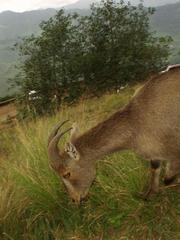
An amazingly tame Nilgiri Tahr, Eravikulam National Park, Kerala.

The Assistant Manager’s Cook’s Assistant. Only in a country with as many people to spare as India could one have such a title; and this was a full grown, middle aged man with a daughter. Earlier, I had also noticed how, in places where an American would store tools or supplies, Indians would add in an extra person or two to operate or distrubute whatever was in the storage space; usually the space wasn’t made any bigger, either. On the train, from Mumbai to Ernakulam there was a linen closet. Besides the linen, it also contained a hard bunk where two linen-dispensing men lived. At the Hotel Lawrence in Mumbai, next to the reception desk, there was a narrow room where two men slept and ate, with the mops, brooms, and spare sheets; they cooked, cleaned, sometimes manned reception, and kept the place running. At Nirav’s friend’s house, there were several servants who, according to Nirav, lived in the garage.

Rajan’s wife returned, as well as another woman, both with large bundles of thick sticks on their heads: gone for firewood, he had been trying to tell me.

It was time for me to go. Rajan walked me out and back towards the path I had been walking on. Before we parted, I wanted to take a picture with my digital camera, and I showed the result to him. This was tremendously exciting to immediately see his own picture. He wanted to show his wife. Pleading with me to not go for another minute or two, he bolted back the way we had come.

Old tea plant, Munnar.

She had left for more fireoota. Rajan consoled himself by arranging a photograph of him handing me a flower, which he had plucked from the Assistant Manager’s garden, and I kept walking on.

I passed what I imagined to be the Assistant Manager himself about a mile later. He looked like an Indian Scoutmaster: he wore khaki shorts, an Indiana Jones hat, a walking cane, and over-the-calf tan stockings, underneath one of which he appeared to have stuck some kind of small tool. I greeted him, and he replied with a baritone “Good Afternoon” worthy of James Earl Jones.

The waterfall was impressive, but there are many waterfalls in India. This does not seem to stop the Indians from admiring them all, however; there were many of them coming down in jeeps, full to the brim, from the dirt road ahead.

I had woken up that morning with a sore throat, and by now I was feeling feverish and miserable. I rested for ten minutes, watching a Indian tourists mill in front of Athukad Falls and gawk. After that, it was a long hike up an enormous stone stairwell to the main road. Schoolchildren streamed down from the top in groups of five to ten; almost every group asked me for “Pen-pen?” or “Chocolate?” and, having neither to spare, I refused them all. I was just about to start greeting each new group with “Hello, no pen, no chocolate,” when a small girl with pigtails tied up in pink ribbon walked boldly up to me and said, “Hello, how are you?”, shook my hand firmly, and went on her way. From the top road, I caught a shared jeep, one of the Mahindra Commanders that are a slightly inflated Indian version of a Jeep Wrangler.

That night my fever got worse. As I lay sweating in bed, I debated taking some of the doxycycline pills that I had for Lariam-resistant malaria in Thailand; they were also useful as a general antibiotic. They had worked to great effect in Mumbai against the bug that I caught from Nirav, for which he said he had been prescribed antibiotics; however, I had foolishly stopped taking them after I was feeling better only four days later. It was very likely that I was suffering from the same illness, only now possibly it was doxycycline resistant. I figured I had nothing to lose; if they were giving it out as an antibiotic to all Americans who were going to Thailand, I wouldn’t reduce its effectiveness too much more by taking it here. I gulped down two pills, the recommended initial dose.

I had read once about how someone had created a video game for pediatric cancer patients, in which they controlled little T-cells that go around telling cancer cells to kill themselves. That night, half-asleep and febrile, perhaps inspired by that invention, I imagined the battle going on inside my veins. Lumbering macrophages sent out pseudopodia, pulling in little clusters of spherical bacteria that swarmed around them. The ensnared bacteria screamed, with their little bacteria faces, until they were swallowed and dissolved. Some of the same white blood cells, bloated from consuming a surfeit of the enemy, lay broken and rotting. Overhead the sky was apocalyptic crimson; the surrounding terrain was as parched and scorched as my throat. Things were beginning to look grim: the enemy forces were dying by the score, but they were spawning even faster, and the cells of my immune system were hard pressed. On a cliff above the battlefield, there were a few little men in white lab coats with mirrors on their foreheads, like doctors from the 1950’s. They were loading two howitzers with turquoise shells that said “Mutual 105” on the side (for such was the color and labeling of the doxycycline pills). Kaboomf! Kaboomf! The howitzers recoiled and two parabolic lines streaked to the battlefield, exploding into turquoise haloes that spread across the combatants. The resulting devastation was, I think, inspired by the nuclear detonation in Terminator 2, which I still think is one of the most terrifying scenes produced by Hollywood: the little bacteria disintegrated before the crest of the shockwave, their cell walls melting quickly, leaving little puddles of endoplasm with ribosomes and DNA fragments in them. The macrophages paused as if in disbelief, for their prey was suddenly missing. The sky began shifting to blue; clouds moved in and it started pouring rain.

I sat up, drenched in sweat; my fever had broken. It was six a.m. I slept for two more hours until a gentle rapping at my door woke me up. It was Joseph.

“You are feeling better?” he asked.

“Yes… yes, I think so.”

“The three Germans who are next door, they are hiring a car to drive around and see the National Park, a tea factory, and some other things in the area. You want to go?”

I went. The Germans were named Martin, Peter, and Rheinhold. They were, predictably, engineers, and at breakfast, when I ordered a poori masala, they ordered “toast butter jam” to a man, only differing in their beverages: tea for Martin, milk tea for Peter, and coffee for Rheinhold. They all spoke English well, and I settled two bets while we ate: “backbag” was not an acceptable synonym for “backpack”, and “cancel” was, in fact, the correct verb for what a mailman does to a stamp.

We drove to Ervikulam National Park (entrance sign: “This is the habitat of wild denizens Seeing animals is a matter of chance”), home of the staggeringly tame Nilgiri Tahr. It was possible to walk within ten feet of them, at which point they would walk away. They only ate grass, so it seemed unlikely that the tameness came from them being fed. I was surprised that they had survived this long. After that it was a crocodile farm; it was not entirely clear why the state of Tamil Nadu (for we had driven over the border from Kerala at this point) was growing the fifteen-foot man eaters, but presumably they were endangered.

A man who pointed out the caterpillars that I saw dangling from trees were poisonous.
One of the men who pointed out the caterpillars are poisonous.

We stopped in at the Talliar tea factory, where we saw tea being processed; this was mostly lower grades, that were dried, chopped, the stems and veins removed by static electricity, fermented, and sorted by grade by a large vibrating chute with wire mesh of descending size lower down; little waterfalls of tea fell from the side of it into large tin bowls. Huge mounds of tea, as fine black powder, were on the floor, and there were rows and rows of canvas sacks that were filled with it. A week later, I saw another factory, where they showed us (non-operating) machinery that processed whole-leaf tea, for the highest grades, but that was not in evidence here.

The day ended with a stop at the Chinnar Wildlife park, which had a rickety thirty foot tower from which it was possible to see tiny little specks of wild pigs, deer, and a trumpeting herd of wild elephants. We retuned to Joseph’s cabin; I bid farewell to the Germans, and packed my bags to go to Kodaikanal, still in the Ghats, but to the southeast.

November 18, 2002

Fort Cochin

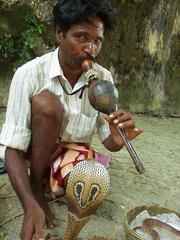
Snake charmer in Fort Cochin, India.

The weather in Fort Cochin is Floridian, and the geography mimics the Bay Area. The air is warm and muggy, and the waters are clogged with water hyacinths. On the Eastern bay, analogous to Oakland, is Ernakulam, which is industrial and has large boat loading apparatus that look like the Imperial Walkers from Star Wars; Fort Cochin is a San Franciscan peninsula to the west, which was settled first and has most of the tourist attractions.

I found a place to stay in Ernakulam, and took the boat across to Fort Cochin. The boat ride across cost five cents, for a ride in a long wooden boat that holds about forty people, with an inboard diesel engine. Upon arrival, I went first to Addy’s Restaurant, which was about a two mile walk from the pier; it got high marks from the guidebook — something that Addy himself was obviously proud of, since he had xeroxed out the guidebook entry, blown it up several times, and posted it on the door. I walked in, and found that I was the only customer. The owner, Addy, and his friend, Brian, were the only other two people there.

I ordered lunch: prawns that had supposedly been caught in the Chinese cantilevered fishing nets that were around the Fort area. A woman went to prepare the food, the owner stepped into a back room, and so I talked to Brian for a while. He seemed like he was well traveled, so I asked him about places to see around India. Did I like trekking and Safaris? I nodded. Ramganya, which was near Corbett Tiger Reserve, was the place to go: there one could hire an elephant and a guide and go looking for tigers.

“Usually you go for two or three days, and even then if you see a tiger they consider you lucky,” said Brian.

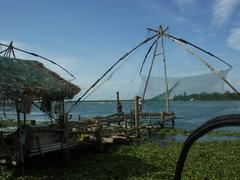
Cantilevered Chinese Fishing nets, Fort Cochin, Kerala.

“Probably have lots of cobras there too, huh?”

“Yes, king cobras even they have there. Have you seen a king cobra?”

No, I didn’t think so.

“They are about four feet high,” Brian held his hand up four feet off the ground, “and if they bite you, you have about one minute to live. They are one of four poisonous snakes in India: there is also the Russell viper, the soft-scaled viper, and the common krait. I used to work for a snake park near Madras, and would catch cobras for them. We’d get ten rupees for each one.”

King cobras?

Brian shook his head and laughed. “No, very small ones. For antivenin.”

Trevor, the owner, came back (Addy, the restaurants namesake, was his grandmother; her portrait was the only item adorning the walls).

“Where are you coming from?” he asked me.

“Mumbai.”

“No, I mean before, originally.”

Right, ‘coming from?’ means ‘where are you from?’.

“Chicago, originally, now San Francisco. United States.”

“Any big events with security in the United States now?”

Not so much with security per se, I told him, but George Bush’s party now controls Congress, so it seems more likely that we’ll invade Iraq now. I explained how that might not be altogether a bad idea, but what with Israel being there and feeling pugnacious, it could get bloody.

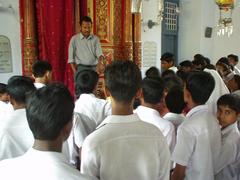
Indian schoolchildren being lectured on Judaism.

“And then the Arab states will join in and it will be trouble,” added Brian.

“But it might be a good thing. Bill Clinton was skimming…” Trevor looked around the room for the rest of the idiom he had started. “He was skimming on the water, he wanted everybody to like him. With George Bush you can see that he in wanting to do the right thing. He is willing to take a side.”

I related a Time magazine article that had given the United States a report card on various parts of the Afghan campaign. We had done brilliantly in combat, but lagged afterwards in dealing with more civilian tasks. If the United States could only do better at the post-warfare bit, I’d be a little more enthusiastic about this nation-building stuff in Iraq.

“It is difficult from the battlefield to make it work,” said Trevor. “From your couch or from your house it is easy to say they should have done this or done that, but it’s hard to pull off.”

“I suppose I am being something of a Monday morning quarterback, huh?”

“A what?”

By the time I had explained what an American football quarterback is, and that games were on Sunday, my prawns had arrived, and they were straight out of Louisiana: covered in blackening spices, with buggy black eyes on stalks. Brian talked me through taking apart the first one.

Most of the time I’m a vegetarian, particularly in the United States. Originally it was from horror at the similarity between my own muscles and those that I was eating: I converted after being a teaching assistant at Eckerd College for vertebrate biology, which involved a great deal of cat dissection, and then coming home for Christmas right after that final and slicing apart Cornish hens; the similarity was a bit much. After a few years, and after reading Fast Food Nation, I’m more inclined to think that perhaps small-scale, grass-fed beef might be morally acceptable, although at this point I doubt I’ll eat it myself. The stuff made by the big meat packing conglomerates, IBP and ConAgra, is revolting, where cattle are treated as a manufactured good, illegal immigrants are considered disposable, and the slaughtering line speeds are pushed to the point that feces and beef frequently commingle. At all times, however, I have thought that tearing apart crustaceans was acceptable: here you are forced to confront the fact that you are eating an animal, because you’re tearing it apart with your own hands. The combination of beer and decapod innards made me nostalgic for Maryland blue crabs.

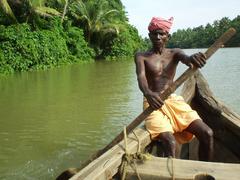
Keralan rowing a riverboat.

Trevor turned on the radio and flipped through some stations.

“Here we also have American music, for you, eh?”

And with that he walked out into the same back room; Clint Black blared out of his stereo.

She’ll be walking in the moonlight

Seeing nothing but the tail lights

And that’s a pair of tail lights she won’t ever see again

She hit me with the left and right

Showing me nothing but the tail lights

George Bush a good president? Clint Black? Blackened prawns? I checked for a Lone Star flag on the walls, but only the portrait of Trevor’s grandmother looked back.

*******************************************

Every hotel in India makes you sign in on an imposing two-foot square ledger, with your name, permanent address, and signature. At my hotel in Ernakulam I noticed that the entry above mine was from 56th Street, in Oakland: about a mile and a half from the apartment I had just left. It seemed a bit much to go about asking everyone I saw if they were, in fact, the people from down the street who happened to be in the same remote corner of the world. Fortunately, I brought a UC Berkeley shirt along for just such occasions, and wore it that day.

After eating at Addy’s, I walked around Fort Cochin and saw the religious monuments: St. Francis’s Church, the oldest Christian church in India that is still standing, and the Synagogue of the Cochin Jews, who have been in the area since at least the tenth century, when the King of Malabar granted status on par with being a minor king to a Jew named Joseph Rabban. Today there are less than twenty remaining, due to emigration to Israel, and they are all elders. Within twenty years there will almost certainly be none left.

On the boat back to Ernakulam there was a couple, and the woman immediately noticed my shirt. You’re from Berkeley? Well, Oakland really. You too, huh? Staying at the Bijus hotel? Me too.

Their names were Becky and John, and they were typical well-educated adventurous Bay Area denizens. On the next two days I did the obvious two Kerala tourist things with them, which both turned out quite well: a backwater cruise and a Kathakali theater.

The Keralan Backwaters were created by damming for rice paddies, and are fresh ten months of the year and brackish the other two. Many people live there, and we saw many of them on the way out. They were fishing, digging and washing in and near the water. All of them stopped to look at our boat as we passed; half of them waved happy greetings, and the other half looked at us in silence with serious, dark eyes.

The first part of the cruise was on a large houseboat, with about twenty people on it, mostly Indians. We visited a village in the backwaters, where we were shown how they carved doors, made cord out of coconut husks (which was not just for illustrative purposes; I have since seen large scale operations of a similar nature on the side of the road), and grew spices. The acre where they grew spices was like a living version of the baking aisle in an American grocery store: turmeric, curry leaf, nutmeg, cardamom, and mace (which is the outer coating of a nutmeg nut) were each shown to us in turn, as well as betel plants, the leaves and nuts of which are used in making pan, a kind of Indian after dinner digestive.

After the village, we were rowed in smaller boats that held about ten people each, through waterways of various sizes, from rivers down to canals four feet wide with overhanging branches. I was the frontmost passenger, with the man rowing the boat facing me. He wore only a bright orange lungi and a red cloth on his head; he was wire thin, without an ounce of fat on his body, and his tiny muscles were nevertheless solid, like whipcord. In the three hours that he propelled us, he burped once, laughed once, and otherwise rowed without pause.

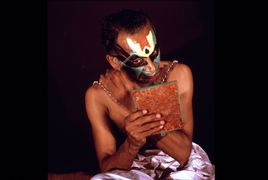
Kathakali theater performer.

The ride back from the boats to central Ernakulam was an unpleasant fast forward from the most idyllic, simple village to the worst scenes of unchecked and unzoned modern development. We started in a village where a man hacked coconuts open for us to drink in front of his thatched hut, and then got in the bus we had arrived in and headed home. First there were a few tea stalls with hands of bananas hanging out front, then concrete walls painted with advertisements; motor scooter repair stands with hand painted signs soon gave way to larger glass encased edifices selling furniture and electronics. Finally, we entered Ernakulam proper, which was in full neon bloom, advertising Tom and Jerry pajamas and cell phone plans: “The only thing that covers Kerala better than us is the monsoon”.

***************************************

Becky, John and I arranged to meet to go to a Kathakali theater performance the next night. We went to the See India Foundation’s show, which the guidebook says “features an extraordinary explanation by PK Devan, who explains the dance’s history.” I was not disappointed. Part of the show is watching the actors get ready, as they put on layers of thick coconut-oil based paints in vivid colors; there were two at this show, one who was wearing mostly green colors, and another in black and red, with a little paper white tuft on his nose, as are used to cover the bone end of a drumstick. They then went into the wings to finish dressing while Mr. Devan explained extraordinarily.

He had a slow, booming voice, with which he introduced two barechested men: a Kathakali drummer with curved drumsticks and white stripes painted on his shoulders, and a dancer without makeup, not one of the two we had seen earlier. The drummer rapped out frenetic beats, and the dancer danced while Mr. Devan tapped together two heavy metal cymbals; this was interleaved with Mr. Devan’s drawled explanations of what the dancer was doing. Every vowel dripped ever so slowly out of his mouth.

“The Kathakali dancers learn from when they are very young to control their eyes. They can move them up and down.”

The dancer assumed a crazed false smile and moved his eyes up and down.

“Side to side.”

The dancers eyes moved wildly from side to side.

“Figure eight.”

The dancers eyes swerved around in loops.

Mr. Devan explained that the dancers have a vocabulary of gestures; they never speak, although bad guys are allowed to grunt and squeal on occasion. He went through a glossary of terms, both concrete and abstract, and the dancer did a thirty second dance expressing each one: fish, love, hate, fear, cobra. The wild, insane grin was always part of the Kathakali guise, modified only slightly to accommodate other emotions as appropriate. The dancer twitched his cheeks to the pulse of the music and stepped broadly about while gesticulating with both arms; he wore long metal spikes on his left hand, like an exotic Freddy Krueger. It was like watching a game of charades, as done by professionals. The final item was “bee at flowers,” where the actor made huge flapping motions that settled down to a gentle nectar-sucking movement, with his silvery fingers fluttering by his cheeks.

Then came the actual performance. The actors, who had left with just painted faces, returned in full regalia, with huge headdresses and enormous hooped skirts. The green one was a prince, explained Mr. Devan, and the red and black one was a demon, which he pronounced “daymun”. The show itself was almost an anticlimax to the explanation; there were three short scenes in which daymun threatened prince, prince threatened daymun, then a brief battle in which the daymun, predictably, lost.

The show closed with a long rambling speech from Mr. Devan, touching briefly on Kathakali, but dealing primarily with how the pace of life in India was slow, such that it was acceptable to make long rambling speeches, “because we have the time”. He also proposed a theory on the Indian affirmative head-wobble.

“Sometimes people ask me why Indians move their head like this.” Head wobble. “Of course, nobody knows, but you see, I have an idea. When you move like this” — he made a short chopping nod — “it is a conquering gesture. You live in lands where you have to fight cold and snow. In India we have never known this; we are like corn swaying in the breeze, so we move like this.” One more wobble.

November 16, 2002

The Kanyakumari Express

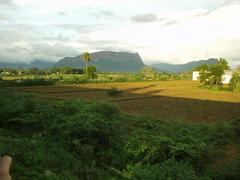
View out of the Kanyakumari Express, around Southern Andhra Pradesh

Victoria Terminus, if you come at it walking in from the north, does not initially appear to be the grand old cathedral of a building that it actually is. The business end of it, where the long distance trains originate and terminate, and where tickets are booked, is a thoroughfare filled with billboards (“Oxyrich Bottled Water 300% More Oxygen Than 16 Other Leading Brands”) and a large archway with a massive digital clock. Only if you walk back out from this and around to the side of the building — and keep walking and walking, it’s probably half a mile long — it then becomes all gothic stone and archways, with steel and glass pods that stick out every hundred meters or so, a shameless mating of bauhaus with ancient rock.

I went to Victoria Terminus (more commonly known just as “VT”) three times before I actually was able to buy the ticket that I wanted. On my first visit, I found the part of the building that housed the offices where tickets are sold, and figured out the process for how you get a ticket. The first step is to find a “Trains at a Glance”, which is a publication the size of a thick magazine with the Indian railways logo on the front, a friendly blue elephant waving a hurricane lamp. The next step is to figure out which train is appropriate for where you want to go; there are tables that describe this, but the instructions are limited, and I didn’t actually realize that I hadn’t fully figured out the system until I was a thousand miles from Mumbai (more on that later). For each train, it also lists all of the stops, and the times that it arrives at each station. After ascertaining the number of the appropriate train — 1081, the Kanyakumari Express, in my case — you take a number, and stand in front of a bank of monitors, each of which iterates through a set of ten trains, and shows how occupied each train is for the next month. A train goes through the stages of booking from open (green) to “Reservation Against Cancellation” or “RAC” (yellow) to “Waitlist” (magenta). RAC tickets give you permission to board the train without a seat assignment, and as far as I could make out from the description, hope that the conductor finds someplace to put you. You then fill out a blue ticket request form, to indicate the desired train, day, and class of service, and take it to a ticket window.

The computer running the monitor that would normally show the Kanyakumari Express had crashed and was permanently displaying the status of the Coimbatore Express instead. I complained to the Stationmaster, whose office was surprisingly vacant; he wobbled his head, asked what train, and promised to fix it. Wandering around the station further, I discovered that there was a special “Foreign Tourist” window, up the worn white marble stairs from the monitor room; it was closed, and there was a dejected Spaniard standing in front of it, evidently hoping that it might re-open off schedule.

The next day I came back; the train was waitlisted for a week out. There was a queue of seven other foreigners at the Foreign Tourist Window. The two at the tail were a pair of English women. We chatted for a while: how are you, how long have you been in India, where to next. One of them, with a group of three other women — only two of them were at the station, one of them just having returned from a mad dash to fetch passports from the hotel, since there was a large sign indicating that it was necessary to have a foreign passport to buy a ticket here — indicated that they wanted to go to Jaipur, in Rajasthan.

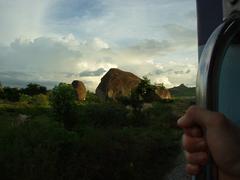
White-knuckled grip on the rail, looking at big rocky formations in A.P.

“We have got to get on this train tommorrow, or I don’t know what we’re going to do,” she said.

“What’s wrong with the day after tomorrow?”

“We’ve been here five weeks and now we’ve only got nine days left and all these things that we want to see. We have every day planned out, and if we can’t get this train… well, I don’t know. There’s a wait list of over 250 people for the train we want tomorrow. I hope they can do something here.”

Inwardly, I gloated at the wealth of time at my disposal, but to her I just replied sympathetically, “Well, I hope you get it then.”

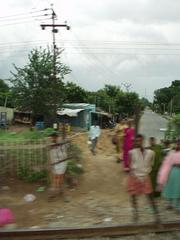
Passing a village on the train.

As we were saying this, a short, pudgy man wearing a grubby undershirt walked up to the side of the line, next to me and within less than a foot of the back of the neck of the other woman, literally breathing down her neck. He let out small grunts every few breaths and had a dirty porcine look, like he had just come from rooting for mushrooms in the fields. The Englishwoman looked over her shoulder with a look of discomfort; this was in flagrant violation of the Western concept of personal space. The proper thing at this point, in retrospect, would have been for me to point out that he was clearly in line behind me. Instead, I blocked him out, making sure to keep stepping forward faster than he was. He stayed right with me, and the result was that he was now standing two inches from my back. He hadn’t shaved in several days; he brushed his cheek against my shirt and the stubble pulled at my shirt.

“Excuse me, but I think you were in line behind him,” said the first Englishwoman.

The pig glanced at her and grunted. Two other young, well dressed Indians who were behind him translated this; he grunted again, glanced about nervously, and stepped back about four inches.

We shuffled forward at a ponderously slow rate, with little grunts and hot breath at my back the whole way. Each ticket purchase took about five minutes, although the two in front of me were swift: the group going to Rajasthan needed to go to Churchgate station to buy tickets, about two miles away, since it was “Western Railways”, another division of Indian Railways, and the other woman and her boyfriend had not filled out their ticket request forms completely and stepped to the side of the window. I stepped up and handed over my ticket request form, which asked for a 3-tier air conditioned ticket to Ernakulam, which is in the middle of the coast of the state of Kerala, to the south.

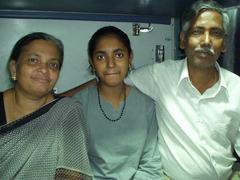
Martha, Josemy, and Jose, the familiy with which I shared a compartment on the tain.

The man behind the counter studied my ticket request for a moment.

“When are you wanting to go to Ernakulam?”

“On the 5th, if that’s possible, or the 6th.”

“Foreign Tourist tickets we only sell the day before. If you want to go to Ernakulam on the 6th, you show up here on the 5th.”

As I hesitated for a moment with this new information, the ticket seller made a waving motion with his hand and the pig took this as a cue to make a dive for the counter, like a halfback ducking into the endzone, except with more grunting. I wandered off, wondering if there would actually be a ticket on the day before; both Naipaul and Theroux had pointed out how many tickets are reserved on Indian Railways for tourists, politicians, and other priveleged groups, so I figured the chances were good. Still, it seemed strange to force people to wait until the day before. Reaching the ground level, I regretted not watching to see if the pig had actually managed to buy a ticket, but it was too late.

Several days passed, and I talked to Amar and Sharek and saw Diwali fireworks. The manager of the Hotel Lawrence — a great budget hotel, with all the stuff that matters: clean showers, mosquito-proof screens, competent management, a touch of old world charm, but no extraneous expenses — confirmed that as a foreigner, I could get tourist-reserved tickets, but only the day before, or the same day if the train left in the afternoon. The Kanyakumari Express departed at 15:35 (the schedules were all in 24-hour format), so I showed up at the tourist window five minutes after it opened on the day I wanted to go. I by now knew the system; I filled out my form, and explained it to two young Korean menbehind me, and then one of them explained it to a group of four college-age Korean women who showed up behind them. The women were giggling, and they all wore surgical masks, in an attempt to ward off the diesel exhaust that wafted through Mumbai’s streets.

I got my ticket without a hitch; I ate lunch, got my bag from the hotel and showed up at the train station an hour ahead of time. The car of the train was thouroughly blue: blue seats, blue drapes, a blue fan. There was a chain under the seat for locking one’s bags; it was covered in blue vinyl. The car was in good repair, but there was some rust on the outside, and a thin layer of grime on the inside. The grime didn’t look like the kind that could be washed off; this was embedded from decades of service in a dusty country. The car was two-tier air-conditioned, or “2AC”, which is somewhere in between first and second class; each (blue) compartment had an upper bunk and a lower bunk on each side, holding a total of four people. It seemed like the upper bunk people got the short end of the stick, since there was no window up there; but I had no cause for worry, since I was in a lower bunk, and the only one in my compartment. Looking around, both inside and out of the train, and everything was as if it were part of a set for a movie that was taking place twenty or even forty years ago. Only occasionally would there be a clue out the window that would break the effect, like a man wearing Nikes.

The train pulled out of the station, and I watched as the railway yards of VT rolled by. There were ten or more parallel tracks, and people seemed to be using them as a sidewalk. There were ordinary Mumbai residents in polyester pants and shirts, street urchins, soldiers, a dozen railway workers, and a smartly dressed businessman with a briefcase; all were walking on the tracks like they were a main thoroughfare. Although the sun would be up for another three hours, the outside world appeared to be bathed in a roseate glow of sunset; Indian Railways had tinted the windows pink. We passed mirror images of my train, with the cars clearly labelled: “2 Tier Air Con”, “3 Tier Air Con”, “Sleeper”, “Pantry”, “Luggage”. Luggage cars were white with red stripes, and they appeared to be the newest of the bunch. I found it hard to imagine the need for a separate luggage car, much less a shiny new luggage car, since there was quite a bit of room under my seat.

Indian Railway employees started to walk through the car. The sheets-man brought me a package of bedding wrapped in brown paper, inside which were nice thick sheets with the date of manufacture sewn into the edge; none are more than two years old. The chai-man stopped and offered me tea. The conductor stopped in and checked my ticket. Each of them completes his task, wobbled his head affirmatively, and moved on. A pudgy boy in a blue striped shirt from a few berths forward walked past more than once, eyeing me curiously, and finally stopped and asks, “Where’re you going?” I tell him, and he goes back to his compartment. He was back a few minutes later, and plopped down on the same seat with a loud fart as he did so; after a minute or two of watching me read my book intently, he walked away again.

Fifteen minutes later, there were big cement block buildings with hundreds of anonymous apartments each; they could have been tenements, but some of the buildings were painted haapy pinks and yellows, and there was decoratively patterned Indian clothing hung out to dry from most of the windows. Half an hour after that, the urban jungle started to thin. There was a small brown thatched hut in a gap between some of the tracks, with thin white trees poking out of the roof and a goat tied up out front. In the strip of land at the border of the tracks, there were short seedlings, some kind of crop being grown. Half an hour after that, and there was green, swampy wetland outside, the first land that I had seen in India that was not being used.

The pantry car started to send forth emissaries, droning the names of their wares in monotone chant, like Benedictine monks: “chaiiiicoffeeeee, coffeeeeeeechaiiiii”, “samosaaaay”, “pakorrrraaaaaaay”. Unlike the Mumbai hawkers, I found it to be a pleasant sound, even when they started the next day before dawn. I bought a bottle of water, the label on which stated: “Process: filtration, reverse osmosis, UV sterilisation, micron filtration and ozonisation”, and then in another spot: “100% bacteria free, by process RO (American)”. I decided it was probably safe to drink.

At Kalyan Junction, a family of three moved into the remaining berths in my compartment. The father was short, with a thin face and wiry hair, streaked with silver, that was carefully parted; the mother was dressed in a sari, with wide bulging eyes and an otherwise pleasant, even happpy, face; their daugther was probably about sixteen, wearing a blue-gray salwar kameez. She was fairly pretty, and seemed intelligent, but she also has a kind of callow, wide eyed manner. The train journey seems to be a big event for her. They spent several minutes moving in and chaining their hard-side suitcases underneath the seat. They finally settled in, all three sitting across on the opposite lower berth.

I had a wad of trash, and I asked the father if he knew where I could dispose of it. He led me down to the end of the rail car and pulled open a battered, unlabeled metal door that contained a trash can. I thanked him. He put his arms at his sides and pulled up his hands, palm down, and beamed broadly; it was the slightly effemiate gesture of a Dravidian genie granting a wish.

We returned to our seats, and the father interrogated me with the standard questions: where are you from, how long will you be in India. The reply “nine months” to the latter question brought him up short: I was here studying with a university, right? No, just wanted to see a big chunk of Asia without being rushed. I realized I didn’t know his name, and asked him.

“My name is Jowse,” he replied.

“I’m sorry, did you say Jowse?”

“Jowse; it is a Latin American, Spanish name, Jowse. J-O-S-E Jowse.”

Here was a quick summary of Indian history: a man with a Portugese Catholic name, with an anglicised pronunciation. I wondered at what point Indian mothers had continued to give their children Portugese names, but forgot how to pronounce them. I explained how a Spaniard would say his name; he seemed to either not understand or not care. His wife’s name was Martha, and his daugter’s was “Josemy”, which he later explained was a fusion of each of their names. I also told him, in response to his inquiry, that I was going to Ernakulam.

“We are from Trichur, two hours north of, Ernakulam,” said Jose. “The day after tomorrow, we will get off of the train, Trichur, at four in the morning. Two hours after that, six in the morning, you arrive at, Ernakulam. Trichur, two hours, then, Ernakulam.”

He paused each time he said “Ernakulam”, and then he rushed through the actual name, so that it came out “Ernaggilam”. And while many Indians will repeat an important word — saying “pen pen” to ask for something to write with, for example — Jose took this a step further and would repeat phrases, sentences, even whole thoughts.

Jose and Martha exchanged a few words in another language, and I asked what it was.

“We are speaking in, Malayalam,” replied Jose. “All on this train are going to Kerala where we speak, Malayalam. We are going to Kerala so, we speak Malayalam.”

I went back to reading The Old Patagonian Express, with which I was almost finished; Theroux was now with the aging Argentine author, Jorge Luis Borges, and was reading him Poe and Kipling. At one point they discuss the Nobel Prize in literature, for which Borges has been nominated, and Borges had just insulted Tagore, a Bengali poet, from eastern India — Tagore got it [the Nobel] and he was an atrocious writer. He wrote corny poems — moons, gardens. Kitch poems. — when I looked up and realized I was about to miss the sunset; with the pink windows, it didn’t look much different, except that the sun was lower in the sky. We were at the Karjat station, and there were green hills in the distance that recalled my fathers slides of Machu Picchu. The station was almost deserted, except for a few dogs flopped indolently on the platform. After we pulled out of the station, it turned into borderline jungle, with deep underbrush and vines hanging from the trees. Fifteen minutes later there were farmed fields, separated into vague grids by short walls of hay, with more of the machu picchu hills behind. The train went through a short tunnel, and when we popped out on the other side, there were stonework arches worthy of Southern France, sometimes short but more often a eighty feet high. There are several more tunnels; then we were in a gorge; suddenly there is a canyon on the east side of the train, plunging hundreds of feet to the rain forest floor. It was the sort of place where tigers pounced and king cobras slithered. The highest trees sprouted up like small broccoli bunches, but each with its own texture and shade of green. There is a big white house perched on a distant cliff, sticking out against the green.

I finished the remainder of The Old Patagonian Express, and then visited the bathroom, which was a squat toilet, from which eminated the sound of clacking wheels: the waste went straight out onto the track. There was a sign: “Please Avoid Using the Latrine in Stations.”

I returned to my seat. It was only seven o’clock, but I was still tired from being sick and the rocking of all vehicles — boats, cars, and trains — has always had a strong sedative effect on me; so I unwrapped my blanket and October 2001 Indian Railways sheets and curled up. The family ordered dinner, and I fell asleep to loud slurping sounds and murmuring sounds of Malayalam. I woke up briefly at nine and the train was black and dead quiet. Dinner, it seeemed, put Indians to sleep.

I woke up at dawn. There were cultivated fields of sunflowers in full bloom; more green swampland; crops low to the ground; a two-story stone turret standing all alone. Marichethal was the next station. It was small, with roofless, abandoned buildings. Jose, Martha and Josemy pulled out sandwiches and eat them for breakfast. They did not close their mouths when they ate, and it made disturbing smack smack smack sounds as all three of them munched away. I had previously found Josemy to be rather pretty, but the sight of halfway chewed bread in her maw utterly demolished the attraction.

The fields out the window became more and more agricultural, with bulls pulling plows. At the next station, a boy came in selling stubby Indian bananas, which were each about the size of a Twinkie. Martha bought a hand of them; I held up three fingers, got three bananas, and gave him ten rupees. The boy started to turn away, and I put out a hand to try to stop him, but Martha got him first, addressing him in an upbraiding voice in — Malayalam? Hindi? — and then turned to me.

“You can get many more for that price,” she said.

“I’d rather get change,” I said, and then, like an Indian, repeated the salient word: “Change?”

“No, you should get ten rupees’ worth, then eat for whole train ride.” More stern words from Martha to the boy. He counted off twelve bananas and hands them to me. Martha chastised him one more time, and he reluctantly counted off three more: one and a half bananas per rupee was apparently the going rate. I peeled one and ate it in two bites; it was like a North American banana, but sweeter.

I walked down the length of the train as far as I could go, and reached a corrugated tin wall. I stood around, looking out the door, when a railway employee addressed me.

“You” — mumble mumble — “train?” he asked.

“I’m just looking at the train,” I replied, pointing at my eyes.

“You ” — mumble mumble — “car?”

“1A?”

He pointed back. I gave up and walked the other way; there was nothing to see there anyway. I walked back through my car, past my compartment and through to sleeper class, where the windows were open and the wind swirled through the compartment. The people who rode here have three bunks to a compartment; there was still a bench at the bottom, and one bunk hanging from the ceiling, but from that dangled hooks from which the third bunk, presumably, hung at night. The weather was perfect, and I breathed in the fresh air. It was also crowded and noisier. The people in second class looked like life has been harder on them: there was a wild haired old woman with a red and gold nose stud and a wooden staff, looking like a witch come in from the wilds, and a man who was missing a leg and limping on crutches. I came to the pantry car, and it was possible to go no futher — the kitchen blocked the passage — so I stopped at the last doorway and looked out. There was no barrier of any kind, I could have jumped out if it struck my fancy.

I walked back to my compartment, made short work of the remainder of The Old Patagonian Express, and started in on The Brothers Karamazov. It had nothing to do with India, trains, or even travel, but I had been meaning to read it for the last several years. I read for an hour, and then set my book down to look out the window. The woman from across the aisle, wearing a pink and red sari, came across and sat on my bench, picked up my book, and started to flip through it. She did this without speaking a word, and she was flipping through it mindlessly, without reading any of the words.

“Uh, hello?” I said.

She looked at me with an ingratiating, vacant smile and made a noise that might have been a greeting.

“Do you like Russian novels?” I asked. It was an inane thing to say, but she was still sitting there flipping through my book, back to front, front to back, and I felt the need to say something.

“Ah, well, excuse me,” she said, and moved back across. “Excuse me” would have been a good way to start out, I thought, and stretched out to put my feet out to the end of my bench. Moments later, another woman who was with her sat on my feet, with her crying baby in her arms. I was just starting to wonder if this sort of imposition was commonplace on Indian trains, or if I was being taken advantage of, when a man sat down on the opposite bench, and Martha shooed him away. I glared at the woman on my bench until she moved, and Martha then closed the curtain on our compartment. The pink sari opens the curtain, and asked, can she sit here for two minutes? I can see that the baby has spilled some kind of food on their side of the aisle. Two minutes only, I reply. She cleaned up the mess from on our seat and then left; I made sure to keep the curtain closed as much as possible from then on.

There are brown fields out the window, which are separated by a haphazard grid of green grass; it’s like a crazed chocolate mint dessert. There are occasional trees, with tiny trunks supporting wild poofy green afros.

I slept for an hour, and when I woke up, Martha immediately wanted to talk to me.

“There was a mouse, or rat, running,” she said, pointing from their side to mine. “You should look, maybe behind your bags.” She made a gesture that I should move my bag.

As I started to do so, all three of them pulled their feet. Martha and Josemy looked fairly frightened. This was India; there were supposed to be rodents. I was happy to see that the country was now prosperous enough that people were disturbed when they were in their rail car. There was a sheet of metal behind the area under my seat, but there was a space where a rat could go through. It was long gone.

Jose started to explain things to me that went by out the window.

“This is a neem tree, you see, neem tree. It has bitter seeds, good for health. It is in the Ayurvedic texts. A bitter seed, good for health. Neem tree. Here is paysaam, a drink that you can get. Only in good hotels, payssam.”

“You can eat it with a spoon,” added Martha.

“This is Andhra Pradesh, Andhra Pradesh,” said Jose.

I started. I thought I was heading down the west coast of India, in Karnataka or perhaps Goa. Andhra is far to the east.

“This is what?” I managed to get out. I fumbled for my Indian Railways map and unfolded it.

“Andhra Pradesh, here, look,” explained Jose. “We go through Andhra Pradesh, then to Tamil Nadu, then back to Kerala, for Trichur and then, Ernakulam. So this is, Andhra Pradesh. There is other train, which goes to Goa then Ernakulam, coast train, Trivandrum express. It is a newer train, faster train, Trivandrum express.”

I explained that that was what I thought I was on.

“If you take that train, you would be in Ernakulam in six hours from now. This train, goes to Andhra Pradesh, Tamil Nadu, then Kerala. It is old train, slow train. We only bought tickets two days ago, so, only on this train. When did you buy tickets?”

I explained the tourist ticket scheme; I could have gotten on that train, I just didn’t read the schedule very carefully.

“Ah, well, next time, next time. If you were on that train, from now,” Jose held up his watch and made a motion to indicate the hour hand moving, “eight hours, tonight you would be there. Next time you take Trivandrum Express.”

The striped shirt farting boy returned and sat on my bench, obviously still intent on talking to me.

“Do you follow cricket?”

“No, but I follow football,” I replied. This was not entirely accurate; I was just making conversation. I had watched part of a Manchester United game two days ago at Nirav’s friends’ place, but that didn’t really qualify as “following”.

“Ah, Renaldo is my hero, you know, Renaldo?”

I had to admit that I didn’t really; my bluff had been called.

“Brazilian football player, Renaldo,” said Jose. I nodded in agreement.

“You are speaking all languages?” asked the pudgy boy.

“No, no,” I laughed. “Only English, French, some Spanish. No Indian languages.”

Jose asks the boy what languages he speaks.

“Tamil, English, Malayalam, and Hindi,” said the boy, counting them on his fingers. A voice called him back to his native compartment, and he excused himself and left.

“You are playing sports in school? Football?” asked Jose.

“No, windsurfing, though. You know windsurfing?”

Jose and Martha smiled blankly. Josemy, as always, was looking down.

“Sailing, do you know sailing? It’s like sailing.”

“Sailing, yes, sailing. And fishing, you are fishing as well?” asked Jose.

“Um, no. No fishing. And then there is surfing, do you know what that is? Surfing?”

More blank looks.

“I guess not. You get a long board, a long foam board about this long, and stand on it. You stand on it in the ocean, where there are waves, and ride them in, whooosh!” I stood up in a surfing stance, arms out and rocking slightly. I was hoping that possibly some old surfing movies might have made it to India to help me out, but evidently not: Jose still looked confused. I gave up and sat down.

“I am old, fifty five, and did not have these when I was in school. We have football, sometimes cricket. At school, we had one small ball, one big ball. Just football and cricket.”

Lunch came, for which the orders had been taken half an hour before. We ate; within an hour, almost the entire car was in silence. Jose, Martha, and Josemy took to their respective bunks and slept. I went back to reading Dostoevsky. Fifteen minutes later, a small gray ball of fur scurried from my bags to Martha’s, so quickly that I would have missed it if I had blinked. I pulled my legs up and kept reading; a doctor was talking to a monk: The more I love mankind in general, the less I love human beings in particular. I might have gone to the cross for human beings, had that suddenly been required of me, and yet I am unable to spend two days in a room with someone else, and I know this from experience. How about two days in a train compartment? Looking down the hallway of the car, I could have done a lot worse for company.

The family woke up after an hour and a half, and Jose pointed out that we were in Tamil Nadu now. There was a thick, many-layered blanket of clouds outside, which were both in the sky, and reflected in the rice paddies on the ground. Steep green hills reached up, with deep valleys in between: you could film a Vietnam war epic here.

I went back forward to second class and found an open doorway to hang out of. The tinted windows of 2AC looked were a sepia print, but this was Kodachrome. The air in 2AC was thin, only halfway air-conditioned, but the air outside was warm and thick with humidity; it recalled the same kind of transition I had experienced many times when getting off of an airplane in Florida, going from home back to college.

Out the doorway, a pole went by every five seconds, like a telephone pole, and they seemed to be right in front of my nose. In between these, there were men working on piling rock next to the track, and villagers walking by with water, hay, and other burdens. There were rice paddies next to the tracks, and several miles away there rose red cliffs that levelled out to mesas, and then enormous red blobs of rock; it was as if pieces of Colorado red rock and been lopped off of the Rocky Mountains with a giant scalpel and scattered here, on the green carpeting of Tamil cropland. Some hills are covered in greenery, but even these had streaks of red where landslides had exposed the rock.

The land was suddenly gone from under my feet and the bogie was flying through the air. Alarmed, I stepped back, bumping into a man behind me, and then approached the door again, timidly: we were going over a chasm on a bridge; I could look down and see a stream and smooth rocks below us.

We reached the far side, and soon after it started to rain. The first couple of drops hit my hand and stung like being shot with a low-powered BB gun, and I was forced to take a step back from the doorway. I stood watching the rains pour down onto the plains for two minutes, and then the man from the closest upper bunk came down to close the door: he was getting soaked. The train door was solid, with only a tiny window. There was nothing to see, so I headed back to my compartment.

Pulling out my Indian Railways map again, I started to plan future legs of my journey: how would I get from Kodaikanal to Pondicherry by rail? There were several possible routes, one through Trichy and one through Madurai. I asked Jose and Martha.

“You can go first to Trivandrum, then back, same track, to Coimbatore and then to Kodaikanal,” said Martha.

“There is a bus service from Ernakulam to Kodaikanal, maybe a bus from Ernakulam to Kodaikanal,” offered Jose.

Neither of these answers fitted my question. I tried to explain again that I was interested in how to get from Kodaikanal to Pondicherry. A woman, who turned out to be the mother of the chubby boy, was walking by; Martha stopped her and said something in another language.

“Her husband was for several years from Kodaikanal, you can ask him.”

A walleyed man came by several minutes later, and began to converse with Jose in what I presumed was Malayalam.

“We are soon going through Coimbatore, and you can go from there to Kodaikanal,” said Jose. “But it will be late at night, and now you are thinking of going to Ernakulam. So now you should not go to Coimbatore, and go to, Ernakulam. Then you take a bus from Erkakulam to, Kodaikanal.”

This kind of route planning continued for five or more minutes; Jose, Martha, and the man who had lived in Kodaikanal were running me all over Kerala and Tamil Nadu. From there, it degenerated to general travel advice.

“Taxis are no good, take the busses. The busses are, fixed price,” said Jose. “Buses will not cheat you like taxis. If you take a taxi, you make sure you pay the right price, the taxi drivers will cheat you.”

“When you need directions, you ask at a hotel; never ask people on the street, they will give you the wrong answer. Always ask for directons at a hotel,” added Martha.

It was like Polonius times three; Hamlet never had it this bad. Fortunately, Jose and the newcomer started in on an animated conversation in Malayalam, and then Martha looked out the window. As soon as it seemed safe to do so, I started back in on The Brothers Karamazov.

At four o’clock that morning, the family made a quiet commotion as they picked up their bags and prepared to leave the train at Trichur. I looked up sleepily.

“Now it is four; at six, you will be at Ernakulam. Half and hour and we are at Trichur, then two hours, and it will be Ernakulam,” said Jose.

“Mmmm, okay,” I replied, and dropped my head back into my pillow.

“You sleep! Are you sure at six you are awake and leaving the train?” asked Martha.

I assured her I would. The train came slowly, slowly to a halt at Trichur, as it did at all stations. It was sometimes difficult to tell exactly when the train had stopped, without looking out the window. They got off the train in a rush, although it stayed in the station for another fifteen minutes.

At the next station a man got on, locked up his suitcase, and flopped on to the opposite bunk. I slept for an hour, but then woke to watch the dawn rise on the palm trees and green plains of central Kerala, and at six, right on schedule, I got off at Ernakulam. As I rode in an autorickshaw to my hotel, dodging and weaving through traffic, I thought not for the last time about how nice it was to be on rails.

Kodaikanal

My not-so-humble abode in Kodaikanal.

Joseph Iype, the man who ran the cottage where I stayed in Munnar, told me where the bus station was, where I could catch the morning bus to Theni at 7:30, and from which there would be a connecting bus to Kodaikanal. Since we were high on a hill, he actually pointed to it, a long shed with an advertisement written on it. My pack is pretty heavy at about fifty-five pounds, but I can carry it several kilometers without much of a problem. I set out, walking down the rutted path from Zina cottages, past several restaurants and towards the bus stand.

About three-quarters of the way there, there was a gas station with several battered Tamil busses that were sitting there. I stopped and asked if this was the bus station, and if I could get to Theni from there. The bus had already left at seven, I was told; there would be another one at noon that I could catch in the center of town. Much has been written on the subject of Indians creating bogus directions and advice in the interest of seeming knowledgeable, and Joseph had so far given me a wealth of flawless information. I kept going to the station he had pointed out.

The shed I had seen before was actually one side of a three-sided compound that was full of closed shops. On the far wall from where I entered, there was a man of about fifty years sitting on one side, with long hair that curled up like a natural pompadour with ambitions of becoming an afro. On the other corner there was a group of about ten people, an extended family of some kind. They looked poor, but not desperately so.

There was an office that claimed to be a ̶