Hampi
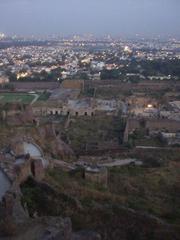
In the fourteenth century, two Telugu princes founded the city of Vijaynagar on the shores of the Tungabhadra river, near the modern village of Hampi in what is now central Karnataka. The city grew, and by the early sixteenth century it was the capital of one of the most powerful empires in the subcontinent.
After a bumpy rickshaw ride from Hospet, the closest railway station, I had to agree with the Telugu princes: if there was an empire to be founded, this was an idyllic place to do so.
The lazy, winding river cut a fertile slash through the surrounding red-tinted wasteland. Palm, guava, and mango trees lined its banks, and the blue skies were dotted with white fluffy clouds. It was what I imagined the Nile would have looked like in ancient times, with the little baby Moses floating downstream in a basket. The weather was perfect, like Florida in February or Berkeley in September. Away from the banks of the river, large chunks of rock were scattered around, sometimes piled into big, surreal heaps. It was as if cyclopean armies had been at battle here, tossing boulders at each other.
I stayed on the quieter north side of the river, which meant taking a coracle across to visit the main ruins on the south side, and the main bazaar of what is modern Hampi, which occupied old Vijaynagar buildings. The Virupaksha Temple at one end of the bazaar was built in the fifteenth century, and was now again a bustling center of Hindu worship.
There were a lot of travelers in Hampi, particularly on the north side of the river, and they were mostly Israeli. Signs at guesthouses were all in Hebrew as well as English. This was remarkable only because I had met no Israelis anywhere else in India; it was as if they all arrived and immediately headed for Hampi. There were many of them in the guesthouse where I was staying. They dressed in wild colorful hippie clothing, and they seemed to have a predisposition for shirts with the "Om" symbol on them. They played Israeli pop music at the guesthouse. The conversations on the coracle were laced with the hocking H's of Hebrew; they sounded similar to the throaty French R, and I found myself continually trying to decipher what they were saying as if it were French, but then it just came through as static.
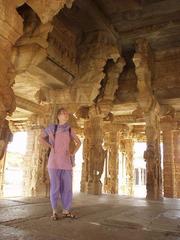 |
| Angélique in the central atrium of the Vittala Temple. |
After I had deposited my things on the north side of the river, I took the boat back across the river. I was almost too late; it was leaving the shore, but I called out and ran towards the big rock that served as a jetty, and the coracle, spinning slowly, started to come back to shore. Suddenly I noticed hands waving in the boat, and two familiar faces: it was Céline and Angelique, the two French women that I had met weeks before in Ooty. After I boarded the boat, we caught up: they, too, had stayed with an Indian family, but in Bangalore. The family had also wanted them to eat as much food as possible, and they had been wealthy socialites.
"They invited us to these really fancy soirées, and we always thought we were a little under-dressed, look, all I've got is this," said Angelique, pointing to her salwar. "But we'd go, all the same, and it wasn't that big of a deal."
Céline bought a sari. "They're hard to put on, but then they are also uncomfortable to wear," she said. Which probably explains why young Indian women almost always opt to wear a salwar kameez instead.
We ate dinner, and then climbed up to some ruins on a nearby hill to watch the sunset. A small boy wanted to sell us postcards, but Céline started trying to ask him, in her halting English, about where he lived and how much money he made; he was from a town that was a ten minute bus ride away, and came to Hampi each day after school. He made about one hundred and fifty rupees a day, which seemed like a pretty good sum. We were in the middle of trying to figure out whether that was sales or profit when another man came up to us, who also spoke fragmented English. We went through the usual preliminaries of our nationalities; he was a teacher in a nearby town.
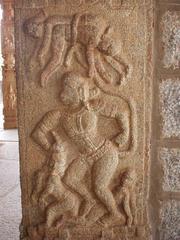 |
| The god Hanuman, whipping his enemies about with his tail. |
"Ah, from America. I think your American accent best," he said. "Particularly the ladies."
I told him that was news to me; I thought everybody liked English and Scottish accents.
After a pause, he asked us, "You think love marriage or our Indian marriage is better?"
"It is very different between 'ere and in France," replied Céline. She dropped her h's and spoke with a thick French accent. "I would like to choose my 'usband, because I love 'im and 'ee is loving me. But sometimes eet is deefeecult. Maye boyfraynd in France, my parents do not like eem, so that makes it 'ard."
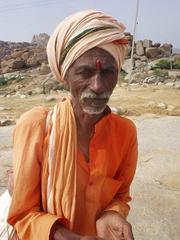 |
| Hindu holy man, or Sadhu, asking for money on the path between Hampi bazaar and the Vittala Temple. |
"But you do not respect your parents?" the man asked. "Is that not good? Here in our India it is important that we respect our parents."
Céline explained that the two cultures were very different, and in France and the West it was a big landmark (we spend a long time trying to translate the French word for "landmark", which I didn't know) to be independent from your parents.
"I can perhaps understand that. But here in our India we see how relationships are just 'as you like' in your blue films, and that is what many people see of France and the United States and think that is normal life." 'Blue Films' turned out to be an Indian euphemism for pornography.
"Yes, but in Bollywood and in Indian TV, you also see women in clothes that are very small, very sexy," said Céline.
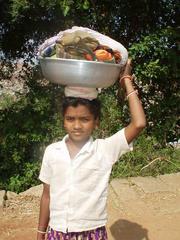 |
| Indian girl carrying laundry on her head, Hampi. |
"Yes, but we are just following you and your films."
It was getting dark; we headed down from the ruins and all went our separate ways. Céline and Angelique went back to their guesthouse, which was in the main bazaar nearby, and the teacher and postcard seller headed off to their village. I stopped for a beer and wrote in my journal at a rooftop restaurant nearby.
The waiter offered the beer bottle to me like a sommelier, which is usual in India, so you can check to make sure that it's cold enough before they open it. I checked, and gave him the go ahead; he poured, and then lingered for a minute. "You want bhang lassi?" he asked. "Good grass, kerala grass."
Bhang is an Indian word for marijuana. Lassi is a beverage made from mixing yoghurt with a bit of water, and it comes in a wide variety of flavors: salted, sweet, banana, mango, chocolate, pineapple, bhang.
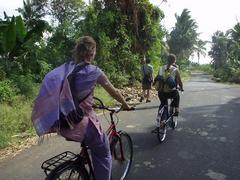 |
| Céline and Angelique pedaling from the Vittala temple to the Zenana enclosure. |
I stuck with beer.
*******************************************
The next day, I saw the ruins of Hampi with Céline and Angelique. We rented bicycles: heavy, battered bicycles made by the Hero company, the company that holds the Guiness record for making the most bikes. Quantity, alas, is not quality. By the time we made it back one of my pedals had disintegrated, and at one point we had to wait for five minutes while Céline kicked and pulled at the chainguard of her bicycle, which had bent inward and jammed up into the chain. Angelique got a more recent model that looked vaguely like a mountain bike and, more importantly, did not break.
We visited the Vittala Temple, which had pavilions, presumably for some religious use, that were surrounded and filled with pillars carved into the shape of warriors riding tigers and elephants; it felt more like a war memorial than a temple. Although they had been made over three hundred years earlier, the carvings were still in very good shape, and the structures intact.
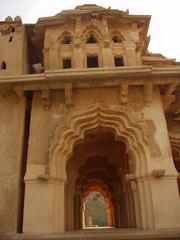 |
| The Lotus Mahal in the Zenana Enclosure, Hampi. |
The other big attraction was the Zenana enclosure, where the women of the royal Vijaynagar household lived, and the Lotus Mahal within it. Although it wasn't very large, the Lotus Mahal was a beautiful structure that showed the cultures that influenced the Vijaynagars: it had Moghul arches, but it was topped with a stack of smaller stories like a Dravidian temple. The red color of the red stone arches changed from light to dark and back to light again as you looked through the building, which was a very pleasing effect. Adjacent to the Zenana enclosure were the royal elephant stables -- it takes a pretty room building to stable an elephant, and there were eleven of them in one building. It seemed possible that they might have fit two elephants to a stable, depending on how pampered the royal elephants were.
Céline had decided that the 250 rupee combined entrance fee -- five dollars -- for the Zenana Enclosure and Vittala Temple was excessive, and had stayed outside; Angelique and I climbed a tower in the Zenana enclosure, which ended abruptly in a series of windows that were open to a thiry foot drop. Each window was about as wide as a person; we each sat down in a window and looked past our toes to the ground far below.
"In America you would never be in open windows like this," I said.
"Not in France either. There would be bars, windows, guards."
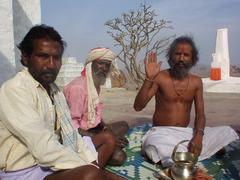 |
| The Hanuman guru, in the Hanuman temple, near Hampi. |
"This is pretty nice."
"Yep."
Compact, agile birds with a little orange spot near their tails circled and dove among the walls of a roofless building below. They flapped their wings a few times and then glided in tight turns, and often came so close to the top of the wall that I was certain they were going to smash into it, but they always skimmed past.
That evening I finished Riding the Iron Rooster. Theroux ended up in Tibet, after surviving a car wreck when his inexperienced but enthusiastic Chinese driver bounced the car off the road. I hadn't been particularly interested in Tibet previously, mostly because there were so many "Free Tibet" bumper stickers around Berkeley that it had come to seem like a fashionable "rich hippie" cause. But Theroux, normally acerbic Bostonian, made me think otherwise: "Lhasa was the one place in China which I eagerly entered, and enjoyed being in, and was reluctant to leave," he wrote, which contributed to my later decision to visit McLeod Ganj, the center of the Tibetan government in exile.
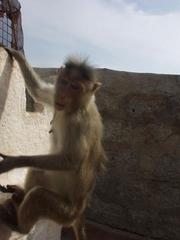 |
| Monkey at the Hanuman temple near Hampi. |
*******************************************
Three miles away from town, and five hundred and seventy-six steps higher(a German I met later in the day had counted them), lay a temple to Hanuman, the monkey god, to which I paid a visit. The stairs wove in between a group of very large rocks, among which there were, appropriately, many monkeys. They had white and silver fur, and the males had red buttocks. They had slack, dumb faces, except for their beady black eyes that darted around with simian cunning. I hesitated for a moment, unsure if they posed a threat, but two of Hanuman's supplicants came down with sticks and drove them away, removing the question.
At the top, the door of the temple was closed, although I could hear sounds of people inside. There were several other buildings around it, so I walked the perimeter first. A wild looking man called me over to a particularly large boulder, where he was talking to a German couple. He was balding, a fact that he tried to conceal with a white cloth wrapped around his head; his right eye was bloodshot and his teeth were in a sorry state.
"Where you from?" he asked.
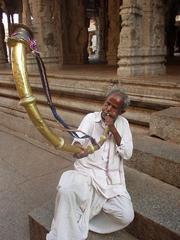 |
| Man blowing his kompu in the Virupaksha temple. |
"America," I replied.
"America, small country."
"It's quite large, actually."
"Big country, America, yes. You George Bush daughter going LSD having?" he said with a ragged, insane grin. "You understanding?"
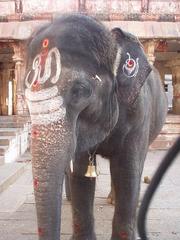 |
| The elephant of the Virupaksha temple. |
I nodded dumbly. Perhaps I had missed some recent headlines about the First Twins. Regardless, asking him to repeat it probably wouldn't help.
"Not natural, not natural," he said.
He pulled out a pipe and some matches, packed the pipe, and asked me to light it. I lit the match, but a puff of breeze blew it out.
"You God giving ten fingers but not using! Not natural." He took the matchbox from me and handed it to an Indian sitting on the other side of him, who mutely proceeded to light Mr. Not-Natural's pipe properly, with the match properly shielded in the shell of his hands.
After he had smoked for a minute, he gabbled further about America; it was like a schizophrenic's word salad. One of the rocks was a large slab that covered the other; he asked the Germans, and then me, take a picture of him as if he were supporting the upper stone by pushing up on it with his legs.
Having had their fill of gobbledygook, the Germans left, leaving him a hundred-rupee "donation", and I followed, giving him twenty, which seemed like a more reasonable sum -- although, having performed no services other than perhaps entertainment, he really didn't deserve anything.
I went to the door of the temple and loitered uncertainly; the door seemed firmly closed. Should I knock? I watched two young monkeys fight on top of a nearby barrel, falling to the ground intertwined. They rolled around, arms and legs flailing. Mr. Not-Natural started coming back from walking the Germans to the stairwell.
"Go! Go!" he exhorted me, just as a woman opened the door from the inside. I walked in, and the lunatic followed.
I stopped for a moment for my eyes to adjust to the darkness and to take in what was going on. Cooking and sleeping happened here: it was as much a home as a temple. Two foreigners were conversing, sitting at the base of a small room with barred windows to the left, and a woman was cooking in a room to my right.
"Come, come, you meet the baba," said the lunatic: baba was the holy man of the temple. He told me the baba's name, which started with "Sri Sri" ("Great Great"), ended in "Guru", and had a difficult to pronounce bit in the middle that I promptly forgot.
I followed him through another room that had a dimly lit temple to the right and a large red donation box, and then outside to where the baba was sitting with two of his disciples. One of them was a silent Indian dressed in ordinary clothes, and the other wore a lunghi and looked Japanese or half-Japanese. The latter and the guru were having a relaxed discussion.
"Here, sit, sit!" said the lunatic. I sat on one of the plastic mats around the baba.
After a few moments the baba turned to me and smiled. He had wild hair and a fairly long beard, and wore a white lungi and a Brahmin string. Brahmins are the the highest-caste Hindus who traditionally work as pujaris, and those Brahmins who still take their caste seriously still wear the string, sometimes all the time. I met a former general of the Indian Army on the train to Chennai who, in the course of conversation, mentioned that he was a Brahmin and pulled his string out of his shirt to prove the fact. Baba's string was orange, the color of Hanuman.
"You want chai?" he asked.
"Um, no thanks."
"You want smoking maybe?"
Smoking weed with Hanuman guru was probably something to put in the Interesting Life Experiences file, but for whatever reason -- mostly that I had just sat down and met him -- I declined again.
"How about tikka?" he asked.
"Umm... tikka?"
"Tikka, tikka," he said, with the usual Indian assumption that if something is said twice, it will all be clear.
I still looked confused.
"Blessing, tikka." He made a thumb-to-the-forehead gesture.
Ah, right, the forehead-blessing mark. I assented, and he led me inside to the temple, where there was a large orange image of Hanuman. Intoning "Sri Ram Hanuman" three times, deeply and slowly, he gave me a solid smudge of orange on my forehead. He took me over to the room with barred windows, which turned out to be another temple to Hanuman's mother, Anjana. He indicated that the proper thing to do was to walk around it, which I did.
"Very good, very good," he said. "You come, sit."
I went back out and sat back down on the mat. Baba talked more to the Japanese man, with Mr. Not-Natural and the quiet Indian commenting occasionally. Langur monkeys loped around the outside terrace and occasionally tried to dash inside, enticed by the smell of cooking, and one of the disciples of the monkey god had to get up and chase them away.
After listening (although I understood nothing) and watching for a few minutes, I asked if I could take the baba's picture.
"After smoking! You take picture after smoking," said Mr. Not-Natural with a vehemence that implied that taking a picture before smoking would be immoral.
Baba pulled out a cylindrical pipe and proceeded to pack it, and one of the others lit it for him. As they did so, Mr. Not-Natural gestured to tell me that as it was now the proper picture taking time. If all goes well I should have an excellent series of half a dozen pictures of the process of Baba lighting up.
The pipe was passed around, and the quiet man was the last; after he finished he smacked it against the ground and a small black thing fell out.
I sat around for a few more minutes, but there wasn't much else going on, as the others continued to converse in Hindi, Kannada or whatever. I got up to leave. Mr. Not-Natural waved, and then got up.
"You have card?" he asked me.
I actually did have cards; Edward Hasbrouck had recommended bringing them in Practical Nomad: How to Travel Around the World, since you're always meeting people and wanting to give them your email. I hand out a hell of a lot more cards traveling than I ever did when I was actually employed. I gave him one.
"You have other card?" he asked.
I gave him another card, although I couldn't imagine what he wanted it for. He didn't look like a big postcard writer.
"Picture very important, million dollars maybe fire stone going. Natural."
I nodded in agreement. Natural.
*******************************************
On the coracle back, I started talking to a wiry German named Danny, who was dressed in standard modern-hippie attire with beads around his neck. I complimented him on his English, which was almost devoid of the gutteral vowels Deutchlanders frequently carry over from their language. He said that he had been studying for a while in Germany, and had also been traveling for a few weeks with two Americans; they were from San Francisco. San Francisco! That's where I'm from. I could come and meet them if I wanted. Sounds good.
I get tired of speaking in the slow. clearly. enunciated. manner. that is necessary to communicate with most of the people that I ran into on a daily basis, or in French, which is just as bad going the other way. I had talked to a man from Edmonton that morning, but they say "Bouwt" for "boat" and look at me blankly when I tell them, "Right on!". I was looking forward to talking to some Americans. They were from California: I could say "dude", and they wouldn't laugh.
I walked with Danny along the dirt road that led past my guesthouse (Mama Krishna's, with Indian Soul Food Restaurant) to his. The serving boy at my guesthouse walked up to us.
"Want to smoke something?"
"How much?" asked Danny.
"One hundred rupees." Two dollars.
Danny assented; he biked off and returned five minutes later with a small wad of dried plants in a wad of newspaper. I'm not an expert weed buyer, but it looked more like a very small snack for a ruminant than something one would inhale. Danny poked at it in the dim light.
"I have better stuff, three hundred rupees," said the Mama Krishna boy, proffering another wad of newsprint.
"No, I think this is okay," said Danny.
We made it to his guesthouse, which was more like a compound, with a thick hedge and a long walkway leading up to it. He greeted several people on the porch of the adjoining room, which was shrouded in darkness by a power cut, and then checked on the other side for the Californians, who were not home. Danny inquired with the other neighbors; they had gone to see a movie nearby a while back.
"Well, they are not here, but you can wait and see if they come back, or whatever, as you like," said Danny, pulling up a chair next to his neighbors.
I started talking to the one closest to me, who said that his name was Hans and he was from Germany. Just as he said that, the power was restored and I could see him: he had dark skin and a prominent nose, and was grinning broadly. His head was shaved clean, but two out of the three of his companions had springy-curly dark hair.
"You, uh, don't look very German, Hans," I said.
He turned to his companions. "You see, that is the problem." Then back to me, he said, "We are all Israeli, actually. My name is really Adi." We shook hands. "And just so you know I am very stoned, so you shouldn't take anything I say too seriously. Anyway, we were just talking about how Israeli women are not interested in Israeli men in India, so we are inventing new names and nationalities for ourselves. This is Jörgen from Germany, that's Giovanni from Italy of course, and in the hammock there is Sean from America. He looks like the famous Mr. Penn, you know?"
Jörgen had shoulder length blond hair and Teutonic features. Giovanni had the dark sproingy hair that could pass for Italian. Sean, true enough, looked like Penn, with a sproingy-hair transplant. I asked them each their Israeli names, but they were just random syllables to my American ear compared to their more mnemonic aliases.
"So, wait: Israeli women aren't interested in Israeli men? That sounds like a pretty fundamental problem, huh?"
"No, no," said Adi. "Just here in India, they are like, 'We have that at home', you know?" He paused, and then looked thoughtful. "I need another name. How about Charlie? Charlie the American," he said, looking at me.
"Maybe it's better if you're Canadian," I said. "You just say 'eh' after everything, and everybody will believe you."
"That's good! 'I'm Charlie from Canada, eh?'" He smiled, pleased with his new identity.
Danny had meanwhile fetched a bong from his room, a pint soda bottle half-filled with water and with a small bowl attached near the bottom, into which he put his new purchase and smoked it tentatively. He gagged and coughed.
"This stuff is shit," he said. "I didn't think it looked very good."
The Israelis offered him some of theirs, but he declined and inhaled again.
"No, no, I think this will be good enough for me."
I wanted to ask if my impression that most Israelis in India just came to Hampi and smoked up was accurate, but it seemed possibly tactless, so I just pointed out that there were a lot of Israelis in Hampi.
"Yeah, mostly we come here and go to Goa and Hampi, sit in once place, and smoke. If you asked me later in Israel what I remembered of Hampi, I would say it's just a few trees, a field, maybe a muddy stream," he said, gesturing out towards the view from their porch. In the darkness, at least the trees and field were visible.
There was a short conversation in Hebrew between Jörgen and Charlie, but Charlie chastised him into speaking English for my benefit. Charlie wanted to go to another place down the road where more of their friends were staying; Jörgen was opposed to any movement whatsoever. The other two weighed in on Charlie's side, and after a bit we headed off. Danny stayed put.
The other compound -- huts and a guesthouse, with a restaurant and a little general store -- had another nine Israelis; when we sat down at the table, that made for thirteen Israelis, and me. There were no one else that I could see staying there. I felt like I was in Tel Aviv.
After a bit of introductory conversation in Hebrew, Charlie said, "Hey, since we have an American friend here, we should try to speak English."
Most of them spoke some English, and a few spoke quite well. You're from Berkeley? One of my friends was going to school there, I hear it's a nice place. So it is, so it is.
"Chillum or bong?" asked a heavyset girl to my right.
Uh. I had never heard the word "chillum" before, and in five years of American higher education and three years in California (Berkeley, even) my experience with bongs was limited to smoking sweet tobacco from a hookah in Damascus once. I didn't really think was enough to constitute an opinion on bongs, particularly not in this context.
"I have no idea," I replied. They laughed, but not in an unfriendly way.
"Here you must smoke from my bong," said a fellow across the table. "Bedouin hospitality, you know?"
He handed across a pint bottle bong, similar to the one Danny had been using, with a lighter stuffed in the top. I held it like a strange live animal. Jörgen, sensing my trepidation, explained: put your finger here, light this, inhale here. I followed his instructions, and the result was the no-oxygen lightheadedness of smoking a cigarette, but instead of the zoom-zip of nicotine, it was a deceleration, the kersplash! of falling from water skis, and there you are, bobbing along and watching reality pass you by.
I set the bong down.
"No, no, you must smoke until it falls in!" said its owner. The little wad of grass was "done", evidently, when it was burned up enough to collapse in.
"God, no, that would be bad."
Jörgen explained the variety of smoking options: a joint was really sedating, a bong was "like pow! you know, a big hit" (true, true), and a chillum -- which was the same as what baba and Mr. Not-Natural had been using -- was kind of "a little bit extra, you know, while you are talking to friends or whatever."
A chillum made its way around from someplace near my right, and, mercifully, ended with Jörgen. He smacked out a small black thing, and at the same time there was a lot of laughter from the other side of the table and I sensed people looking at me. I looked over.
"They were speaking English for your benefit, and for him it is very hard, you know, but then you were not listening, you were talking over there," somebody said. I apologized, but it was too much effort to repeat whatever it was.
Jörgen explained how the chillum worked: it was a small tube of clay, larger at one end than the other, and the small black thing, which he cleaned with a rag, was the chillum's stone. The idea was that the space between the stone and the clay was so small that it acted as a filter, with only the smallest particles making it through.
"The more money you spend, the better you get," he said. "With a not so good chillum you can really feel little bits of ash hitting your throat, you know? Not so good. A good chillum, the best are Italian clay, can run you over a hundred dollars."
The little bit extra seemed to completely anesthetize Jörgen: he stared, slack jawed, into space. Everyone else had pretty much forgotten that they were supposed to speak English. I thanked them, and headed home.
On the walk home, and later lying in bed, I reflected that I had now been in enough places that it was possible to start to piece together a picture of the people that were visiting India. Broad generalizations like these always have exceptions, but there are definite trends, the personalities of nations:
The Israelis purpose was quite clear: they wanted a place with most of the conveniences of Israel, but none of the violence, with a pretty view and a steady supply of pot. Hampi was very close to Goa, a former Portuguese enclave on the southwest coast of India which is the unofficial "party capital" of India, which probably explained why they were there. I couldn't really blame them: if my country was ensnared in a interminable bloody conflict, I'd probably want to be far away and sedated as well.
As I was touring the ruins with Céline and Angelique, we stopped for tea and talked to another Frenchman who described the purpose of his trip as "tourisme culturelle", which pretty much summed it up for all of them. They have five to ten weeks of vacation to burn, and they're all like dilettante anthropologists; they dress more like natives than any other nationality, they're in more remote regions, and they seemed to talk to more Indians (as well as they can -- France being a proud country, with a lot of tradition in the language, they put forth less effort to learn English than, say, Scandinavians) and visit more people in their homes than anyone else. With most nations, it seems like there is an unwritten rule that you're supposed to stop independent travel and start doing package tours around age thirty, but the French feel no such compunction; most of them, in fact, seemed to be in their forties or later. When the French retire (were they ever working?) many spend a lot of their time finding small corners of the globe to explore.
Japanese, Germans, and Americans tend to stay home or go on package tours, but when they go, go big, for really long trips or going native entirely; getting out of the country is a form of personal expression, a revolt against the fact that their own country is too structured, safe, and calm.
The Scandanavians are urbane, well-educated and well traveled. Norwegians and Swedes have culturally homogenous, socialist countries with small populations; I get the impression that it's sort of like living in one big community, particularly as compared to to the United States, with it's dog eat dog immigrant-based heritage. They speak good if not magnificent English (are you sure you're not British?), since there is such a small audience for their native tongues.
The Australians are the quintessential travelers; it is not a coincidence Lonely Planet was founded by Australians. That said, I've been surprised at how few of them I have seen in India; but it could just be that my standard was set when I visited Turkey near ANZAC (Australia and New Zealand Army Corps) day, which commemorates their catastrophic losses at the landing at Gallipoli in the First World War and serves as a kind of Memorial Day for them. Many young Australians came out there to visit the Gallipoli, just south of Istanbul, and from there spread out all over the Middle East. There are a lot fewer in India, for whatever reason; the recent Bali bombings probably cancelled a lot of trips. Australians remind me of Texans, only more easy going; they are always happy, outgoing, with a what the hell, can-do attitude.
The British were like the Australians, but more urbane; many of them were working in India. They seem to read a lot of books; whenever I ask someone with their nose in a fat book what they're reading, they seem to be from the UK. I asked one of them what it was like being someplace that the British had previously colonized. "Well, we arrived here on Republic Day, which is like 'We Hate the British Day', but most of the people were still quite nice to us," he replied, and then paused to reflect. "But mostly I just can't imagine all these Brits here, running everything."
There were Italians, Danes, Spaniards, a few Africans; but for these there were just not enough of them to really put together a picture. It makes the news more interesting reading; the world becomes like a group of people in a room, arguing, trading, and negotiating.
*******************************************
After Hampi, I stopped in Gulbarga, Preethi's hometown, and visited Hari and Preethi again for a day, and then moved on to Delhi, the nation's capital; Amritsar, the center of the Sikh religion (turbans, drive taxis) and McLeod Ganj, the center of the Tibetan government in exile. Stay tuned for more.