Main

April 11, 2003

Delhi, The Sikhs, and the Tibetans
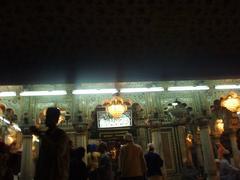
Nizam-ud-din's shrine, Delhi.
As I sat waiting for the Karnataka Express to take me from Gulbarga to Delhi, a man covered in grease approached me and asked me a few of the standard Indian questions: what is your good name? are you married? what is your job?

Since I was unemployed, I was mercifully spared inquiry into my salary. His name was Basha. He asked me where I went to school -- Florida, I replied.

"India is very poor country, we are having no education. Only two states are education giving, books giving, teaching giving. Kerala and Chennai, in Tamil Nadu are educaton giving. Many states, but others no, only Tamil Nadu, Kerala."

I nodded in agreement. I'm not sure if he was strictly accurate -- that no other states provided education -- but those two southern states had a reputation for being well educated.

Continue reading "Delhi, The Sikhs, and the Tibetans" »

December 19, 2002

Hampi

In the fourteenth century, two Telugu princes founded the city of Vijaynagar on the shores of the Tungabhadra river, near the modern village of Hampi in what is now central Karnataka. The city grew, and by the early sixteenth century it was the capital of one of the most powerful empires in the subcontinent.

After a bumpy rickshaw ride from Hospet, the closest railway station, I had to agree with the Telugu princes: if there was an empire to be founded, this was an idyllic place to do so.

Continue reading "Hampi" »

December 10, 2002

Hyderabad

Hari studies the Genetics lesson of the day.

As we walked up the stairs to his parents’ second story flat, Hari turned to me and said, “You know what to say, right?”

“Uh, namasté?”

“Namasté, Auntie.”

This made sense; Hari had just instructed me when he and his father had picked me up at the train station that I should call his father “uncle”. This was the rule in India; everyone called their real aunts and uncles by the Hindi (or Telugu or whatever) words for those relations, and so the English words were used for all other elders. To me, it seemed like a little bit of a betrayal to my real relatives in the United States, but I got used to it in time, particularly after I figured out that older people, who usually have the most photogenic faces, were more likely to let me take their picture if I greeted them with “Namasté, Auntie” or “Namasté, Uncle”.

Continue reading "Hyderabad" »

November 28, 2002

Madurai to Ooty

Bull walking down the street, Madurai.

From Kodaikanal I went to Madurai. I left one of my favorite pairs of pants in the United States, and after learning it was possible to get a tailor to make a pair of pants to your description, I was eager to get them recreated in India. I asked them to make me the pants, with a gusseted crotch (a “joint”, the Tamil tailors called it) pockets on the sides, velcro fly and a drawstring waist. They offered to make the pants, as well as a shirt that I wanted for my father, for thirty dollars. I walked away to the next place selling fabric, only to discover that it was a cartel: they worked for the same man, had the same fabric, and the tailor from the first store, a diminuative man who had just taken my measurements, patiently and quietly followed me. But my action had the intended effect; they brought the price down to 1100 rupees, twenty-two dollars. I agreed, and picked it up the next day, and by and large they had done a good job. The price was a bit high, but they spoke good English and now I could take the pants to any tailor and say, “Here, copy this!”, which is more straightforward than trying to describe what you want.

Continue reading "Madurai to Ooty" »

November 22, 2002

Munnar

Busses passing each other on the way to Munnar

The bus ride from the plains of Kerala up to Munnar took my breath away: partly from awe at the view out the window, and partly from fear that the bus would drive off of the precipice that followed the right hand side of the road. Munnar in a town in the Western Ghats, the mountains that follow the southwestern coast of India, and is home to some of the highest tea growing estates in the world.

The road leading up to Munnar, like all of the roads in the Ghats that I have seen, was narrower than most American driveways and full of potholes. When it was necessary for two of the battered Kerala State Road Transportation busses to pass each other, their diesel engines would drop to a gutteral growl. The downhill bus would pull halfway off of the road and halt, and the uphill bus would slowly nuzzle past, less than a foot away. In some cases, there was no room on the shoulder for the downhill bus, so it would have to slowly, slowly back up, with the uphill bus following, until it could make way. Out the window the trunks of palm trees, less than a foot thick, rocketed up a hundred feet from the valley floor, exploding into a green burst of leafy fronds. Far below them short shrubby trees grew like oversized broccoli.

Continue reading "Munnar" »

November 18, 2002

Fort Cochin

Snake charmer in Fort Cochin, India.

The weather in Fort Cochin is Floridian, and the geography mimics the Bay Area. The air is warm and muggy, and the waters are clogged with water hyacinths. On the Eastern bay, analogous to Oakland, is Ernakulam, which is industrial and has large boat loading apparatus that look like the Imperial Walkers from Star Wars; Fort Cochin is a San Franciscan peninsula to the west, which was settled first and has most of the tourist attractions.

I found a place to stay in Ernakulam, and took the boat across to Fort Cochin. The boat ride across cost five cents, for a ride in a long wooden boat that holds about forty people, with an inboard diesel engine. Upon arrival, I went first to Addy’s Restaurant, which was about a two mile walk from the pier; it got high marks from the guidebook — something that Addy himself was obviously proud of, since he had xeroxed out the guidebook entry, blown it up several times, and posted it on the door. I walked in, and found that I was the only customer. The owner, Addy, and his friend, Brian, were the only other two people there.

Continue reading "Fort Cochin" »

November 16, 2002

The Kanyakumari Express

View out of the Kanyakumari Express, around Southern Andhra Pradesh

Victoria Terminus, if you come at it walking in from the north, does not initially appear to be the grand old cathedral of a building that it actually is. The business end of it, where the long distance trains originate and terminate, and where tickets are booked, is a thoroughfare filled with billboards (“Oxyrich Bottled Water 300% More Oxygen Than 16 Other Leading Brands”) and a large archway with a massive digital clock. Only if you walk back out from this and around to the side of the building — and keep walking and walking, it’s probably half a mile long — it then becomes all gothic stone and archways, with steel and glass pods that stick out every hundred meters or so, a shameless mating of bauhaus with ancient rock.

I went to Victoria Terminus (more commonly known just as “VT”) three times before I actually was able to buy the ticket that I wanted. On my first visit, I found the part of the building that housed the offices where tickets are sold, and figured out the process for how you get a ticket. The first step is to find a “Trains at a Glance”, which is a publication the size of a thick magazine with the Indian railways logo on the front, a friendly blue elephant waving a hurricane lamp. The next step is to figure out which train is appropriate for where you want to go; there are tables that describe this, but the instructions are limited, and I didn’t actually realize that I hadn’t fully figured out the system until I was a thousand miles from Mumbai (more on that later). For each train, it also lists all of the stops, and the times that it arrives at each station. After ascertaining the number of the appropriate train — 1081, the Kanyakumari Express, in my case — you take a number, and stand in front of a bank of monitors, each of which iterates through a set of ten trains, and shows how occupied each train is for the next month. A train goes through the stages of booking from open (green) to “Reservation Against Cancellation” or “RAC” (yellow) to “Waitlist” (magenta). RAC tickets give you permission to board the train without a seat assignment, and as far as I could make out from the description, hope that the conductor finds someplace to put you. You then fill out a blue ticket request form, to indicate the desired train, day, and class of service, and take it to a ticket window.

Continue reading "The Kanyakumari Express" »

Kodaikanal

My not-so-humble abode in Kodaikanal.

Joseph Iype, the man who ran the cottage where I stayed in Munnar, told me where the bus station was, where I could catch the morning bus to Theni at 7:30, and from which there would be a connecting bus to Kodaikanal. Since we were high on a hill, he actually pointed to it, a long shed with an advertisement written on it. My pack is pretty heavy at about fifty-five pounds, but I can carry it several kilometers without much of a problem. I set out, walking down the rutted path from Zina cottages, past several restaurants and towards the bus stand.

About three-quarters of the way there, there was a gas station with several battered Tamil busses that were sitting there. I stopped and asked if this was the bus station, and if I could get to Theni from there. The bus had already left at seven, I was told; there would be another one at noon that I could catch in the center of town. Much has been written on the subject of Indians creating bogus directions and advice in the interest of seeming knowledgeable, and Joseph had so far given me a wealth of flawless information. I kept going to the station he had pointed out.

Continue reading "Kodaikanal" »

November 15, 2002

Mumbai Encounters

The day after I visited Nirav, I meandered about south Mumbai; I made a first failed attempt at getting a train ticket, and then ate at the Leopold Cafe, the best place in town to get clean, cheap food, and stopped by American Express to change money, but arrived ten minutes after closing. I was walking across the street — making sure to take the side away from a particular beggar woman with her children, one of whom she had flung at my leg earlier, and I had to limp for several steps before it let go — when I heard a meek voice say, “It’s very crowded here, isn’t it?”

The voice came from a man who couldn’t have been more than five foot four inches; he had slightly graying hair, wore a battered but well-kept blue coat, and was carrying a shopping bag and a water bottle. I had, in just two days in Mumbai, become inured to the pleas of merchants, and I routinely stonewalled aggressive calls of “Hello, coming from?” (which is the Indian way of asking “Where are you from?”) and similar questions that stall owners and merchants use to get your attention. But this question was so humbly put, and its asker didn’t have anything obvious to sell right away, so I actually answered: yes, Mumbai is crowded, but not at much as I thought it would be. The trees make it seem more open. He asked where I was from — I told him San Francisco — and my name, and I asked his.

“My name is Amar, A-M-A-R. Are New York and San Francisco close together?”

Continue reading "Mumbai Encounters" »

November 04, 2002

Mumbai - The Lakshmi Puja

In the month before arriving in Mumbai, I had vicariously travelled with Paul Theroux by rail around Europe and Asia, and then down the length of the Americas; I was now in the land of Indian Railways, which at 1.6 million people is the world’s largest employer. I was eager to get on a train. And after the chaos of Indian roads, the idea of being in a vehicle that was on rails was very appealing.

I got my chance when I was invited by a friend of a friend, Nirav Desai, to visit a Lakshmi prayer service, or puja, at the factory that his family owned. “It’s not a big Ganesh parade kind of deal, just a small puja in the factory. I just don’t want to get your hopes up,” he explained. Small is just fine, I replied.

Continue reading "Mumbai - The Lakshmi Puja" »

November 02, 2002

Mumbai - Arrival

Man selling Bananas in Colaba, Mumbai.

We seemed to move through a city of the dead. There was hardly a suggestion of life in those still and vacant streets. Even the crows were silent. But everywhere on the ground lay sleeping natives — hundreds and hundreds. They lay stretched at full length and tightly wrapped in blankets, heads and all. Their attitude and rigidity conterfeited death. — Mark Twain, Following the Equator

Mumbai, 11/2/02, 1:15 a.m. On the midnight ride to my hotel after arriving at the airport, I saw a similar scene to what Twain had described a century before. There were rows and rows of dark-skinned bodies, flopped on carts, on the ground, and on each other, most wrapped in a modicum of cloth, a small slash of white about each waist. It looked like the city had been gassed; this was more like Bhopal than Mumbai.

But the dead came to life the next morning. As I walked down the same road at dawn the next morning, was seething with every household function, performed in broad view of passers-by: a man lathering with soap, another squatting to defecate in the rubble on the far side of the street, a woman boiling water for breakfast. Children chased each other in the street, dodging autorickshaws and cargo trucks. Late sleepers still slumbered in their string beds, which were like a four-poster hammocks, rough hewn rods holding up a net of twine. It was like I had walked into a neighborhood of glass walled houses; I was embarrassed to be right on top of all of these basic household functions. To an American eye, it was poverty, but both V.S. Naipaul in and Gucharan Das make reference in their books to “middle class, in the Indian sense”, which meant a roof over your head and not wanting for food. By that standard, I guessed this was lower-middle class; these people did not have an air of desperation to them.

Continue reading "Mumbai - Arrival" »

October 30, 2002

Transit

Heading out, 6 am.
Heading out, 6 am.

29 Oct 2002, 6:45 am, Michigan City, Indiana. I was sitting on the same United Limo bus I’ve used to get to the airport for the last decade; I’ve ridden it dozens of times to get to college, and recently to return to California where I work and live. This felt unique, though; I was more sorry than usual to be leaving the comforts of home, and my ageing parents, but also very nervous and excited about the places and people to come.

There were five of us on the bus: four senior citizens who I imagined where heading for Las Vegas, one young black woman, and me. I waved to my parents, by their car outside. My mom waved back ardently, since she was watching her only son head off for the wilds of Asia for nine months. One of the Vegas women looked in my direction, smiling warmly, touched by this show of affection.

The bus lurched forward, my first inch towards India. A burst of adrenalin made my nerves sing; I was suddenly more awake than I have in several months. It seemed like I was suddenly moving faster, or perhaps the world had slowed down.

Continue reading "Transit" »

October 26, 2002

The (sort of) Plan

Map of roughly where I think I'll go
Map of roughly where I think I’ll go

The greatest thing since the creation of the world, except for the incarnation and death of Him who created it, is the discovery of the Indies. — Francisco Lopez de Gomara

I’m about to leave for Mumbai in three days, via Seoul. I wanted to test out my emailing system that I’ve programmed here before I go, so if anybody finds the format of this email hard to read or otherwise annoying, let me know.

My plan, so far as I know it, is thus: I’m going to fly in to Mumbai, via Seoul, and see the Indian festival of lights, Dewali, in Mumbai, which is November 3rd through the 7th. After that, to Kodaikanal, in Tamilnadu and the Western Ghats, where there are friends of my family, the Oberdorfers, who teach at the Kodaikanal International School; I should be there around November 14th. By about December 1st, I will have made my way to Hyderabad, a city in south central India. I’ll be staying there with the family of one of my until-recently coworkers, Hari. He wants to see some of his own country, so we’ll take off to see someplace — Mumbai again perhaps, or whatever seems like a good idea at the time.

Continue reading "The (sort of) Plan" »