<?xml version="1.0" encoding="utf-8"?>
<feed xmlns="http://www.w3.org/2005/Atom">
    <title>xenotropic.net</title>
    <link rel="alternate" type="text/html" href="http://www.xenotropic.net/" />
    <link rel="self" type="application/atom+xml" href="http://www.xenotropic.net/atom.xml" />
   <id>tag:www.xenotropic.net,2005://2</id>
    <link rel="service.post" type="application/atom+xml" href="http://www.xenotropic.net/cgi-bin/mt/mt-atom.cgi/weblog/blog_id=2" title="xenotropic.net" />
    <updated>2005-11-08T22:51:57Z</updated>
    
    <generator uri="http://www.sixapart.com/movabletype/">Movable Type 3.2</generator>
 
<entry>
    <title>Travels With Valentine</title>
    <link rel="alternate" type="text/html" href="http://www.xenotropic.net/2005/08/travels_with_valentine.php" />
    <link rel="service.edit" type="application/atom+xml" href="http://www.xenotropic.net/cgi-bin/mt/mt-atom.cgi/weblog/blog_id=2/entry_id=5" title="Travels With Valentine" />
    <id>tag:www.xenotropic.net,2005://2.5</id>
    
    <published>2005-09-01T06:15:52Z</published>
    <updated>2005-11-08T22:51:57Z</updated>
    
    <summary>&amp;#8220;I grew up in Europe, where the history comes from. We got tons of history lying about the place, big old castles, and they just get in the way. We&amp;#8217;re driving &amp;#8212; &amp;#8216;Oh, a @#$% castle! Have to drive around...</summary>
    <author>
        <name>Joe</name>
        <uri>http://xenotropic.net</uri>
    </author>
            <category term="Europe" />
    
    <content type="html" xml:lang="en" xml:base="http://www.xenotropic.net/">
        <![CDATA[<p>&#8220;I grew up in Europe, where the history comes from.  We got tons of history lying about the place, big old castles, and they just get in the way. We&#8217;re driving &#8212; &#8216;Oh, a @#$% castle! Have to drive around it&#8230;&#8217; Disney came over and built Euro Disney, and they built the Disney castle there, and it was, &#8216;You better make it a bit bigger, they&#8217;ve actually got them here&#8230; And they&#8217;re not made of plastic!&#8217; We got tons of them, because you think we all live in castles, and we do all live in castles! We all got a castle each. We&#8217;re up to here with castles! We just long for a bungalow or something.&#8221;  &#8212; Eddie Izzard
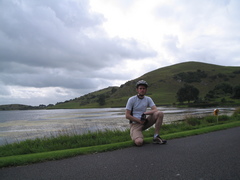
<table align=right border=0 cellpadding=25 width=290><tr><td><img src="http://xenotropic.net/images/Ireland/Ireland617_sm.jpg" width=240 height=180 /><tr><td><small>On the shore of Loch Gur</small></table>
<p>&#8220;<i>Have a nice time</i>, people said to me at my send-off at South Station. It was not precisely what I had hoped for. I craved a little risk, some danger, an untoward event, a vivid discomfort&#8230;&#8221; &#8212; Paul Theroux,  <i>The Old Patagonian Express</i>
<p>Since I have developed a habit of traveling in the last few years, people often have asked me, &#8220;So, where&#8217;s your next trip going to be?&#8221;  In the course of my answer I used to say that I would go to Europe when I got old &#8212; better to get the dangerous countries out of the way while I was young and agile.]]>
        <![CDATA[<p>However, when plans fell through for a trip to India a few weeks before it was to occur this August, I decided to bike across parts of Ireland and France.  Because even if it isn&#8217;t where <i>all</i> of the history comes from, it is where some of <i>my</i> history comes from.  I got my Irish citizenship a few years ago, because my grandparents were born there.  The process is simple: send in the chain of birth, death, and marriage certificates linking you to the grandparent born in Ireland, wait around for a year and a bit, and then <span class="caps">BANG, </span>there you are, document saying &#8220;Congratulations, you&#8217;re Irish, one of us now.&#8221;  Uh, really?  I mean, I can&#8217;t do a jig, don&#8217;t know any words of Gaelic, I haven&#8217;t got the brogue &#8212; hell, I can&#8217;t even recognize it: right before this trip I mistook an Irishwoman for an Australian.
<p>When I was twelve my parents took me on a trip to Ireland (after giving me a choice of Ireland or Disneyworld:  &#8220;Um.  Ireland, please.&#8221;) and we drove around for a few weeks.  We visited castles, kissed the Blarney stone, met a couple of long lost cousins and saw the remaining walls of the house where my grandmother grew up.  
<p>My Dad drank Guinness.  I remember taking a sip once in a pub, at thirteen years of age, and gagging.  
<p>Now, fifteen years later, I like Guinness, and I have this maroon passport with a harp on it.   So it seemed appropriate to drop in for a bit.
<p><center>*          *          *</center>
<p>Allegedly I have a great-great grandmother from Alsace, but my ties to France are mostly the language.  Freshman year of high school, the choice was between French or Spanish.  Those are the normal choices in America, its sort of like the McDonalds and Burger King of languages, available in every town.  Italian?  Chinese?  That&#8217;s more In N&#8217; Out Burger kind of languages, only in specially selected places.  France ended up being the BK language because the French are language imperialists.  They bribe other countries to speak French.  I talked to a group of Cambodian university students once who all spoke near-perfect French.  Reason?  France funds Cambodian higher education, conditional on it being done in French.  I suspect a similar plot got French into my Catholic high school.  Wouldn&#8217;t you think Italian would be a natural choice for a Catholic school?  Good for getting around the Vatican.  Maybe it is more important to communicate with the Swiss Guard.
<p>So anyway.  High school decision:  French or Spanish, Spanish or French.  The French program had a regular trip planned to France.  The Spanish program didn&#8217;t.  I went with the French people.  I did eventually get to go to France in high school through another program, with the Lion&#8217;s Club.  But now instead of being able to converse with the 30 million Spanish speaking Hispanics in the <span class="caps">US,</span> I can speak with the like fourteen French people who live here.  Therefore, I went to France as well, where the French speakers live.
<p><center>*          *          *</center>
<p>Valentine is my bicycle, an eleven year old blue Mongoose Switchback.  My parents bought Val for me the day I started college.  The second year of college, when students were permitted to have cars on campus, several of my friends got automobiles and gave them names like Obie and Helga.  This was more fun than saying &#8220;my car&#8221; and was used like: &#8220;Hey, let&#8217;s all pile into Obie and head down to the beach for the day.&#8221;

<p>I didn&#8217;t have a car to name (until junior year, not so sad), so I figured I&#8217;d name my bicycle.  At the time I was reading Ender&#8217;s Game, a spectacular science fiction novel by Orson Scott Card, and one of the main characters is named Valentine.  I named my bike after her.  The thing is, a bike being not such a social vehicle as a car, there is not much opportunity to refer to it by name.    
<p>	Valentine has mutated over the years as parts have broken or worn out.  I like fixing things, and that is one of the things that has kept me from getting a new bike is that there would be nothing to fix then.  Val is sort of a Mad Max kind of a bike.  Mad Max is the move in which gave Mel Gibson got his start in 1979.  Set in the post-apocalyptic near future, all of the cars are pieced together from whatever parts people can find, and they look like this:  
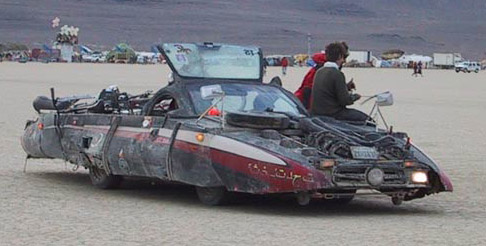
<p><img src="http://xenotropic.net/mad_max_car.jpg" />
<p>	I took my bike in to the local shop to have them repair something I didn&#8217;t have the tools to do the day before I left for Ireland.  The work ticket, when I picked it up, had a paragraph of closely-printed text of things the shophand thought were bizarre or mismatched that I &#8220;might want to take a look at before taking this bike on a tour.&#8221;
<p><center>*          *          *</center>
<p>The second day in Ireland was cold and rainy.  I had bought online a high-visibility yellow jacket in preparation for the trip.  The description had stated that it could &#8220;shed a light rain.&#8221;  I subsequently realized that if there is a light rain it is rarely important to have a jacket to shed it because it is over so quickly.  It was a &#8220;sheds a day-long, slow, dripping, shivering cold rain&#8221; jacket that I needed.
<p>Just at the point that my jacket had ceased shedding and started leaking, I pulled over and stopped in an old farmhouse with half a roof.  The only inhabitants were two swallows and their chicks.  The chicks were situated in a nest attached to the side of a rafter.  I felt guilty because I was obviously disturbing to the swallows, but I really needed to rest and stay out of the wind and rain for a bit.  They would barnstorm through the open window with food for the kids.   Then they would circle in unbelievably tight circles in the far side of the room, caught in orbit between parenting instincts and mortal fear of me.  
<p>The thought process going through their head must have been &#8220;feed children &#8212; crap human near children fly away &#8212; no must feed chicks &#8212;human in high visibility jacket! run away! run away! &#8212; no must feed children…&#8221;  
<p>Half of the time they would end up feeding the chicks and the other half they zipped back out the window.  I experimented with other locations in the room, but they seemed worse.  Hopefully after I left in a few hours they got back to normal bird-parenting patterns.
<p>The house was not much different from how I remembered the ruins of my grandmother&#8217;s house, except this one had a partial roof created by the attic flooring.  What a small space to live in!  But I supposed that for farmers, with open land all around them, it was not so confining of a space to cook and sleep in.
<p>It became evident that it was not merely a long rain, it was a day-long rain.  At that point all a bike tourist can do is keep going to stay warm until you reach someplace with a warm shower where you can stay the night.  There is a short story in Ray Bradbury&#8217;s The Martian Chronicles that hovered half-recalled in my mind throughout the day, like a song that gets stuck in your head even though you can&#8217;t remember the words.  The protagonist in the story has to walk a long distance across Venus (this was written back when it we weren&#8217;t sure if Venus was habitable).  I think he was a soldier in a forced march.  It rains incessantly on Bradbury&#8217;s Venus, and the story is mostly about the main character&#8217;s struggle to stay sane in the constant drip-drip-drip of rain.  The goal of the march is to reach this dome inside of which it is bright and dry.   Bradbury leaves the reader hanging at the end of the story, not sure whether the protagonist went nuts or made it to safety.
<p>This day in Ireland was not that bad.  Ireland becomes even greener in the half-light of rainfall, and the beauty of the countryside was a good distraction.
<p>All the same, I was particularly happy on the third day when the weather was beautiful.  I got an early start because of jet lag and early-trip eagerness.  I planned to cover many miles so I could make some interesting detours as I neared Cork, and still be able to make my boat to France, which only left once a week.
<p>Twenty miles into the day, and five miles out of the nearest town of any size, <span class="caps">POW</span>! my chain slipped and the pedals spun freely.  This happens sometimes, particularly on an old and imperfect bicycle like Valentine.  Usually the chain has just slipped off of the chainring or cogs.  I looked down.  The chain was still on the front chainring and on the rear cog.  This meant a Very Bad Thing had just happened: the chain, freewheel, or derailleur had in some way failed.

<p>It turned out to be the derailleur.  It was original Valentine equipment, eleven years old.  Three years earlier a mechanic had told me that it would probably fail sometime soon.  After it didn&#8217;t fail for a while, I think I had sort of started to assign some kind of mystical property to it.  It certainly worked well for eleven years, right up to the point that it disintegrated.  Post-destruction, it looked like this:
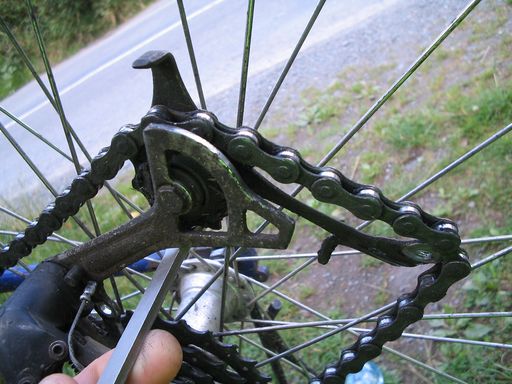
<p><img src="/busted_derailer.jpg" />
<p>So I was sitting on the side of the road five miles from nowhere and across the street from a quarry.  One of the quarry workers, driving a kind of dump truck, stopped near me for a moment.  At first I thought perhaps he was checking on whether I was all right and I tried to walk over and talk to him.  As it turned out, he was only trying to figure out whether he needed to turn on the small path that was across the road from where I had stopped.  He waved as he drove away.
<p>Although it would coast, the bike could not be pedaled as it was.  Besides moving the chain to shift gears on a bike, the rear derailleur also takes up slack in the chain, since the chain needs to be different lengths for different gears.  Without a derailleur, the chain was too long for any gear.  It dragged on the ground and slipped over the cogs when I tried to pedal.  If I had a chain tool &#8212; I had one at home that I had forgotten to pack &#8212; I could have shortened the chain down to a single gear.  I did have the tools I needed to install a new derailleur.  I did own a new derailleur, a nice one recently purchased on ebay.  However, I also left it at home.
<p>I did have some string.  For a half hour, I tried tying the derailleur in different places to see if I could get it to take up more slack in the chain.  To a certain extent, I succeeded.  In the right position, the one remaining cog on the derailleur took up enough slack that a choppy pedal-CRUNCH-pedal-CRUNCH was possible, where at each <span class="caps">CRUNCH </span>the chain slipped off and caught sometimes on the same gear, sometimes on another gear.  It was slow, it was probably chewing away at the teeth on my drivetrain, but I moved.  
<p>I went over the hill I had been climbing, down it.  There were some buildings, mostly country cottages that seemed uninhabited.  The best thing would have been a new derailleur, but second best would be a chain tool so I would at least be solidly in one gear.
<p>After the next hill, there was a large building.  An automobile shop.  It was a rural, hard-core mechanic&#8217;s car shop, with cars in various states of repair everywhere.  The building was like a warehouse.  It had two doors, each enclosing a space sufficient to house four vehicles and workspace around them.  I walked in to each space and called out.  No response, although it looked like it was open and cars were being worked on.  I walked around the building.  No dice.  
<p>I peeked back into one of the garages and there was a short gnarled looking man who had come out of a back area.  He had white hair that was staring to bald.  His hands and face were blackened with grease.  If you replaced his grease-stained wool sweater with a leather jerkin and handed him a heavy hammer he could have stepped right out of Middle Earth or Narnia as a gnome blacksmith.
<p>&#8220;I am having quite a problem with my bike,&#8221; I said.  &#8220;Do you have any bike tools?  Or do you know anyone who has any bike tools around here?&#8221;
<p>He looked at me quizzically, looked at my helmet (still on my head) and past me at my bike, which was lying on the ground out in the shop yard.  He then walked past me and out to my bicycle, beckoning for me to follow.  So much for the Irish gift of gab.
<p>&#8220;See, look, the derailleur is broken,&#8221; I explained.  &#8220;I really need a chain tool to shorten up the chain.&#8221;
<p>The gnome looked at the bike, looked at the derailleur, and pinched out the extraneous chain links.  He stood up and nodded and beckoned for me to follow him.  I picked up my bike and rolled it in to the shop, following him.
<p>There was another man, also wearing a grease-stained wool sweater, who had now also appeared in the shop.  The gnome just walked clear on past the both of us as if we had had no interaction at all, on to the back of the shop.  The new man, thirtysomething and at least six feet tall, looked at me quizzically.  
<p>Is this a shop of mutes?  I thought.  I explained and demonstrated the situation again.  He nodded.
<p>&#8220;You need chain make short,&#8221; he said.  Slavic accent &#8212; Czech? Pole?  That explained the gnome&#8217;s muteness.
<p>&#8220;Yes.&#8221;
<p>&#8220;Wait ten minutes, we fix.&#8221;

<p>I waited.  Another customer came in, a pudgy Irishman and his son.  He seemed upset.  He talked to the tall Slav.  He called someone on the telephone.  He talked to the tall Slav again.  There was some problem about the person on the telephone not having done painted a vehicle well or not having painted it on time.  Despite the gnome&#8217;s appearance of having lived most of his life in contact with machinery, I started to wonder if this was the right place to get work done.
<p>&#8220;Are you guys heading to Mallow or Cork, by any chance?&#8221; I asked the Irishman.
<p>&#8220;No, no we&#8217;re not going far.  Bit of bike trouble?&#8221;
<p>&#8220;Yep.&#8221;
<p>&#8220;Bad?&#8221;
<p>&#8220;Medium bad.&#8221;
<p>&#8220;These fellows will fix you up all right.&#8221;
<p>Both reassured and stripped of options, I continued waiting.  Eventually the gnome came over and examined the chain, peering closely at the pins holding the links together.  The chain had a special link so that it is possible to remove the chain from the bike without a tool.  I undid that link and the gnome started, then beamed at the brilliance of the design of the special link.  He measured and moved the chain around until he knew how many links needed to be removed.  
<p>He then carried it over to his workbench and tap-tap-tap-BAM-BAM-BAM hammered out the appropriate pin.  
<p>Please please don&#8217;t bend or mutilate my chain, I thought.  A normal chain tool is a tiny screw-press that removes the pin in a much less violent manner.  If the chain were bent I would no longer even be limping along &#8212; I would be walking or bumming a ride.  I needed to be in a small town 20 miles south of Cork in 36 hours to catch a boat.
<p>He brought it back and we put the chain back on, not threading it through the derailleur.  The special pin made it easy to make the chain whole again.  If it were a &#8220;normal&#8221; chain without one, there would have been no way that he could have put the chain on the bike and hammered a pin in to link the chain back up.
<p>I pedaled it around the yard in front of the shop.  It worked.  I now had a single speed bicycle, but it stayed in that speed.
<p> 	I had been wondering how much he was going to charge me &#8212; after all, I was kind of over a barrel.   I had also violated one of the cardinal rules of travel: ask how much before obtaining services.  Fifteen Euros?  Twenty?   I came back to the shop.  

<p>&#8220;Good!&#8221; I said, giving a thumbs up.  He nodded appreciatively and smiled slightly.  &#8220;How much?&#8221; I asked.
<p>He held up five fingers.
<p>I must have looked surprised, and I was because that seemed fair bordering on too cheap.  He must have thought I was surprised in the other direction: two of his fingers immediately dropped.

<p>&#8220;Tree erros.&#8221;  He walked to the back of the shop and fiddled with something on a bench.
<p>The smallest Euro bill denomination is five, and then there are one and two Euro coins.  I looked through my pockets for three euros, and all I had was about eighty cents.  I pulled a fiver out of my wallet and offered it to him.
<p>&#8220;No, no.  Little, little money.&#8221;  He pointed to the light copper coins in my hand.
<p>Who was I to argue?  I shrugged and handed him the coins.
<p>He walked with me as I went to pick up my bike near the entrance to the shop.
<p>&#8220;Polska?&#8221; I asked, pointing at him.  I think that&#8217;s the Polish word for &#8220;Polish.&#8221;
<p>He shook his head.  &#8220;Russian.&#8221;
<p>&#8220;Russian people, very good!&#8221;
<p>He smiled.
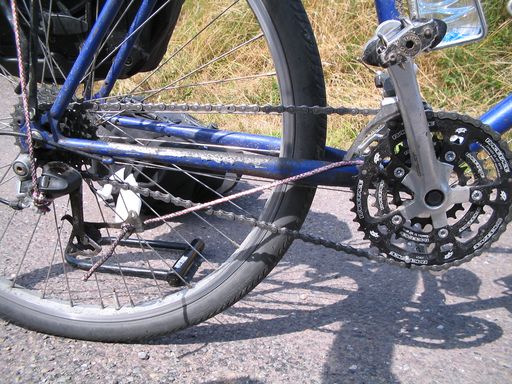
<p>I racked up my panniers and headed out.  The single speed took some getting used to but after a few miles I decided it was just fine.  The chain length put it in 3-2 &#8212; my highest chainring and next to lowest rear cog. It looked like this; you can still see the string holding the derailleur, which I hadn&#8217;t removed:
<p><img src="/busted_derailer2.jpg" />
<p>It was a medium-high gear, ideally suited for a slight uphill grade.  It required me to stand up on uphills and just coast going downhill.  The entire way from Shannon airport to Cork is pretty flat agricultural country.  While this last section was the most hilly, that wasn&#8217;t saying much: they were still low rolling hills.
<p>I was about thirty miles from Cork.  As I got closer to the city I asked people who I saw on bikes where I could find a shop.  Three out of three people told me there was one in Ballincollig, a kind of second city to Cork, like St. Petersburg is to Tampa or St. Paul to Minneapolis.
<p>I got to the Ballincollig city limits at around a quarter to six.  I had to ask three more people for directions, each of which gave increasingly specific directions.  Each of them did so only after looking skeptically at their watch and saying something to the effect of, &#8220;Well, I&#8217;m not sure about when they head from there to the pub on a Friday evening, but&#8230;&#8221;
<p>They closed at six.  I got there at five &#8216;til.  It was a small shop that appeared to be run by two guys in their late 20&#8217;s.  It was moderately disorganized and had as many bikes in a state of half-repair as actual new ones for sale.  The guy behind the counter &#8212; working on a bike &#8212; was sort of flabbergasted but nevertheless impressed at the idea of biking alone across France.  He sold me a new derailleur for fifteen dollars, which seemed cheap, and a chain tool.
<p>There was a bed and breakfast and a pub back down the road about a quarter mile.  I hadn&#8217;t yet had a chance to camp out:  I had stayed at <span class="caps">B&amp;B&#8217;</span>s both nights so far because I was jet-lagged and soaked to the bone, respectively.   Here I was on the last night in Ireland already, an hour and a half before sunset, with a crippled bike.  

<p>I was fairly certain that I could install a new derailleur, but only about 95% sure.  It was probably pushing it to camp out, particularly if I couldn&#8217;t get my bike fixed up. 
<p> I went back to a nearby <span class="caps">B&amp;B. </span> After knocking on the door there was a minute delay before the owner, whose name was Liam, answered.  I am fairly certain in retrospect that the delay was caused by Liam searching for a shirt.  After I checked in, he walked around bare-chested for the remainder of daylight.  If the auto mechanic was like a gnome, Liam was a friendly ogre, a non-green Shrek.   He was barrel-chested and portly, with a broad, friendly face.  Like the owners of the other two Irish <span class="caps">B&amp;B&#8217;</span>s I stayed at, he was garrulous and immediately made me feel more like a nephew than a customer.
<p>The derailleur was actually very easy to install.  The <span class="caps">B&amp;B </span>had a nice yard and garden in back and I just flipped by bike onto the seat and handlebars to work.  Liam took great interest and stopped by about every ten minutes.
<p>&#8220;Do you need any tools, Joseph?&#8221;  
<p>(I told the Irish my name was &#8220;Joseph&#8221; because it seemed like the more proper Irish name, more Catholic.   It also sounds good with the long &#8220;o&#8221; that the Irish accent puts into it.  I also told people I was Joseph in France as well.  The choice there is between being &#8220;Zho,&#8221; which makes me feel Chinese, or being &#8220;Zhosef,&#8221; which always makes me think of Stalin.)  Or, &#8220;Would you like to use my workbench in the shed, Joseph?&#8221; &#8212; &#8220;Are things going well there, Joseph, do you think you&#8217;ve got it?&#8221;
<p>I got it after an hour.  The next day I made it to the ferry, an enormous beast of a boat that swallowed hundreds of Irish cars and only three bicycles, of which mine was one.
<p><center>*          *          *</center>
<p>The pace of bike touring is different from normal life, of course.  The only timekeeping device I had was my camera, which I did not consult for that purpose often.  Instead, I learned the pace of the sun setting.  Sunset was the most important event of the day, and I always managed to make it to someplace to stay before dark.  Near the end of the trip, the last day I camped, that I learned after I checked in to the (very picturesque) campground that the nearest food was three miles away in the next town.  I biked there at dusk and back in the dark.  It wasn&#8217;t too bad, but I would not have wanted to do more than the six mile round trip.
<p>After the position of the sun, the strength of my body was the next thing in my consciousness.  Sometimes (mornings, after lunch) my legs felt like little sputtering decrepit Cessna propellers, and others (late afternoon) they felt like fighter jet turbofans.  Since I felt best later in the day, I would pass by places to stay in the afternoon and I would find myself racing against the sunset to make it a town large enough to stay in.  
<p>Keeping myself supplied, repaired, and fed was a nice preoccupation.  The reward for doing a good job was more miles, more cruising through villages and down farm roads.  I am a big fan of vintage video games, and the challenge and reward were reminiscent of Oregon Trail.  Anybody ever play that on an Apple (or later versions on the PC) in grade school?  You are cast as settlers trying to make it across the United States to Oregon in the 1850&#8217;s, and you have to keep yourself supplied with food, keep your wagon repaired and rolling, and keep everyone in your wagon party healthy.  If everything goes well, you keep moving towards the Deschutes river valley.  If you screw up, you end up stuck in the Sierras in winter.  Likewise, I always had to keep topped up on water, keep the bike repaired, and keep eating enough calories to keep pedaling all day.

<p>My worst case scenario was not so bad as in the Oregon Trail:  if I did not make it to Paris in time, I would be forced to punt and take a bus partway to Paris, probably from Orl&eacute;ans.  The reward was greater:  rolling across the French countryside is more entertaining than any video game by a long shot.
<p><center>*          *          *</center>
<p>I stayed in campgrounds and bead and breakfasts (called &#8220;Chambres d&#8217; Hôte&#8221; in France) and, on a two occasions, in hotels.  My pattern was usually two days of camping and one day of <span class="caps">B&amp;B</span>/hotel.
<p>A campground is something that every French village, once it reaches a certain size, feels like it ought to have.  As towns became larger, the order in which village institutions appeared was usually: church (no church, not a village); bar-tobacconist (&#8220;Bar-Tabac&#8221;); school; convenience store; patisserie (baker) ; boulangerie (butcher); restaurant; campground; town hall; large commercial grocery store.
<p>Some of the campgrounds were municipal, owned by the town.  Others were private.  Like restaurants and hotels, they are given star ratings, one to four.  Some, which are either new or perhaps don&#8217;t bother with the process, are unrated.  The ratings seemed to most strongly correlate to hotel-like services such as a swimming pool, washing machine and dryer, and a general store.  This was unfortunate, because my primary criteria in judging a campground was whether it had a copse of trees and a shower.  The shower part was universal but the copse of trees part wasn&#8217;t.  I wanted trees because I had brought along a Hennessey Hammock, which is a fabulous lightweight shelter &#8212; if you have trees.  In its native habitat, it looks like this:
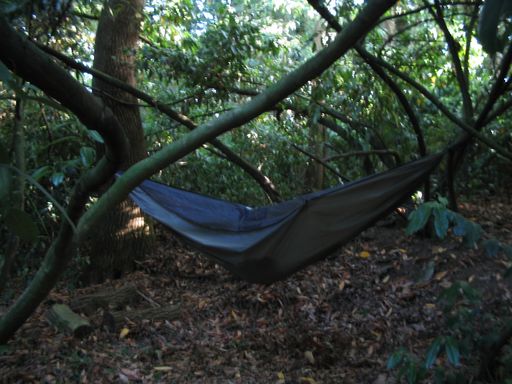
<p><img src="/hhammock.jpg" />
<p>It is seriously comfortable and keeps out rain except, perhaps, in the event of hurricane.  
<p>In the absence of trees, however, it boils down to being one tarp that is a groundsheet and another tarp you can put over your head, which is much less cool than being a seriously comfortable hurricane-proof shelter.  I found nice copses of trees three times during my trip, only one of which was at a commercial campground.  The other two were camping (possibly illegally, although it&#8217;s just not clear) in state-owned forests.
<p>If I were Slartibartfast, the designer of planets and fjords in <i>The Hitchhikers Guide to the Galaxy</i>, I would model campgrounds on the one in Sarzur.  Sarzur is  a small French town in Bretagne.  Its campground received a rating of two stars.  The campground was privately run, I think, and called &#8220;Camping à la Maison.&#8221;  &#8220;La Maison&#8221; was a immense country manor house, probably mid-19th century, that had been converted into basic rooms or suites in which families could stay.  The surrounding area was campground.  Unlike other French campsites, it was not cut up into specific plots; people just settled where they would.
<p>It had a copse of trees, of course, in which the Hammock is pictured above.  Perhaps big enough to be called a vale.  It apparently had been originally intended as a nature walk but had since overgrown, and the trees were just the right size and spacing that it was easy to pick a spot to set up my hammock.  I slept until eleven that morning, even though I had probably been in bed by nine-thirty the previous evening.  The trees made it cool and shady.  If it were not for the tolling of the  town&#8217;s church bell reminding me of the time, I don&#8217;t think I would have gotten out until mid-afternoon.
<p>Most other campgrounds had plots of land with one or two trees, usually the wrong size or spacing to set up the hammock.  So I was sleeping on the ground a lot.  It was not a big imposition as it sounds, since after six or more hours of biking I was tired enough to sleep balanced on a tree branch.  It seemed a little strange sometimes to wake up just me in my sleeping bag, where most everyone else was in cars and campers.  It&#8217;s common in California to not use a tent, where the weather is also perfect, and the practice in fact often referred to as &#8220;California camping.&#8221;  The equivalent &#8220;Loire camping&#8221; has apparently not caught on in France.
<p>If there is any problem with the campgrounds it is that they were filled primarily with English and Dutch families in car-caravans.  For the most part they were quiet and went to sleep about 10 in the evening, which was an hour after sundown.  The Dutch seemed quieter.  However, that could just be that when an English brat says &#8220;Mommy, she spat in my hair!&#8221; (direct quote from my journal) it makes me think &#8220;bloody little English brat.&#8221;  In contrast, a Dutch child saying &#8220;Mama, die zij in mijn haar heeft gespuugd!&#8221; (Babelfish translation of &#8220;Mommy she spat in my hair&#8221;) does not make me think of anything.
<p>My worst night of camping was in Chinon, a medium sized city midway up the Loire.  It was one of those evenings where I raced the sun to get there, and it was getting dark as I found the campground.  Everything that could be wrong with a French campground was wrong at Chinon.  One: the office was closed, so the campground &#8220;host&#8221; obliged me to give me her passport for the night.  I hate that.  I am attached to my passports.  It is equivalent to an American hotel asking for your car keys for the night.  Two: it was disco night (at a <i>campground</i>?) until midnight, presumably to entertain the older Dutch and English children.  I must have been really tired, because that alone should have motivated me to look for and spend money on a hotel.  I stayed on the furthest part of the campground from the disco but I still recall dozing off to the sound of the Bee Gees.  Three:  the hedgehog.  A few hours after the disco stopped, I was awakened by a loud scraping or chewing sound near my panniers, which were on the ground.  After fumbling for my headlamp, I illuminated a prickly gray-black blob.  A hedgehog.

<p>Squirrel-like creatures are usually cute if they are not from your country.  I used to own sugar gliders as pets, which are basically the squirrels of Australia and Indonesia.  A friend who grew up in Minneapolis told me of his Australian neighbor who was fascinated by North American squirrels and set up feeders in his back yard to attract them (if you detach yourself for a moment, the bushy tails are kind of cute).  Another friend had a pet hedgehog in college.  So I knew a hedgehog when I saw one.
<p>It was cute, the first time.  So I forgave it, although I still scared it away from my bags.  Because they curl up and stick out their spines as a primary defense, scaring away a hedgehog is a two step process.  First, you must scare the hedgehog, then you must leave it alone for a bit until it feels that it is safe to run away.  This I did: I thawacked my pillow next to it.  It bristled; there was a pause; it ran away.  I went back to sleep.
<p>It came back.  This was no longer cute; I was annoyed.  I stepped up the scaring-it part by thwacking it and then flipping it with my bike helmet, hoping to give it the impression that there was a one hundred and sixty pound mammal trying to eat it for a midnight snack and it was lucky to get away.  It ran away again.  And came back again, a third time.  I repeated the early-morning-snack treatment.  I also put my panniers up on my bike, which is what I should have done the first time; after that, it stayed away.
<p><center>*          *          *</center>
<p>It was more difficult to meet other bike tourists than I was expecting.  Before the Loire Valley, I wasn&#8217;t expecting to see too many tourists, and I didn&#8217;t.  In the Loire Valley itself there are &#8220;Loire à V&eacute;lo&#8221; (Loire on Bike) signs that pointed out best routes for following the Loire.  The routes were very good, usually one-lane farm roads with just bike traffic, and which were not always evident on the otherwise-useful 1:200,000 Michelin maps.  There were occasional problems in linking the routes together between administrative districts; near Tours there was an administrative boundary and the trail abruptly stopped, and not in a particularly useful or logical place.  After going back to the Michelin map, it was necessary to bike back a few kilometers in order to cross a bridge to keep going and not have to bike on the highway.
<p>It seemed like there were a lot more people going the other direction.  At first I chalked this up to the fact that there are just naturally going to seem like there are more people going the opposite direction.  You&#8217;re going to pass people going the other way more often than those going the same way.
<p>In a chambres d&#8217;hôte in the town of Rochefort-sur-Loire, I got into a conversation with the hostess about what there might be to see coming up.  My only guidebook was twenty pages or so I had sliced out of Lonely Planet&#8217;s Cycling France, and so I didn&#8217;t even really know what the most interesting chateaus or other things might be coming up.  The hostess kept describing things to the west that I could go see.  Since she was hard of hearing and my French is imperfect, it took a couple of attempts before it sank in that I was going the other direction.
<p>&#8220;Eh, tu <i>montes</i> le Loire!&#8221; she said with surprise. &#8220;Oh, you&#8217;re <i>climbing </i> the Loire.&#8221;  As if I were climbing in the second-story window my room instead of taking the staircase.
<p>That gave me pause, and then I felt foolish.  East was the hard way, wasn&#8217;t it?  Not the way the river was flowing, which necessarily had to go down.  Well, chalk it up to hasty trip planning.  The extra exercise wouldn&#8217;t kill me.  At least now I knew why everyone else was going the other way.  If I didn&#8217;t like the look of other cyclists, I could sneer at them: &#8220;Oh, yeah &#8212;  well, je <i>monte </i> le Loire, you pansies.&#8221;

<p>Near the end of my trip I met a couple of Englishmen, named Rory and Lawson.  Englishmen are easy to travel with.  I spent several weeks traveling with another pair in Cambodia and China.  Communication is easy, and since England is like a parallel universe to America, there is the perennial game of &#8220;So in the <span class="caps">UK, </span>do you have…&#8221; to figure out exactly what is same and what is different.  Rory had also lived in the US and in France, making him a particularly interesting cultural reference.  I learned, for example, that there are no right turns on red anywhere in Europe; and I came to appreciate what a ridiculous amount of open land we have here.
<p>We were staying near each other in a campground on the outskirts of Tours, and I ended up sitting next to them in a nearby restaurant and struck up a conversation.  Rory was a triathlete and married to a Frenchwoman, and he and Lawson was a friend from high school.  They were about to part ways: Rory was heading south to Burgundy to meet up with wife and family.  Lawson was flying out of Tours in two days and was going to make some short side trip.
<p>Lawson really wanted to camp, not in a campground, but just in a forest somewhere.  In the <span class="caps">US, </span>most National Forests and <span class="caps">BLM </span>land are fair game for camping, set your tent up wherever you want.  This is something that you can not do in the UK &#8212;  there are too many people and not enough forest.
<p>&#8220;We have this thing called the National Trust that owns a lot of the coastal and other &#8216;good&#8217; land in the <span class="caps">UK,</span>&#8221; explained Lawson.  &#8220;The only problem is that you can&#8217;t camp on it, no fires, just about the only thing you can do is walk your dog on it.  So they mostly get old people walking their dog on it.  Seems like you&#8217;d want to have more younger people outside, which would happen if they opened it up to camping.&#8221;
<p>Lawson also thought that Spain was the best place in Europe to camp, since allegedly there is a law that one kilometer outside of town, it is legal to camp.  It&#8217;s not clear if that is public land or private, but either way at least it is clear.
<p>In France, it is unclear what the rules are.  It seems like sleeping outdoors is just not a concept.  It is like vegetarianism in Laos:  I once ordered a soup and asked for no meat.  The waiter nodded, and proceeded to bring me the soup &#8212; without chunks of meat, but still with bits of gristle floating in it.  They had no mental box for &#8220;food with no animal products.&#8221;  It seems that France, similarly, has no mental box for &#8220;place to sleep out in the wilderness.&#8221;
<p>The LP has this to say on the subject:  <center><table width=80%><tr><td>Pitching your tent anywhere else [than a designated campsite] is known as camping sauvage in French, is usually illegal, though it&#8217;s often tolerated to varying degrees&#8230;. You probably won&#8217;t have any problems if you&#8217;re not on private land, have only a small tent, are discreet, stay only one or two nights, take the tent down during the day, and are at least 1500m from a camping ground (or, in a national park, at least an hour&#8217;s walk from a road).</table></center>
<p>I have no idea where they got that information from.  For starters, I don&#8217;t know that there is a place in a national forest an hour&#8217;s walk from a road.  The French plan forests like they plan cities:  they pave a couple of clearings in the center of the forest as roundabouts and then run roads out radially.  
<p>I noticed on my map that, in the Forest of Orl&eacute;ans, there were two &#8220;forester&#8217;s houses.&#8221;  I biked past them, hoping they would be like <span class="caps">U.S.</span> Forest Service park headquarters, with maps and people who know about the park and could tell me what the rules are.  No such luck.  It was a house like any other in France, except there was a sign out front that said &#8220;Forester&#8217;s House.&#8221;
<p>Certainly there are a lot of smallish plots of land from four acres to dozens or hundreds, that are labeled chass&eacute;e gard&eacute;e (hunting preserve).  They were always tempting because they often had perfect hammock-trees, but I had clear mental images of a Frenchman kicking my Hennessey Hammock at dawn to get me off of his land.  Or accidentally shooting me, thinking the hammock was a very large duck.
<p>Lawson and I ended up camping in the Forest of Blois.  The sign when you enter, on a smallish road, says &#8220;Welcome to the Forest of Blois.  Fires forbidden.&#8221;  Now as a lawyer, that says to me that camping would be permitted.   By the time you&#8217;ve gone through the trouble of forbidding fires, how much harder would it have been to forbid sleeping, if that is what you wanted to do?
<p>Lawson had a stove, and so we cooked pasta with vegetables and cheese and drank a bottle of wine.  Everyday French are less into spending money on wine than Americans.   I bought the most expensive bottle in the store: $9.  It was pretty good.
<p><center>*          *          *</center>
<p>What with Valentine being Mad Max and all, other things broke.  I snapped my rear derailleur cable on a Friday afternoon before a three-day weekend.  That dropped me down to three speeds for a few days.  I found that I didn&#8217;t mind.  You don&#8217;t really need more than three speeds unless you are grinding up a really serious hill.  If you are willing to burn a few more calories and stand up, the lower gears aren&#8217;t even necessary for that.  

<p>Partly because of that experience, and from reading Sheldon Brown&#8217;s pages on fixed gear bikes, I have since bought a fixed-gear bike for getting around Berkeley.  Two weeks in, so far, so good.  It is a very different experience, much like starting to ride with clipless pedals, but equally rewarding.   
<p>One of Valentine&#8217;s spokes snapped, which wasn&#8217;t too much of a big deal.  You can snap a few spokes and keep rolling.  I trued up the wheel as best I could (glad I brought that tool) and headed for the nearest bike shop.  The French mechanic did a great job at re-spoking and truing the wheel.  However, he also slimed my chain with thick black grease that resembled motor oil.  Previously, my chain had been coated in White Lightning, a dry wax-like chain lubricant that sheds dirt.  I think my chain appeared to him to be so clean that he thought it must be unlubricated.  The motor oil lubricant collected dirt and became progressively more slimy throughout the trip.
<p>Finally, one of my pedals blew a bearing.  This meant that it became more and more difficult to turn the pedal over several days.  Eventually, with Rory and Lawson, I found a Decathlon, the French equivalent of SportMart.  My pedals of choice, Time <span class="caps">ATAC, </span>are made by a French company and so were even cheaper than they are in the United States, which was nice.
<p><center>*          *          *</center>
<p>Paris was not particularly a highlight of the trip.  I have often thought, previously, that it might be nice to live in Paris someday.  Speaks French, is EU citizen, lives in Paris.  Seems like a natural progression for me, but after this visit I am less interested.  I mean, I wouldn&#8217;t sneeze at a job offer in Paris, but it&#8217;s not as much of a life goal.
<p>Paris is like an overgrown French village.  There are nice French things like artisan bakers and old buildings.  It has nice caf&eacute;s.  Much of the Gallic flavor, however, has necessarily been diluted as Paris has expanded.  Paris has millions of tourists; about 20 million a year visit the city.    Paris is also a melting pot, which gives it a feel like New York, or San Francisco.  That&#8217;s fine, but it doesn&#8217;t allow you to experience French-ness in the same way as the countryside.  
<p>In China, I traveled for about a week with an Israeli named Amir.  Amir wanted to visit the United States, but he really wanted to visit the American Midwest.  I thought that was a little strange.
<p>&#8220;Amir, I grew up in the Midwest,&#8221; I said.  &#8220;It&#8217;s just flat farmland with corn.  Why would you want to visit there instead of, say, California or New England?&#8221;
<p>&#8220;Because it is more American.  It is more different from other countries.  It is also where everyone votes for George Bush, and I want to see what these people are like.  Voting for George Bush doesn&#8217;t make sense to anyone anywhere else.&#8221;
<p>Politics aside, I get what Amir was driving at.  The French countryside is extremely French.  
<p>I took a course on World Trade a few semesters back with Professor Andrew Guzman.  Professor Guzman lectured on how the French and Germans subsidize their farms like crazy, more even than the United States.  Government regulations also keep them owned, more than the <span class="caps">U.S. </span>anyway, by smaller farmers.  This is purely for aesthetic reasons: they find their countryside to be attractive.  The mental images of farmer Jacques out milking the cows in the morning; of fields of wheat and sunflowers on the banks of the Loire; and of ancient stone stables filled with livestock are important them.  The French stereotype of good food also derives from this small-scale artisanal production mentality, for cheeses, vegetables, and livestock.  
<p>If anyone has a Trader Joe&#8217;s near them, buy yourself some Brittany Blend of vegetables (imported from France) and tell me those are not the best carrots you have ever eaten.  It is hard to find produce that good in the <span class="caps">U.S.</span>;  I think it is because everything in Safeway, Jewel and Albertson&#8217;s is produced by ConAgra and other massive agricultural giants, where the goal is to make the cheapest, not the best, carrot.
<p>Back to Paris:  it is probably a good place to take a date.  As cities go, Paris is an above-average city.  They have nice monuments and art.  The food is good, although expensive (e.g., four bucks for an espresso); I prefer the village restaurants.  Paris has clothing stores with clothes that fit skinny people, which I liked.  I&#8217;m not sure which one is accurate, but a 32 inch waist on a French pair of jeans is about two inches smaller than a 32 inch pair of Levis.
<p><center>*          *          *</center>
<p>I saw some live music on the trip.  I made a detour in Lorient to see the Festival Interceltique.  A French doctor named Herv&eacute;, whom I had met on a train in Southwestern India, had recommended it to me as the best thing to do in France.  It was a large, commercial festival, but because of its magnitude it attracted lots of smaller performers as well.  Ironically, the best shows I saw were free, and the best Irish music I saw on the trip was at the Festival in France, not in Ireland.  There was a group of five young Irish, three women and two men, playing jigs and reels to a large tent packed with French people.  None of them could have been older than twenty-five, and they practically glowed with the excitement of being in front of such a large and appreciative crowd.

<p>I paid to go to one of the official events, allegedly Breton sacred music, in a church in Lorient.  It was disappointing.  Of all the amazing churches in France, the Church of St. Louis in Lorient is one of the least remarkable.  It is large, but made of cast concrete in the last fifty years.  The musicians were a small chamber orchestra and two women singing.  A moment before the music started, the women started bouncing to the tempo.  Up until that point, I had been thinking, traditional Breton sacred music: must be some kind of cross between Enya and a church hymn.  It turned out to be more like a cross between bouncy-tempo Christmas carols &#8212; what the women were singing &#8212; and a bad movie soundtrack, with lots of dramatic but basic major chords from the orchestra.  It was a very cast-concrete version of Breton sacred music, if there ever was such a thing.
<p>I saw another good, free concert in Paris.  There is a lot of free music in Paris, particularly classical music.  Upon purchasing the weekly event magazine, I realized I had just missed a free concert by Uakti, a Brazilian group that I like.  To salve my disappointment, I went to a concert of baroque music at the Armenian Catholic church.  The Paris Armenian Catholic Church was old enough to be a monument in the United States, but not in Paris.  The concert was performed by two Japanese women, one playing harpsichord and the other the oboe.  They played works by Geminiani, Vivaldi, Loeillet, and Haëndel.  The French denote keys by their do-re-mi names, which makes for a strange injection of of Mary Poppins into the program: &#8220;Sonata in C Minor&#8221; becomes &#8220;Sonate en mi mineur&#8221; in French.  
<p>I have always enjoyed baroque music, but I realized now that it really spoke of continental countryside life in the seventeenth century, which was still easy to imagine because the countryside and villages haven&#8217;t changed that much.  The harpsichord&#8217;s precise plucking spoke of a natural order between God, nature, and humankind.  The oboe meandered through the structure: sometimes largo, like a hot Sunday in July; sometimes allegro, like a day of harvest.  When I was biking through French fields, I often thought about what it must have been like to be a peasant three hundred years ago, getting up daily to work the fields with the church steeple marking the location of town; then walking the two miles into town once a week to go to church.  Did these people wonder about the purpose of their existence?  Did they really believe their world to be as ordered as Loelliet&#8217;s harpsichord makes it sound it was?
<p><center>*          *          *</center>
<p>I am neither a believer nor a churchgoer, but the churches of France impressed me.  The stood as monuments to a seemingly more organized era.  They were also impressive in quantity.  A village is not a village without a church.  The age and size of the church, in typical Gallic fatalism, seemed to have ordained centuries ago what the the magnitude of a particular village, town, or city would be.  A new church in France was one built in 1900; most were from the eighteenth century or before.  The French, weary of having to write the word &#8220;century&#8221; repeatedly, simply have adopted the convention that using roman numbers implies &#8220;century.&#8221;  A sign will just say, for example, &#8220;Frauntvaud-l&#8217;Abbaye  <span class="caps">XIII</span>&#8221; so that you know the abbey is from the 13th century.  
<p>Their churches&#8217; spires were visible for several kilometers outside of town, a symbol of civilization and supply, as well as social organization, theology and morality.  In the plains of France, nothing else stood out against the blank horizon like a church spire.  The castles and chateaus, while dramatic, were less frequent and seemed more detached from the everyday.  The chateaus were particularly remote: they were resorts for the wealthy that were specifically not in town.  Many were built after the advent of gunpowder had made battlements obsolete.  Therefore, they were low, sprawling complexes designed primarily for entertainment, the Club Med of the 18th Century.  Looking at one of the later-built chateaus, I couldn&#8217;t help but think, &#8220;You dolts, no wonder your peasants revolted.&#8221;  Hindsight, of course.
<p>Because I went around most of the cities instead of through them, I saw mostly lots of smaller churches.  The first large one I saw was the Cath&eacute;drale Sainte Croix in Orl&eacute;ans, which is much more impressive if seen in series with its smaller brethren, rather than in isolation.  The natural reaction to Notre Dame in Paris, or Sainte Croix in Orl&eacute;ans, is to compare it to other buildings you know, as in:  The White House, Sears Tower, Sydney Operahouse, Cathedral of Orl&eacute;ans.  But it doesn&#8217;t really go like that.  It goes small village church, small village church, small village church, Cathedral at Orl&eacute;ans.  In that order, the cathedral becomes much more impressive.
<p>Flying buttresses amaze me.  How did that first conversation go getting someone to fund one of these things before they were commonplace?  
<p>Architect: &#8220;So I want to build this big balanced arm-like thing, sticking out of the side of the building.&#8221;
<p>Duke/Bishop of Orl&eacute;ans: &#8220;I&#8217;m sorry, out of stone?&#8221;
<p>Architect:  &#8220;Well, yes, and I know it looks perilous and like it will fall over in the first stiff wind, but actually it is going to shore up the building so it will be taller than everyone else&#8217;s cathedral.  The peasants will be awed, the other dukes will be impressed.&#8221;
<p>Duke: &#8220;Uh, ok.  I&#8217;ll chop your head off if it falls down.&#8221;
<p>French people do not go to church any more than Americans do.  If anything, they go less.  The same chambres d&#8217;hôte woman who told me I was climbing the Loire was also very Catholic.
<p>&#8220;It is terrible that no French youth are going to church anymore,&#8221; she said. &#8220;The churches have these huge halls built for everyone from the surrounding area, and now there will be thirty people inside.  Awful.&#8221;
<p>I think the continuing presence of the churches still has a major impact on French consciousness, though.  It is a reservoir for fatalism, to have these centuries-old buildings around.  It gives a sense of durability to the world, and a sense of smallness in time of one human life.  Might just as well sit around and sip espresso as work if life is so short.  Americans, by contrast, have always had lots of undeveloped land and nothing to remind them that the world has been around for more than two hundred years.  Eddie Izzard again: &#8220;I saw  something in a program on something in Miami, and they were saying, &#8216;We&#8217;ve redecorated this building to how it looked over 50 years ago!&#8217; And people were going, &#8216;No, surely not, no. No one was alive then!&#8217;&#8221;
<p><center>*          *          *</center>

<p>Bike touring in Europe is good.  I want to go back more than I want to go back to anywhere else I&#8217;ve been.  Maybe that means I&#8217;m getting old and lazy that I like good food and wine more than dodging tuk-tuks, but so be it.  Next time &#8212; which will be next fall, after I take the bar exam &#8212; I am thinking Spain or Italy, which surely must also have old farm roads and good cooking.  I would like to bring more people next time, and a more reliable bike (or at least more spare parts).  
<p>The pace of biking is fast enough to keep life interesting, but slow enough to let you digest everything as it goes by.  If train, car and bus are the movie version of a location, bicycle travel seems like the book version that they were based on, with all the nuances and extra bits still included.  The book version, as always, was better.

<p><small>More pictures accompanying this story <a href="http://www.flickr.com/photos/xenotropic/sets/814750/">are on Flickr</a>.</small>]]>
    </content>
</entry>
<entry>
    <title>Delhi, The Sikhs, and the Tibetans</title>
    <link rel="alternate" type="text/html" href="http://www.xenotropic.net/2003/04/delhi_the_sikhs_and_the_tibeta.php" />
    <link rel="service.edit" type="application/atom+xml" href="http://www.xenotropic.net/cgi-bin/mt/mt-atom.cgi/weblog/blog_id=2/entry_id=4" title="Delhi, The Sikhs, and the Tibetans" />
    <id>tag:www.xenotropic.net,2003://2.4</id>
    
    <published>2003-04-12T05:55:33Z</published>
    <updated>2005-09-12T05:59:35Z</updated>
    
    <summary>Nizam-ud-din&apos;s shrine, Delhi.As I sat waiting for the Karnataka Express to take me from Gulbarga to Delhi, a man covered in grease approached me and asked me a few of the standard Indian questions: what is your good name? are...</summary>
    <author>
        <name>Joe</name>
        <uri>http://xenotropic.net</uri>
    </author>
            <category term="India" />
    
    <content type="html" xml:lang="en" xml:base="http://www.xenotropic.net/">
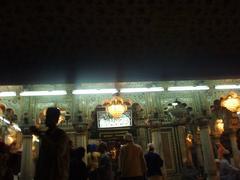
        <![CDATA[<table align=right border=0 cellpadding=25><tr><td><a href="http://xenotropic.net/image.php?id=386&size=med"><img src="http://xenotropic.net/images/Delhi/Nizamudin386_sm.jpg" width="240" height="180" border="" alt="Nizam-ud-din's shrine, Delhi."></a></tr></td><tr><td width=240><small>Nizam-ud-din's shrine, Delhi.</small></td></tr></table>As I sat waiting for the Karnataka Express to take me from Gulbarga to Delhi, a man covered in grease approached me and asked me a few of the standard Indian questions: what is your good name? are you married? what is your job?

<p>Since I was unemployed, I was mercifully spared inquiry into my salary. His name was Basha. He asked me where I went to school -- Florida, I replied.</p>

<p>"India is very poor country, we are having no education. Only two states are education giving, books giving, teaching giving. Kerala and Chennai, in Tamil Nadu are educaton giving. Many states, but others no, only Tamil Nadu, Kerala."</p>

<p>I nodded in agreement. I'm not sure if he was strictly accurate -- that no other states provided education -- but those two southern states had a reputation for being well educated.</p>]]>
        <![CDATA[<p>He asked me where I was from.  Chicago and San Francisco, I told him.
<p>"America where is your drinking water coming from?  What rivers, what oceans?"
<p>"Ummm, the Pacific, Atlantic Oceans; the Mississippi River," I replied.
<p>"My Gott!"

<p>I asked him if he had heard of the Mississippi; he hadn't.  My journal had a world map in it;  I showed it to him, and pointed out the United States and the two oceans (best to be safe) and then drew in a line for the Mississippi down through the middle of the U.S.
<p>"My Gott!  And your government is paying for travelling, some money giving?"
<p>"No, it's all my own money, I worked as a computer programmer to make money to travel, it's a good job."
<p>"My Gott!" he said, and then had a quick exchange with another Indian next to him that was in Kannada or Hindi, and involved the word "compooter degree" several times.
<p>"Are you a Muslim?" I asked.  It seemed like a Hindu ought to be swearing by Krishna or Vishnu or something.
<p>He said he was, and then explained that he was working as some kind of computer technician for the train that was about to leave the station, and ran off to do his duty.
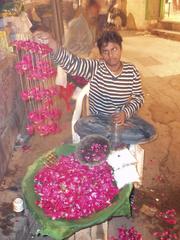
<table align=left border=0 cellpadding=25><tr><td><a href="http://xenotropic.net/image.php?id=388&size=med"><img src="http://xenotropic.net/images/Delhi/Nizamudin388_sm.jpg" width="180" height="240" border="" alt="Boy selling rose petals for those asking for Nizam-ud-din's favor."></a></tr></td><tr><td width=180><small>Boy selling rose petals for those asking for Nizam-ud-din's favor.</small></td></tr></table><p>I looked at the train.  It wasn't mine; I was waiting for the Karnataka Express to Delhi, and this was a cargo train made up primarily of tankers with "Natural Gas 37.8 Tonnes, Not to be Loose Shunted, When Empty Return to Bajuwa" stencilled on them.  I counted the cars -- 25 that I could see, possibly more: 10,000 tons of natural gas, if they were full.  I was happy when they rolled out of the station, ever so slowly, five minutes later.
<p>The Karnataka Express showed up merrily on time; I had a 2 tier AC compartment, which was nice and spacious.  I was stuck in the upper corner, which was next to the air conditioning duct, so it was somewhat chilly.   A big bear of a Sikh installed himself in the opposite bunk and took off his turban, revealing a shaggy halo of uncut, graying hair -- one of the five kakkars, or emblems, of a devout Sikh, the other four being a comb to maintain their uncut hair, a steel bangle, loose underpants to indicate modesty, and a sword of some kind that made him look even more ursine.  I felt like that was a sight that I, as a non-Sikh, shouldn't witness, like a Muslim woman removing her veil, but he didn't pay any notice to me.
<p>After we had started on our way, I walked back to sleeper class to sit in one of the open doorways and see Karnataka.  It was dry.  We passed a river bed at one point, where it was possible to see a few small pools of water that looked like they would evaporate within the hour.   Two men were walking across a cracked field in the dying sun, walking their bikes on one of several paths that all seemed to lead to nowhere.
<p>A middle aged man with a scarf wrapped tightly around his ears and his neck, although it wasn't that cold, asked me what I thought the "scope" of computer science was; after figuring out that he wanted to know what the outlook was for the profession, I told him it was good (I related this to Hari, and he told me, "I'm always careful with that sort of thing.  You say it's looking good and some kid's life hangs in the balance,  because that man going to go home and say that he talked to an American who said that computer science has good scope, so he should study it."  Oops.)
<p>Night fell soon.  I  made a reasonable attempt at studying my guidebook's history section: Indus river settled 3500 B.C., Aryans invade 1500 B.C., the Maruya emperor Ashoka, who contributed to the spread of Buddhism in India, ruled in 250 B.C.  Before I reached the birth of Christ, however, I
<p>fell asleep book in hand and woke up somewhere in the middle of Madya Pradesh, to breakfast in bed brought by the attendant.  After that, I walked back to my open-air sleeper class again and sat in the doorway of the train, watching the heartland of India roll by, sipping Indian Railways chai. 
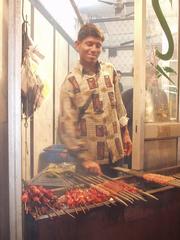
<table align=right border=0 cellpadding=25><tr><td><a href="http://xenotropic.net/image.php?id=387&size=med"><img src="http://xenotropic.net/images/Delhi/Nizamudin387_sm.jpg" width="180" height="240" border="" alt="Muslim boy preparing sheek kebabs in the winding alleys near Nizam-ud-din's shrine, Delhi."></a></tr></td><tr><td width=180><small>Muslim boy preparing sheek kebabs in the winding alleys near Nizam-ud-din's shrine, Delhi.</small></td></tr></table><p>There were fields of rice and soybeans, punctated by bursts of yellow from a crop that I could only get the Hindi name at the time -- "ya'oo" -- that I later figured out was mustard.  Circular huts with pointy roofs dotted the landscape, and two herdsmen with red turbans, which doubled the circumference of their heads, prodded a herd of at least two hundred brahma bulls through a field near the track.  Buildings with spires, made of brick and stone that I guessed were small-scale incinerators.  A brown fallow field, into which a barrelful of monkeys seemed to have been emptied: rolling and fighting, poking and preening.  Bushes in another field with crazed branches like silly string sprayed out of the ground.  A wet field with filthy pigs and angelic cranes, foraging side by side.
<p>In sleeper class there is no security to keep out the assortment of beggars that seem to frequent public place in India.  They tried different tactics to get me to pay them: one boy kept poking me in the hopes that I would pay him to leave me, another with a painted face who played the drums badly with similar intentions, an old woman selling cheap toys, and an old sadhu with an incense altar to some god, asking for donations.

<p>*******************************************
<p>I arrived in Delhi on the next day, a Thursday.  By now the day of the week was usually of little importance, but I was pleased that it was a Thursday, since I had recently read William Dalrymple's <I>City of Djinns</I>, his chronicle of a year in Delhi, in which he narrated his visit to the tomb of Nizammudin, a sufi mystic, where traditional qawwali singing occurred every Thursday.  Dalrymple had hoped to see a whirling dervish, a sufi devotee overcome by the singing, but he was disappointed: but it sounded like a worthwhile visit, dancing or no.
<p>It was about a five mile walk to the shrine from where I was staying near the train station, which wasn't that much compared to the distances I had covered walking around Hampi or Mumbai.   The first two miles were vaguely interesting, filled with the usual sights of shops selling everything from alternators to frying pans.  As I went further south, further from Old Delhi and towards New Delhi, though, the streets broadened, the pedestrians dwindled, and I realized that I was in the Los Angeles of India, a city that was ruled by the automobile.   As the sun set, the headlights of passing automobiles and autorickshaws cutting bright beams of white through the dark cloud of pollution that hovered over Delhi, belched out by factories and two-stroke engines.  For two miles, I only saw two other pedestrians.  I felt like I had entered some kind of post-apocalyptic television or movie set; around every corner,  I expected to see the Network 23 tower from <I>Max Headroom</I>, or the Devil's Night fires from <I>The Crow</I>.
<p>Then there was a parking lot, followed by a small street leading off to the right, peppered with lights and filled with a milling throng of people.  Many of the men wore small white skullcaps, and the women veils:  Islam was here.  I had traveled near the heart of Islam ¡V Istanbul to Cairo --  two years previously and felt quite safe, but with the continued strife in Palestine and Israel and impending conflict in Iraq, I felt a bit edgy.
<table align=left border=0 cellpadding=25><tr><td><a href="http://xenotropic.net/image.php?id=389&size=med"><img src="http://xenotropic.net/images/Delhi/Old%20Delhi389_sm.jpg" width="180" height="240" border="" alt="The Jama Masjid, Delhi."></a></tr></td><tr><td width=180><small>The Jama Masjid, Delhi.</small></td></tr></table><p>Then I reminded myself: these people are devotees of Nizamuddin, they're Sufis, mystics.  The month before I left, I had visited an art exhibition in Detriot by Tom Block (<a href="http://www.tomblock.com/">tomblock.com</a>) comparing the mystical traditions of Judaism (Hasidism), Christianity (Meister Eckhart) and Judaism (Sufis).  The Sufi section consisted of little framed quotes of Sufis stuck up around the upper gallery, short paragraphs that read as if they had been written by Zen Buddhists that believed in God (Rumi: "Even though you tie a hundred knots -- the string remains one.").  Sufism is banned in the more fundamentalist Islamic states:  these people had to be safe.  And they were all far too preoccupied trying to sell me kebabs and rose petals.
<p>There seems to be an unwritten rule in Islam that you can't have a proper holy site unless it's nestled deep in a warren of tiny alleys.  The way to Nizammudin's tomb twisted and turned repeatedly, and was lined with shops selling books in Urdu, shawls, skull caps, and lots and lots of magenta-colored rose petals.
<p>"Stop shoes sir!" one of the rose-sellers called out after about the fifth corner, as if I would commit a terrible heretical act if I took another step.  Two others slightly further in echoed his call, and all three of them had stands filled with sandals: it was apparently a profitable sideline to hang on to people's shoes while they visited the saint.  I deposited my sandals with the nearest one.
<p>I walked barefoot through several more turns -- and past several more shoe-storers -- and past a small clearing with two tombs, like stone coffins that were one with the stones of the alley, and into the main courtyard of Nizammudin's shrine.

<p>A group was gathered around a group of musicians, and I stood on the edge; since I was a foot taller than most of the audience, I could see easily.  There was one man singing and playing a battered brown harmonium that must have been around at the Partition of India.  He was round-faced and balding, his teeth were broken and stained red from a lifetime of chewing paan, and he was wearing a white kurta suit: the overall effect was that of a lost cousin of the Munster family.  His voice was gravelly but gentle, in a whiskey-and-cigarettes kind of way, and he sang passionately; ten other men flanked him and backed him up as a chorus.  One right next to him was around twenty years old and sang with a clear, strong voice, pausing occasionally to sweep in the twenty and fifty rupee notes that accumulated in a pile before the performers.  Another played a pair of drums.
<p>The musicians faced the shrine, and supplicants -- all men -- lined up to the right of the entranceway, heads covered and hands holding bowls of rose petals.  They seemed to stay in the shrine for a minute or two, and then they backed out, bowing to touch the step of the portico as they did so.  Many were dressed in Muslim kurtas, but then one with an Orlando Magic Starter jacket, and then one with a Subway USA jersey -- the sandwich chain -- walked in and back out.  One man walked in with an orange three-pronged fork on his forehead, a mark of Shiva: Sufism -- or perhaps just Nizammudin -- seemed to reach, at least a little bit, over the barrier to Hinduism.
<p>I counted the Westerners in the crowd; there were four.  One of them, a woman, tentatively walked out into the clearing in front of the musicians and dropped some rupees on the pile.  After a moment, I followed suit, leaving fifty rupees.  As I walked near the shrine, towards where I had been standing, a man with a massive ledger, the universal Indian sign of officialdom and authority, stopped me.
<table align=right border=0 cellpadding=25><tr><td><a href="http://xenotropic.net/image.php?id=392&size=med"><img src="http://xenotropic.net/images/Delhi/New%20Delhi392_sm.jpg" width="240" height="180" border="" alt="The Bahai Temple of Delhi."></a></tr></td><tr><td width=240><small>The Bahai Temple of Delhi.</small></td></tr></table><p>"Would you like to make a donation?" he asked.  He showed me his ledger, which had columns for name and address, and a wide variety of different things to donate to:  maintenance of the shrine, food for the poor, and a "freeschool", whatever that is, among others.  I donated a hundred rupees to the maintenance of the shrine, and asked if it was ok for me to enter the shrine.
<p>"Yes, but you should cover your head."
<p>"I don't have a hat with me."
<p>"You don't have a hanky or anything?"
<p>"Um, no."
<p>"Well, no problem, then."
<p>I went in, and it was very green.  There was a large green sheet covering what appeared to be another stone coffin, which was in turn sheltered by a big green canopy, supported by stone pillars, as if for a large four-poster bed.  Nizammudin's devotees orbited around the room clockwise, putting their rose petals on the sheet and then standing near the wall and muttering in prayer for a minute before moving on.  Three people laid a smaller red cloth over the green one, where the blob of the tomb supported it, in what seemed to be another form of offering.  An old man with a clean-shaven head, a beard that reached halfway down his chest, and a fervent look in his eye leaned far over the balustrade to kiss the tomb.  Above the canopy, it seemed like there was a small room: perhaps where a guardian of the shrine lived?  It was hard to tell.  I made the orbit of the shrine and then squeezed out in a crush of people, some entering and some exiting, and then backed across the threshold like everyone else, touching it as I did so.  No one had seemed to register my presence or even glance at me.
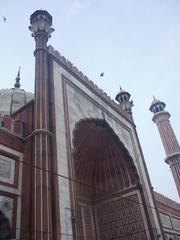
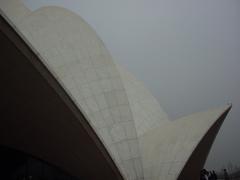
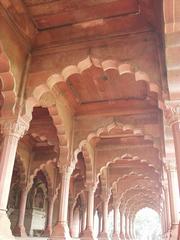
<p>I stayed in Delhi for four more days.  I used the Lonely Planet bulletin board to arrange to rent a car for ten days with a Norwegian named Henrik -- $130 for each of us -- to see Rajasthan, but he wasn't going to arrive from Oslo for ten more days.  I saw things around the city.  The Red Fort: grand-scale Mughal architecture in red sandstone, built by Shah Jehan.  Jama Masjid:  grand-scale religious Mughal architecture, also in red sandstone, also built by Shah Jehan. The Bahai temple: soaring curves in a 1970's kind of way; I guessed about two thousand people milling around outside, and fifteen actually sitting in the enforced silence inside.   The Birla Temple: maroon and yellow oblong domes and freezing cold marble floors, but remarkable in that it was open to all castes.  Old Delhi: small shops, cycle-rickshaw drivers straining to pedal through swarms of pedestrians.
<p>One evening, walking back from Old Delhi to where I was staying, crossing the  bridge over New Delhi train station that was stuffed to the brim with people and vehicles, I noticed a woman walking towards me, going the other way across.  At first I thought she was a Westerner, since she was too indecently dressed for an Indian woman, with her hair piled on her head, and a dress that was a little too low-cut.  As she got closer, I noticed that she was looking at me, that her jaw was quite squaure, her chest flat, and her arms muscular.
<p>At the same moment that the word "transvestite" materialized in my brain, she called out "Halloooooo!" and casually reached out to grab my crotch.  Before I realized that I had done it, I swatted her hand away forcefully, the result of a deep seated don't-grab-my-nuts reflex of which I had hitherto been unaware.
<p>I would have been totally bewildered, had <I>City of Djinns</I> not prepared me, but as it was I burst out laughing after a moment of shock.  "She" was a <I>hijra</I>, one of a group of eunuchs that constitue a separate, tightly-knit social class.  Dalrymple spent a great deal of time and effort trying to court some of them -- in a journalistic sense -- and finally succeeded in talking to some of them in their homes.  They also made an appearance in Vikram Seth's novel <I>A Suitable Boy</I> where they appear in their conventional role of visiting wedding receptions and playing loud, obnoxious music and harassing guests until the host pays them a large sum of money to leave.

<table align=left border=0 cellpadding=25><tr><td><a href="http://xenotropic.net/image.php?id=398&size=med"><img src="http://xenotropic.net/images/Delhi/Old%20Delhi398_sm.jpg" width="180" height="240" border="" alt="The Diwan-i-Am of the Red Fort, up close and personal."></a></tr></td><tr><td width=180><small>The Diwan-i-Am of the Red Fort, up close and personal.</small></td></tr></table><p>Having survived that encounter and seen the sights of Delhi, I couldn't really think of anything to do for a week in Delhi, and the thought of the amount of pollution I would inhale in that time was depressing.  I bought a train ticket for Amritsar, where the Golden Temple serves as the center of the Sikh religion.
<p>I knew when I arrived at the Golden Temple that they offered free food and lodging to all pilgrims -- which includes non-Sikhs -- but it wasn't immediately evident where it was.  There were many people walking in and out of the complex, many wearing "Golden Temple" bandanas to fulfill the head-covering requirement, but it seemed wildly inappropriate to walk in with a massive backpack.  After some exploration, I found a baggage check near the door.  The attendant seemed mildly annoyed to have to haul in my fifty pound bag, but he complied.
<p>I bought a bright orange bandanna, tied it around my head, and headed through the gate to the temple complex, which passed through a massive white marble wall.  As I did so, I stepped in what was like a miniature moat of freezing cold water, provided to allow people to wash their feet as they entered.
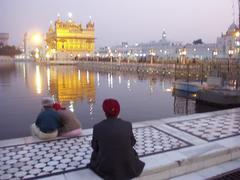
<p>The Golden Temple complex was one of the most amazing places I saw in India.  The Taj Mahal, for all of its architectural merits, was like a dead husk being chewed over by hordes of tourists compared to the vibrancy of the Golden Temple, which was obviously still the pulsing center of a religion.   The structure itself is gilded with over 100 kilograms of gold, and is surrounded by a wide pool called the Amrit Sarovar, from which the surrounding city took its name.  There is a pathway around the pool, which is about a quarter of a mile around; several other temples are in the same complex.
<p>The causeway across the lake was filled with a line to rival that at Space Mountain in Disneyworld, except it was all Sikhs, waiting with food offerings in hand to bring for blessing into the temple.  I queued up.  All the way around the pool Sikhs walked clockwise around the temple.  They ran the gamut from bearded, wizened old men, dressed in bright orange and carrying pikes and spears, to families that seemed to have come from America or Europe to show the kids where their religion came from.  Some of them paused and talked; a group of old men were grouped around a book and half-chanting, half-singing what they were reading in it.  The wall had a colonnaded walkway in it, and some people -- again, mostly old men, with wrinkled faces that exuded character -- sat in listless meditation, looking at the temple.  The sun, sinking slowly into the west, turned the temples gold to bronze.
<p>After half an hour, I was admitted to the temple, which was similar to Nizamuddin's shrine: the supplicants went to a central area, surrounded by a balustrade, within which there were attendants who took their food offerings, blessed them, and gave them back.  Four elderly, bearded men kept up constant chanting that was played throughout the complex of the Guru Granth Sahib, the Sikh's holy book, and they were engulfed in a mass of microphones and mixing boards worthy of a commercial radio station.
<table align=right border=0 cellpadding=25><tr><td><a href="http://xenotropic.net/image.php?id=399&size=med"><img src="http://xenotropic.net/images/Amritsar/Golden%20Temple399_sm.jpg" width="240" height="180" border="" alt="The Golden Temple, Amritsar."></a></tr></td><tr><td width=240><small>The Golden Temple, Amritsar.</small></td></tr></table><p>I had presumed from the crowds outside that the interior of the temple would be packed.  The central area was filled with those seeking food-blessing, but the upper balcony was relatively empty, which people sitting in the windows and gazing out at the pool.  One young but devout-looking man sat reading a text.  Only a handful of people went up to the roof, where it was possible to take in the whole scene of people orbiting around.  Looking upon them, it was hard to imagine the violence of nineteen years earlier, when Indira Gandhi used military action against Sikhs occupying the temple, demanding a separate Sikh state;  "Operation Bluestar", although successful, motivated Indira's Sikh bodyguards to assasinate her shortly afterward.
<p>On the way out, where the causeway across the pool ended, a man was handing out a doughy paste to everyone.  I started to walk by on the far side:  I was never certain how involved people wanted unbelievers to be in the motions of their religion.  But the man called me over, and motioned for me to take some, and to eat it.  It was sweet and tasty, probably made from milk, grain, and sugar.
<p>After slow lap around the temple, I found the gurdwaras on the far side, where supposedly all pilgrims were granted free accomodation.   I fetched my backpack -- brought back out my two of the attendants -- and walked back around.  After a brief misunderstanding with the orange-clad, pike-wielding attendant (foreigners are placed separately from Sikhs), I settled in; it was a triple room with two other backpacks, but neither of the owners.
<p>The Guru Ka Langar is a massive kitchen that serves 30,000 meals a day to pilgrims.  People were milling about outside when I went looking for a bite to eat, but the gates were closed.  No one seemed to speak English, but one man indicated that I should wait.  I studied the signs over the door, which, juding from the pictures, exhorted the faithful to not cut their beards.
<p>Eventually the doors opened, and we poured in and sat in lines on either side of long straw mats that ran the length of the hall.  When all were settled, a young man in his twenties stood up.  He had the beginnings of a beard and a black piece of nylon covering his hair, which was tied into a knot on the top of his head.
<p>"Swateth nah nawaheh guruuuuuu," he intoned.  "Swateth nah nawahah guruuuuuu."
<p>"Swateth nah nawahah guruuuuuu," replied the hungry faithful.
<p>The chanting – the same line repeated – lasted ten minutes while other turbanned men walked down the mats, giving each person two chapatis and a bowl of dal.  After all had been served, and a few more extra minutes of chanting, the prayers were brought to and end with a few quick claps and the eating began with a great deal of clatter and slurping.  The food was simple, but the dal had a pleasant taste of black pepper to it, and seconds and thirds were brought by in abundance.  One emaciated looking man across from me obliterated his first share in what must have been record time and was replenished with more chapatis and dal dropped unceremoniously from the serving men walking by, which vanished just as quickly.  Like with the traditional Indian all-you-can-eat thali, it was necessary to physically defend your plate and bowl, covering it up if you <I>didn’t</I> want anything to eat.

<table align=left border=0 cellpadding=25><tr><td><a href="http://xenotropic.net/image.php?id=400&size=med"><img src="http://xenotropic.net/images/Amritsar/Golden%20Temple400_sm.jpg" width="180" height="240" border="" alt="Woman paying homage to Guru Deep Singh."></a></tr></td><tr><td width=180><small>Woman paying homage to Guru Deep Singh.</small></td></tr></table><p>The crowd dribbled out into the night as they finished, handing their plates to the volunteer crews that were washing  them off.
]]>
    </content>
</entry>
<entry>
    <title>Hampi</title>
    <link rel="alternate" type="text/html" href="http://www.xenotropic.net/2002/12/hampi.php" />
    <link rel="service.edit" type="application/atom+xml" href="http://www.xenotropic.net/cgi-bin/mt/mt-atom.cgi/weblog/blog_id=2/entry_id=17" title="Hampi" />
    <id>tag:www.xenotropic.net,2002://2.17</id>
    
    <published>2002-12-19T08:00:00Z</published>
    <updated>2005-10-16T19:01:38Z</updated>
    
    <summary>In the fourteenth century, two Telugu princes founded the city of Vijaynagar on the shores of the Tungabhadra river, near the modern village of Hampi in what is now central Karnataka. The city grew, and by the early sixteenth century...</summary>
    <author>
        <name>Joe</name>
        <uri>http://xenotropic.net</uri>
    </author>
            <category term="India" />
    
    <content type="html" xml:lang="en" xml:base="http://www.xenotropic.net/">
        <![CDATA[<p></td></tr></table><p>In the fourteenth century, two Telugu princes founded the city of Vijaynagar on the shores of the Tungabhadra river, near the modern village of Hampi in what is now central Karnataka.  The city grew, and by the early sixteenth century it was the capital of one of the most powerful empires in the subcontinent.  <br />
<p>After a bumpy rickshaw ride from Hospet, the closest railway station, I had to agree with the Telugu princes:  if there was an empire to be founded, this was an idyllic place to do so.  </p>]]>
        <![CDATA[<p>	<p>The lazy, winding river cut a fertile slash through the surrounding red-tinted wasteland.  Palm, guava, and mango trees lined its banks, and the blue skies were dotted with white fluffy clouds.  It was what I imagined the Nile would have looked like in ancient times, with the little baby Moses floating downstream in a basket.  The weather was perfect, like Florida in February or Berkeley in September.  Away from the banks of the river, large chunks of rock were scattered around, sometimes piled into big, surreal heaps.  It was as if cyclopean armies had been at battle here, tossing boulders at each other.<br /><br />
<p>I stayed on the quieter north side of the river, which meant taking a coracle across to visit the main ruins on the south side, and the main bazaar of what is modern Hampi, which occupied old Vijaynagar buildings.  The Virupaksha Temple at one end of the bazaar was built in the fifteenth century, and was now again a bustling center of Hindu worship.<br /><br />
<p>There were a lot of travelers in Hampi, particularly on the north side of the river, and they were mostly Israeli.  Signs at guesthouses were all in Hebrew as well as English.  This was remarkable only because I had met no Israelis anywhere else in India; it was as if they all arrived and immediately headed for Hampi.  There were many of them in the guesthouse where I was staying.  They dressed in wild colorful hippie clothing, and they seemed to have a predisposition for shirts with the "Om" symbol on them.  They played Israeli pop music at the guesthouse. The conversations on the coracle were laced with the hocking H's of Hebrew; they sounded similar to the throaty French R, and I found myself continually trying to decipher what they were saying as if it were French, but then it just came through as static.<br /><br />
<table align=left border=0 cellpadding=25><tr><td><a href="http://xenotropic.net/image.php?id=350&size=med"><img src="http://xenotropic.net/images/Hampi/Vittala350_sm.jpg" width="180" height="240" border="" alt="Ang&eacute;lique in the central atrium of the Vittala Temple."></a></tr></td><tr><td width=180><small>Ang&eacute;lique in the central atrium of the Vittala Temple.</small></td></tr></table><p> After I had deposited my things on the north side of the river, I took the boat back across the river.  I was almost too late; it was leaving the shore, but I called out and ran towards the big rock that served as a jetty, and the coracle, spinning slowly, started to come back to shore.  Suddenly I noticed hands waving in the boat, and two familiar faces: it was C&eacute;line and Angelique, the two French women that I had met weeks before in Ooty.  After I boarded the boat, we caught up: they, too, had stayed with an Indian family, but in Bangalore.  The family had also wanted them to eat as much food as possible, and they had been wealthy socialites.<br /><br />
<br /><br />
<p>"They invited us to these really fancy soir&eacute;es, and we always thought we were a little under-dressed, look, all I've got is this," said Angelique, pointing to her salwar.  "But we'd go, all the same, and it wasn't that big of a deal."<br /></p>

<p>C&eacute;line bought a sari.  "They're hard to put on, but then they are also uncomfortable to wear," she said.  Which probably explains why young Indian women almost always opt to wear a salwar kameez instead.<br />
<p>We ate dinner, and then climbed up to some ruins on a nearby hill to watch the sunset.  A small boy wanted to sell us postcards, but C&eacute;line started trying to ask him, in her halting English, about where he lived and how much money he made; he was from a town that was a ten minute bus ride away, and came to Hampi each day after school.  He made about one hundred and fifty rupees a day, which seemed like a pretty good sum.  We were in the middle of trying to figure out whether that was sales or profit when another man came up to us, who also spoke fragmented English.  We went through the usual preliminaries of our nationalities; he was a teacher in a nearby town.<br />
<table align=right border=0 cellpadding=25><tr><td><a href="http://xenotropic.net/image.php?id=352&size=med"><img src="http://xenotropic.net/images/Hampi/Vittala352_sm.jpg" width="180" height="240" border="" alt="The god Hanuman, whipping his enemies about with his tail."></a></tr></td><tr><td width=180><small>The god Hanuman, whipping his enemies about with his tail.</small></td></tr></table><p>"Ah, from America.  I think your American accent best," he said.  "Particularly the ladies."<br />
<p>I told him that was news to me; I thought everybody liked English and Scottish accents.<br />
<p>After a pause, he asked us, "You think love marriage or our Indian marriage is better?"<br />
<p>"It is very different between 'ere and in France," replied C&eacute;line.  She dropped her h's and spoke with a thick French accent.  "I would like to choose my 'usband, because I love 'im and 'ee is loving me.  But sometimes eet is deefeecult.  Maye boyfraynd in France, my parents do not like eem, so that makes it 'ard."<br />
<table align=left border=0 cellpadding=25><tr><td><a href="http://xenotropic.net/image.php?id=366&size=med"><img src="http://xenotropic.net/images/Hampi/Vittala366_sm.jpg" width="180" height="240" border="" alt="Hindu holy man, or Sadhu, asking for money on the path between Hampi bazaar and the Vittala Temple."></a></tr></td><tr><td width=180><small>Hindu holy man, or Sadhu, asking for money on the path between Hampi bazaar and the Vittala Temple.</small></td></tr></table><p>"But you do not respect your parents?" the man asked.  "Is that not good?  Here in our India it is important that we respect our parents."<br />
<p>C&eacute;line explained that the two cultures were very different, and in France and the West it was a big landmark (we spend a long time trying to translate the French word for "landmark", which I didn't know) to be independent from your parents.<br />

<p>"I can perhaps understand that.  But here in our India we see how relationships are just 'as you like' in your blue films, and that is what many people see of France and the United States and think that is normal life."  'Blue Films' turned out to be an Indian euphemism for pornography.<br />
<p>"Yes, but in Bollywood and in Indian TV, you also see women in clothes that are very small, very sexy," said C&eacute;line.<br />
<table align=right border=0 cellpadding=25><tr><td><a href="http://xenotropic.net/image.php?id=369&size=med"><img src="http://xenotropic.net/images/Hampi/Hampi369_sm.jpg" width="180" height="240" border="" alt="Indian girl carrying laundry on her head, Hampi."></a></tr></td><tr><td width=180><small>Indian girl carrying laundry on her head, Hampi.</small></td></tr></table><p>"Yes, but we are just following you and your films."<br />
<p>It was getting dark; we headed down from the ruins and all went our separate ways.  C&eacute;line and Angelique went back to their guesthouse, which was in the main bazaar nearby, and the teacher and postcard seller headed off to their village.  I stopped for a beer and wrote in my journal at a rooftop restaurant nearby.<br />
<p>The waiter offered the beer bottle to me like a sommelier, which is usual in India, so you can check to make sure that it's cold enough before they open it.  I checked, and gave him the go ahead; he poured, and then lingered for a minute.  "You want bhang lassi?" he asked.  "Good grass, kerala grass."<br />
<br />
<p>Bhang is an Indian word for marijuana.  Lassi is a beverage made from mixing yoghurt with a bit of water, and it comes in a wide variety of flavors:  salted, sweet, banana, mango, chocolate, pineapple, bhang.<br />
<table align=left border=0 cellpadding=25><tr><td><a href="http://xenotropic.net/image.php?id=370&size=med"><img src="http://xenotropic.net/images/Hampi/Hampi370_sm.jpg" width="240" height="180" border="" alt="C&eacute;line and Angelique pedaling from the Vittala temple to the Zenana enclosure."></a></tr></td><tr><td width=240><small>C&eacute;line and Angelique pedaling from the Vittala temple to the Zenana enclosure.</small></td></tr></table><p>I stuck with beer.<br />

<p>*******************************************<br />
<p>The next day, I saw the ruins of Hampi with C&eacute;line and Angelique.  We rented bicycles: heavy, battered bicycles made by the Hero company, the company that holds the Guiness record for making the most bikes.  Quantity, alas, is not quality.  By the time we made it back one of my pedals had disintegrated, and at one point we had to wait for five minutes while C&eacute;line kicked and pulled at the chainguard of her bicycle, which had bent inward and jammed up into the chain.  Angelique got a more recent model that looked vaguely like a mountain bike and, more importantly, did not break.<br />
<p>We visited the Vittala Temple, which had pavilions, presumably for some religious use, that were surrounded and filled with pillars carved into the shape of warriors riding tigers and elephants; it felt more like a war memorial than a temple.   Although they had been made over three hundred years earlier, the carvings were still in very good shape, and the structures intact.<br />
<table align=right border=0 cellpadding=25><tr><td><a href="http://xenotropic.net/image.php?id=372&size=med"><img src="http://xenotropic.net/images/Hampi/Zenana372_sm.jpg" width="180" height="240" border="" alt="The Lotus Mahal in the Zenana Enclosure, Hampi."></a></tr></td><tr><td width=180><small>The Lotus Mahal in the Zenana Enclosure, Hampi.</small></td></tr></table><p>The other big attraction was the Zenana enclosure, where the women of the royal Vijaynagar household lived, and the Lotus Mahal within it.  Although it wasn't very large, the Lotus Mahal was a beautiful structure that showed the cultures that influenced the Vijaynagars:  it had Moghul arches, but it was topped with a stack of smaller stories like a Dravidian temple.  The red color of the red stone arches changed from light to dark and back to light again as you looked through the building, which was a very pleasing effect.   Adjacent to the Zenana enclosure were the royal elephant stables -- it takes a pretty room building to stable an elephant, and there were eleven of them in one building.  It seemed possible that they might have fit two elephants to a stable, depending on how pampered the royal elephants were.<br />
<p>C&eacute;line had decided that the 250 rupee combined entrance fee -- five dollars -- for the Zenana Enclosure and Vittala Temple was excessive, and had stayed outside; Angelique and I climbed a tower in the Zenana enclosure, which ended abruptly in a series of windows that were open to a thiry foot drop.  Each window was about as wide as a person; we each sat down in a window and looked past our toes to the ground far below.<br />
<p>"In America you would never be in open windows like this," I said.<br />
<p>"Not in France either.  There would be bars, windows, guards."<br />
<table align=left border=0 cellpadding=25><tr><td><a href="http://xenotropic.net/image.php?id=377&size=med"><img src="http://xenotropic.net/images/Hampi/Hanuman377_sm.jpg" width="240" height="180" border="" alt="The Hanuman guru, in the Hanuman temple, near Hampi."></a></tr></td><tr><td width=240><small>The Hanuman guru, in the Hanuman temple, near Hampi.</small></td></tr></table><p>"This is pretty nice."<br />

<p>"Yep."<br />
<p>Compact, agile birds with a little orange spot near their tails circled and dove among the walls of a roofless building below.  They flapped their wings a few times and then glided in tight turns, and often came so close to the top of the wall that I was certain they were going to smash into it, but they always skimmed past.<br />
<p>That evening I finished Riding the Iron Rooster.  Theroux ended up in Tibet, after surviving a car wreck when his inexperienced but enthusiastic Chinese driver bounced the car off the road.  I hadn't been particularly interested in Tibet previously, mostly because there were so many "Free Tibet" bumper stickers around Berkeley that it had come to seem like a fashionable "rich hippie" cause.  But Theroux, normally acerbic Bostonian, made me think otherwise: "Lhasa was the one place in China which I eagerly entered, and enjoyed being in, and was reluctant to leave," he wrote, which contributed to my later decision to visit McLeod Ganj, the center of the Tibetan government in exile.<br />
<table align=right border=0 cellpadding=25><tr><td><a href="http://xenotropic.net/image.php?id=378&size=med"><img src="http://xenotropic.net/images/Hampi/Hanuman378_sm.jpg" width="180" height="240" border="" alt="Monkey at the Hanuman temple near Hampi."></a></tr></td><tr><td width=180><small>Monkey at the Hanuman temple near Hampi.</small></td></tr></table><p>*******************************************<br />
<br />
<p>Three miles away from town, and five hundred and seventy-six steps higher(a German I met later in the day had counted them), lay a temple to Hanuman, the monkey god, to which I paid a visit.  The stairs wove in between a group of very large rocks, among which there were, appropriately, many monkeys.  They had white and silver fur, and the males had red buttocks.  They had slack, dumb faces, except for their beady black eyes that darted around with simian cunning.  I hesitated for a moment, unsure if they posed a threat, but two of Hanuman's supplicants came down with sticks and drove them away, removing the question.<br />
<p>At the top, the door of the temple was closed, although I could hear sounds of people inside.  There were several other buildings around it, so I walked the perimeter first.  A wild looking man called me over to a particularly large boulder, where he was talking to a German couple.  He was balding, a fact that he tried to conceal with a white cloth wrapped around his head; his right eye was bloodshot and his teeth were in a sorry state.<br />
<p>"Where you from?" he asked.<br />
<table align=left border=0 cellpadding=25><tr><td><a href="http://xenotropic.net/image.php?id=380&size=med"><img src="http://xenotropic.net/images/Hampi/Hampi380_sm.jpg" width="180" height="240" border="" alt="Man blowing his kompu in the Virupaksha temple."></a></tr></td><tr><td width=180><small>Man blowing his kompu in the Virupaksha temple.</small></td></tr></table><p>"America," I replied.<br />

<p>"America, small country."<br />
<p>"It's quite large, actually."<br />
<p>"Big country, America, yes.  You George Bush daughter going LSD having?" he said with a ragged, insane grin.  "You understanding?"<br />
<table align=right border=0 cellpadding=25><tr><td><a href="http://xenotropic.net/image.php?id=381&size=med"><img src="http://xenotropic.net/images/Hampi/Hampi381_sm.jpg" width="180" height="240" border="" alt="The elephant of the Virupaksha temple."></a></tr></td><tr><td width=180><small>The elephant of the Virupaksha temple.</small></td></tr></table><p>I nodded dumbly.  Perhaps I had missed some recent headlines about the First Twins.  Regardless, asking him to repeat it probably wouldn't help.<br />
<p>"Not natural, not natural," he said.<br />
<p>He pulled out a pipe and some matches, packed the pipe, and asked me to light it.  I lit the match, but a puff of breeze blew it out.<br />
<p>"You God giving ten fingers but not using!  Not natural."  He took the matchbox from me and handed it to an Indian sitting on the other side of him, who mutely proceeded to light Mr. Not-Natural's pipe properly, with the match properly shielded in the shell of his hands.<br />
<p>After he had smoked for a minute, he gabbled further about America; it was like a schizophrenic's word salad.  One of the rocks was a large slab that covered the other; he asked the Germans, and then me, take a picture of him as if he were supporting the upper stone by pushing up on it with his legs.<br />

<p>Having had their fill of gobbledygook, the Germans left, leaving him a hundred-rupee "donation", and I followed, giving him twenty, which seemed like a more reasonable sum -- although, having performed no services other than perhaps entertainment, he really didn't deserve anything.<br />
<p>I went to the door of the temple and loitered uncertainly; the door seemed firmly closed.  Should I knock?  I watched two young monkeys fight on top of a nearby barrel, falling to the ground intertwined.  They rolled around, arms and legs flailing.  Mr. Not-Natural started coming back from walking the Germans to the stairwell.<br />
<p>"Go!  Go!" he exhorted me, just as a woman opened the door from the inside.  I walked in, and the lunatic followed.  <br />
<br />
<p>I stopped for a moment for my eyes to adjust to the darkness and to take in what was going on.  Cooking and sleeping happened here: it was as much a home as a temple.  Two foreigners were conversing, sitting at the base of a small room with barred windows to the left, and a woman was cooking in a room to my right.  <br />
<p>"Come, come, you meet the baba," said the lunatic:  baba was the holy man of the temple.  He told me the baba's name, which started with "Sri Sri" ("Great Great"), ended in "Guru", and had a difficult to pronounce bit in the middle that I promptly forgot.<br />
<p>I followed him through another room that had a dimly lit temple to the right and a large red donation box, and then outside to where the baba was sitting with two of his disciples.  One of them was a silent Indian dressed in ordinary clothes, and the other wore a lunghi and looked Japanese or half-Japanese. The latter and the guru were having a relaxed discussion.  <br />
<p>"Here, sit, sit!" said the lunatic.  I sat on one of the plastic mats around the baba.<br />
<p>After a few moments the baba turned to me and smiled.  He had wild hair and a fairly long beard, and wore a white lungi and a Brahmin string.  Brahmins are the the highest-caste Hindus who traditionally work as pujaris, and those Brahmins who still take their caste seriously still wear the string, sometimes all the time.   I met a former general of the Indian Army on the train to Chennai who, in the course of conversation, mentioned that he was a Brahmin and pulled his string out of his shirt to prove the fact.  Baba's string was orange, the color of Hanuman.<br />

<p>"You want chai?" he asked.<br />
<p>"Um, no thanks."<br />
<p>"You want smoking maybe?"<br />
<p>Smoking weed with Hanuman guru was probably something to put in the Interesting Life Experiences file, but for whatever reason -- mostly that I had just sat down and met him -- I declined again.<br />
<p>"How about tikka?" he asked.<br />
<p>"Umm... tikka?"<br />
<p>"Tikka, tikka," he said, with the usual Indian assumption that if something is said twice, it will all be clear.<br />
<p>I still looked confused.<br />
<p>"Blessing, tikka."  He made a thumb-to-the-forehead gesture.<br />

<p>Ah, right, the forehead-blessing mark.  I assented, and he led me inside to the temple, where there was a large orange image of Hanuman.  Intoning "Sri Ram Hanuman" three times, deeply and slowly, he gave me a solid smudge of orange on my forehead.  He took me over to the room with barred windows, which turned out to be another temple to Hanuman's mother, Anjana.  He indicated that the proper thing to do was to walk around it, which I did.<br />
<p>"Very good, very good," he said.  "You come, sit."<br />
<p>I went back out and sat back down on the mat.  Baba talked more to the Japanese man, with Mr. Not-Natural and the quiet Indian commenting occasionally.  Langur monkeys loped around the outside terrace and occasionally tried to dash inside, enticed by the smell of cooking, and one of the disciples of the monkey god had to get up and chase them away.<br />
<br />
<p>After listening (although I understood nothing) and watching for a few minutes, I asked if I could take the baba's picture.<br />
<p>"After smoking!  You take picture after smoking," said Mr. Not-Natural with a vehemence that implied that taking a picture <I>before</I> smoking would be immoral.<br />
<p>Baba pulled out a cylindrical pipe and proceeded to pack it, and one of the others lit it for him.  As they did so, Mr. Not-Natural gestured to tell me that as it was now the proper picture taking time.  If all goes well I should have an excellent series of half a dozen pictures of the process of Baba lighting up.<br />
<p>The pipe was passed around, and the quiet man was the last; after he finished he smacked it against the ground and a small black thing fell out.<br />

<p>I sat around for a few more minutes, but there wasn't much else going on, as the others continued to converse in Hindi, Kannada or whatever.  I got up to leave.  Mr. Not-Natural waved, and then got up.<br />
<p>"You have card?" he asked me. <br />
<p>I actually did have cards; Edward Hasbrouck had recommended bringing them in <I>Practical Nomad:  How to Travel Around the World</I>, since you're always meeting people and wanting to give them your email.  I hand out a hell of a lot more cards traveling than I ever did when I was actually employed.  I gave him one.<br />
<p>"You have other card?" he asked.<br />
<p>I gave him another card, although I couldn't imagine what he wanted it for.  He didn't look like a big postcard writer.<br />
<p>"Picture very important, million dollars maybe fire stone going.  Natural."<br />
<p>I nodded in agreement.  Natural.<br />
<p>*******************************************<br />

<p><br /><br />
<p>On the coracle back, I started talking to a wiry German named Danny, who was dressed in standard modern-hippie attire with beads around his neck.  I complimented him on his English, which was almost devoid of the gutteral vowels Deutchlanders frequently carry over from their language.  He said that he had been studying for a while in Germany, and had also been traveling for a few weeks with two Americans; they were from San Francisco.  San Francisco!  That's where I'm from.  I could come and meet them if I wanted.  Sounds good.<br /><br />
<p>I get tired of speaking in the slow. clearly. enunciated. manner. that is necessary to communicate with most of the people that I ran into on a daily basis, or in French, which is just as bad going the other way.  I had talked to a man from Edmonton that morning, but they say "Bouwt" for "boat" and look at me blankly when I tell them, "Right on!".  I was looking forward to talking to some Americans.  They were from California: I could say "dude", and they wouldn't laugh.<br /><br />
<p>I walked with Danny along the dirt road that led past my guesthouse (Mama Krishna's, with Indian Soul Food Restaurant) to his.  The serving boy at my guesthouse walked up to us.<br /><br />
<p>"Want to smoke something?"<br /><br />
<p>"How much?" asked Danny.  <br /><br />
<p>"One hundred rupees."  Two dollars.<br /><br />
<p>Danny assented; he biked off and returned five minutes later with a small wad of dried plants in a wad of newspaper.  I'm not an expert weed buyer, but it looked more like a very small snack for a ruminant than something one would inhale.  Danny poked at it in the dim light.<br /><br />
<p>"I have better stuff, three hundred rupees," said the Mama Krishna boy, proffering another wad of newsprint.<br /></p>

<p>"No, I think this is okay," said Danny.<br />
<p>We made it to his guesthouse, which was more like a compound, with a thick hedge and a long walkway leading up to it.  He greeted several people on the porch of the adjoining room, which was shrouded in darkness by a power cut, and then checked on the other side for the Californians, who were not home.  Danny inquired with the other neighbors; they had gone to see a movie nearby a while back.<br />
<p>"Well, they are not here, but you can wait and see if they come back, or whatever, as you like," said Danny, pulling up a chair next to his neighbors.<br />
<p>I started talking to the one closest to me, who said that his name was Hans and he was from Germany.  Just as he said that, the power was restored and I could see him: he had dark skin and a prominent nose, and was grinning broadly.  His head was shaved clean, but two out of the three of his companions had springy-curly dark hair.<br />
<p>"You, uh, don't look very German, Hans," I said. <br />
<p>He turned to his companions.  "You see, that is the problem."  Then back to me, he said, "We are all Israeli, actually.  My name is really Adi."  We shook hands.  "And just so you know I am very stoned, so you shouldn't take anything I say too seriously.  Anyway, we were just talking about how Israeli women are not interested in Israeli men in India, so we are inventing new names and nationalities for ourselves.  This is J&#246;rgen from Germany, that's Giovanni from Italy of course, and in the hammock there is Sean from America.  He looks like the famous Mr. Penn, you know?"<br />
<p>J&#246;rgen had shoulder length blond hair and Teutonic features.  Giovanni had the dark sproingy hair that could pass for Italian.  Sean, true enough, looked like Penn, with a sproingy-hair transplant.  I asked them each their Israeli names, but they were just random syllables to my American ear compared to their more mnemonic aliases. <br />
<br />

<p>"So, wait:  Israeli women aren't interested in Israeli men?  That sounds like a pretty fundamental problem, huh?"<br />
<p>"No, no," said Adi.  "Just here in India, they are like, 'We have that at home', you know?"  He paused, and then looked thoughtful.  "I need another name.  How about Charlie?  Charlie the American," he said, looking at me.<br />
<p>"Maybe it's better if you're Canadian," I said.  "You just say 'eh' after everything, and everybody will believe you."<br />
<p>"That's good!  'I'm Charlie from Canada, eh?'"  He smiled, pleased with his new identity.<br />
<p>Danny had meanwhile fetched a bong from his room, a pint soda bottle half-filled with water and with a small bowl attached near the bottom, into which he put his new purchase and smoked it tentatively.  He gagged and coughed.<br />
<p>"This stuff is shit," he said.  "I didn't think it looked very good." <br />
<p>The Israelis offered him some of theirs, but he declined and inhaled again.<br />
<p>"No, no, I think this will be good enough for me."<br />
<p>I wanted to ask if my impression that most Israelis in India just came to Hampi and smoked up was accurate, but it seemed possibly tactless, so I just pointed out that there were a lot of Israelis in Hampi.<br />

<p>"Yeah, mostly we come here and go to Goa and Hampi, sit in once place, and smoke.  If you asked me later in Israel what I remembered of Hampi, I would say it's just a few trees, a field, maybe a muddy stream," he said, gesturing out towards the view from their porch.  In the darkness, at least the trees and field were visible.<br />
<p>There was a short conversation in Hebrew between J&#246;rgen and Charlie, but Charlie chastised him into speaking English for my benefit.  Charlie wanted to go to another place down the road where more of their friends were staying; J&#246;rgen was opposed to any movement whatsoever.  The other two weighed in on Charlie's side, and after a bit we headed off.  Danny stayed put.<br />
<p>The other compound -- huts and a guesthouse, with a restaurant and a little general store -- had another nine Israelis; when we sat down at the table, that made for thirteen Israelis, and me.  There were no one else that I could see staying there.  I felt like I was in Tel Aviv.<br />
<p>After a bit of introductory conversation in Hebrew, Charlie said, "Hey, since we have an American friend here, we should try to speak English."<br />
<p>Most of them spoke some English, and a few spoke quite well.  You're from Berkeley?  One of my friends was going to school there, I hear it's a nice place.   So it is, so it is.<br />
<p>"Chillum or bong?" asked a heavyset girl to my right.<br />
<br />
<p>Uh.  I had never heard the word "chillum" before, and in five years of American higher education and three years in California (Berkeley, even) my experience with bongs was limited to smoking sweet tobacco from a hookah in Damascus once.  I didn't really think was enough to constitute an opinion on bongs, particularly not in this context.  <br />

<p>"I have no idea," I replied.  They laughed, but not in an unfriendly way.<br />
<p>"Here you must smoke from my bong," said a fellow across the table.  "Bedouin hospitality, you know?"<br />
<p>He handed across a pint bottle bong, similar to the one Danny had been using, with a lighter stuffed in the top.  I held it like a strange live animal.  J&#246;rgen, sensing my trepidation, explained:  put your finger here, light this, inhale here.  I followed his instructions, and the result was the no-oxygen lightheadedness of smoking a cigarette, but instead of the zoom-zip of nicotine, it was a deceleration, the kersplash! of falling from water skis, and there you are, bobbing along and watching reality pass you by.<br />
<p>I set the bong down.<br />
<p>"No, no, you must smoke until it falls in!" said its owner.  The little wad of grass was "done", evidently, when it was burned up enough to collapse in.<br />
<p>"God, no, that would be bad."<br />
<p>J&#246;rgen explained the variety of smoking options:  a joint was really sedating, a bong was "like pow!  you know, a big hit" (true, true), and a chillum -- which was the same as what baba and Mr. Not-Natural had been using -- was kind of "a little bit extra, you know, while you are talking to friends or whatever."  <br />
<p>A chillum made its way around from someplace near my right, and, mercifully, ended with J&#246;rgen.  He smacked out a small black thing, and at the same time there was a lot of laughter from the other side of the table and I sensed people looking at me.  I looked over.<br />

<p>"They were speaking English for your benefit, and for him it is very hard, you know, but then you were not listening, you were talking over there," somebody said.  I apologized, but it was too much effort to repeat whatever it was.<br />
<p>J&#246;rgen explained how the chillum worked: it was a small tube of clay, larger at one end than the other, and the small black thing, which he cleaned with a rag, was the chillum's stone.  The idea was that the space between the stone and the clay was so small that it acted as a filter, with only the smallest particles making it through.<br />
<p>"The more money you spend, the better you get," he said.  "With a not so good chillum you can really feel little bits of ash hitting your throat, you know?  Not so good.  A good chillum, the best are Italian clay, can run you over a hundred dollars."<br />
<p>The little bit extra seemed to completely anesthetize J&#246;rgen:  he stared, slack jawed, into space.  Everyone else had pretty much forgotten that they were supposed to speak English.  I thanked them, and headed home.<br />
<br />
<p>On the walk home, and later lying in bed, I reflected that I had now been in enough places that it was possible to start to piece together a picture of the people that were visiting India.  Broad generalizations like these always have exceptions, but there are definite trends, the personalities of nations:<br />
<p>The Israelis purpose was quite clear: they wanted a place with most of the conveniences of Israel, but none of the violence, with a pretty view and a steady supply of pot.  Hampi was very close to Goa, a former Portuguese enclave on the southwest coast of India which is the unofficial "party capital" of India, which probably explained why they were there.  I couldn't really blame them: if my country was ensnared in a interminable bloody conflict, I'd probably want to be far away and sedated as well.<br />
<p>As I was touring the ruins with C&eacute;line and Angelique, we stopped for tea and talked to another Frenchman who described the purpose of his trip as "tourisme culturelle", which pretty much summed it up for all of them.  They have five to ten weeks of vacation to burn, and they're all like dilettante anthropologists; they dress more like natives than any other nationality, they're in more remote regions, and they seemed to talk to more Indians (as well as they can -- France being a proud country, with a lot of tradition in the language, they put forth less effort to learn English than, say, Scandinavians) and visit more people in their homes than anyone else.  With most nations, it seems like there is an unwritten rule that you're supposed to stop independent travel and start doing package tours around age thirty, but the French feel no such compunction; most of them, in fact, seemed to be in their forties or later.  When the French retire (were they ever working?) many spend a lot of their time finding small corners of the globe to explore.<br />

<p>Japanese, Germans, and Americans tend to stay home or go on package tours, but when they go, go big, for really long trips or going native entirely; getting out of the country is a form of personal expression, a revolt against the fact that their own country is too structured, safe, and calm.<br />
<p>The Scandanavians are urbane, well-educated and well traveled.  Norwegians and Swedes have culturally homogenous, socialist countries with small populations; I get the impression that it's sort of like living in one big community, particularly as compared to to the United States, with it's dog eat dog immigrant-based heritage.  They speak good if not magnificent English (are you <I>sure</I> you're not British?), since there is such a small audience for their native tongues.<br />
<p>The Australians are the quintessential travelers; it is not a coincidence Lonely Planet was founded by Australians.  That said, I've been surprised at how few of them I have seen in India; but it could just be that my standard was set when I visited Turkey near ANZAC (Australia and New Zealand Army Corps) day, which commemorates their catastrophic losses at the landing at Gallipoli in the First World War and serves as a kind of Memorial Day for them.  Many young Australians came out there to visit the Gallipoli, just south of Istanbul, and from there spread out all over the Middle East.  There are a lot fewer in India, for whatever reason; the recent Bali bombings probably cancelled a lot of trips.  Australians remind me of Texans, only more easy going; they are always happy, outgoing, with a what the hell, can-do attitude.<br />
<p>The British were like the Australians, but more urbane; many of them were working in India.  They seem to read a lot of books; whenever I ask someone with their nose in a fat book what they're reading, they seem to be from the UK.  I asked one of them what it was like being someplace that the British had previously colonized. "Well, we arrived here on Republic Day, which is like 'We Hate the British Day', but most of the people were still quite nice to us," he replied, and then paused to reflect. "But mostly I just can't imagine all these Brits here, running everything." <br />
<p>There were Italians, Danes, Spaniards, a few Africans; but for these there were just not enough of them to really put together a picture.  It makes the news more interesting reading; the world becomes like a group of people in a room, arguing, trading, and negotiating.<br />
<p>*******************************************<br />
<p>After Hampi, I stopped in Gulbarga, Preethi's hometown, and visited Hari and Preethi again for a day, and then moved on to Delhi, the nation's capital; Amritsar, the center of the Sikh religion (turbans, drive taxis) and McLeod Ganj, the center of the Tibetan government in exile. Stay tuned for more. <br />
]]>
    </content>
</entry>
<entry>
    <title>Hyderabad</title>
    <link rel="alternate" type="text/html" href="http://www.xenotropic.net/2002/12/hyderabad.php" />
    <link rel="service.edit" type="application/atom+xml" href="http://www.xenotropic.net/cgi-bin/mt/mt-atom.cgi/weblog/blog_id=2/entry_id=18" title="Hyderabad" />
    <id>tag:www.xenotropic.net,2002://2.18</id>
    
    <published>2002-12-10T19:03:23Z</published>
    <updated>2005-10-16T19:14:46Z</updated>
    
    <summary><![CDATA[Hari studies the Genetics lesson of the day.As we walked up the stairs to his parents&#8217; second story flat, Hari turned to me and said, &#8220;You know what to say, right?&#8221; &#8220;Uh, namast&eacute;?&#8221; &#8220;Namast&eacute;, Auntie.&#8221; This made sense; Hari had...]]></summary>
    <author>
        <name>Joe</name>
        <uri>http://xenotropic.net</uri>
    </author>
            <category term="India" />
    
    <content type="html" xml:lang="en" xml:base="http://www.xenotropic.net/">
        <![CDATA[<table align=right border=0 cellpadding=25><tr><td><a href="http://xenotropic.net/image.php?id=320&amp;size=med"><img src="http://xenotropic.net/images/Hyderabad/Nizam%20College320_sm.jpg" width="240" height="180" border="" alt="Hari studies the Genetics lesson of the day." /></a></tr></td><tr><td width=240><small>Hari studies the Genetics lesson of the day.</small></td></tr></table><p>As we walked up the stairs to his parents&#8217; second story flat, Hari turned to me and said, &#8220;You know what to say, right?&#8221;
<p>&#8220;Uh, namast&eacute;?&#8221;
<p>&#8220;Namast&eacute;, Auntie.&#8221;
<p>This made sense; Hari had just instructed me when he and his father had picked me up at the train station that I should call his father &#8220;uncle&#8221;.  This was the rule in India; everyone called their real aunts and uncles by the Hindi (or Telugu or whatever) words for those relations, and so the English words were used for all other elders.  To me, it seemed like a little bit of a betrayal to my real relatives in the United States, but I got used to it in time, particularly after I figured out that older people, who usually have the most photogenic faces, were more likely to let me take their picture if I greeted them with &#8220;Namast&eacute;, Auntie&#8221; or &#8220;Namast&eacute;, Uncle&#8221;.]]>
        <![CDATA[<table align=left border=0 cellpadding=25><tr><td><a href="http://xenotropic.net/image.php?id=323&amp;size=med"><img src="http://xenotropic.net/images/Hyderabad/Hyderabad323_sm.jpg" width="180" height="240" border="" alt="Charminar two days before Ramazan, Hyderabad." /></a></tr></td><tr><td width=180><small>Charminar two days before Ramazan, Hyderabad.</small></td></tr></table><p>Hari&#8217;s mother was waiting for us at the gate at the entrance to the balcony surrounding the terrace.
<p>&#8220;Namast&eacute;, Auntie,&#8221; I mumbled.
<p>&#8220;Namast&eacute;,&#8221; she murmured back with a smile.  Hari&#8217;s mother had long graying hair, and a friendly face; she walked with a stoop that made her look up at the world.  
<p>Hari gave me a tour of the house:  the sitting room in one of the entryways that would serve as my bedroom during my stay; the dining room; his bedroom; his parents bedroom; two bathrooms: one with a western toilet, one Indian, where is set into the floor, so that you squat while using it.  And finally, there was the kitchen.
<table align=right border=0 cellpadding=25><tr><td><a href="http://xenotropic.net/image.php?id=328&amp;size=med"><img src="http://xenotropic.net/images/Hyderabad/Farm328_sm.jpg" width="240" height="180" border="" alt="Hari with zucchini-like vegetables hanging from trellises." /></a></tr></td><tr><td width=240><small>Hari with zucchini-like vegetables hanging from trellises.</small></td></tr></table><p>&#8220;You can just take a peek now, but it&#8217;s better if you don&#8217;t go in until after you&#8217;ve washed,&#8221; said Hari. 
<p>The kitchen was the nucleus of the house; and it was where Hari&#8217;s mother could be found most of the time.  In one corner there was the temple area, where there were numerous icons of various Hindu deities, before which both of Hari&#8217;s parents &#8212; but most notably his mother &#8212; would offer food and perform pujas.
<p>&#8220;We&#8217;ve tried to get her to cut back on her schedule, but she won&#8217;t hear of it,&#8221; Hari explained to me at one point.  &#8220;She gets up at 6 in the morning, and performs a puja to her gods, and then cooks for them and offers food to them.  Then she has to cook for us, and then bathe, and then cook for herself, so sometimes it&#8217;s noon before she eats.  We&#8221; &#8212; meaning Hari and his two brothers &#8212; &#8220;try to tell her that it&#8217;s not good for her health, but she won&#8217;t hear of it.&#8221;
<p>The kitchen was also important for the Tammana household for the simple fact that food was important.  Months previous to this visit, back in the offices of Affymetrix, where Hari and I both worked, I had been warned that my skinny frame would be a cause for concern.
<table align=left border=0 cellpadding=25><tr><td><a href="http://xenotropic.net/image.php?id=334&amp;size=med"><img src="http://xenotropic.net/images/Hyderabad/Golconda334_sm.jpg" width="180" height="240" border="" alt="The city of Hyderabad as seen from Golconda Fort." /></a></tr></td><tr><td width=180><small>The city of Hyderabad as seen from Golconda Fort.</small></td></tr></table><p>&#8220;My mom will take one look at you and say, &#8216;that boy isn&#8217;t healthy, he needs to eat more,&#8217;&#8221; Hari told me.
<p>However, as we sat down for the first brunch (&#8220;We were losing too much time eating breakfast and lunch,&#8221; said Hari, &#8220;So we&#8217;ve decided to just eat one meal at eleven so we can go out and do things during the day&#8221;), I found out that Hari, tactfully, had issued warnings both ways: he told me I would have to eat a lot, and told his parents not to feed me too much.
<p>&#8220;It was kind of a big deal, but we got my parents to treat you like a normal person at the table, and not as a guest.  If you were a real guest, they would have been getting up and serving you all the time and making sure you always had enough food,&#8221; he said.
<p>Being South Indians, every meal involved a great deal of rice, although sometimes at dinner there would be a few of the thin unleavened breads called chapatis.  The first dinner was rice, chapatis, a potato curry, a cauliflower curry, and curd &#8212; yoghurt &#8212; to finish it off.  I tried to make a good impression; I ate as much as I could, and took seconds and thirds when offered.  When it was finished, I felt positively gorged; I was quite certain that I could go for the next 48 hours without being hungry.  The last few bites of food seemed to still be stuck at the base of my esophagus, waiting for room to clear to proceed to my stomach.
<table align=right border=0 cellpadding=25><tr><td><a href="http://xenotropic.net/image.php?id=&amp;size=med"><img src="http://xenotropic.net/images//_sm." width="" height="" border="" alt="" /></a></tr></td><tr><td width=><small></small></td></tr></table><p>Hari&#8217;s mother said something to him in Telugu.  Hari translated.
<p>&#8220;She says that she was pleased that you ate enough.  Not too much, but enough,&#8221; said Hari.

<p>&#8220;Don&#8217;t tell her now, but she&#8217;s going to be disappointed tomorrow.&#8221;
<p>The next day Hari and Preethi, his wife, went out shopping, and I went with them to see the town.  Hari drove.  I was mildly concerned at first: perhaps after five years in America, he had forgotten how to weave in between all the rickshaws and scooters?  I made a point of not talking to Hari any more than necessary for the first five or ten minutes of driving, but by that time it became apparent that all was well, and his old reflexes had returned.
<p>We went first to Hollywood shoes, <i>the</i> place to buy shoes in Hyderabad.  It was packed like a going out of business sale, although Hari inquired and there was nothing of the kind going on, except possibly some extra business from the approach of Id, the end of Ramazan (for whatever linguistic reason &#8212; Urdu versus Arabic, perhaps &#8212; the holiday is pronounced &#8220;Ramazan&#8221; instead of &#8220;Ramadan&#8221; in Hyderabad).  Hyderabad is almost half Muslim, and about half of the women in Hollywood shoes were wearing black burkhas; I found this eerie, that many of the people in the room were hiding their faces.   I felt like an excluded heathen in their midst.
<p>After a few shoe purchases, we walked around Abids, the main upscale shopping area of Hyderabad, a whistle sounded, and there was a sudden rush of people, mostly wearing white knit caps that identified them as Muslims.
<p>&#8220;That&#8217;s the whistle that gives the official time of sunset, and so the end of today&#8217;s fasting for Ramazan,&#8221; said Hari.  He pointed out the Muslim merchants with food carts who were prepared to feed the faithful; dates seemed to be the food of choice for breaking the fast.  &#8220;But they have to pray first,&#8221; said Hari, &#8220;so that&#8217;s why they&#8217;re hurrying into the mosque.&#8221;
<p>The next morning, before brunch was ready, I read the remainder of Peter Hessler&#8217;s <i>River Town</i>, which describes Hessler&#8217;s stint in the Peace Corps in Fuling, a small Chinese town (by local standards: 200,000 people) in Sichuan Province.  It was well put together, honest and simple and yet very engaging.  Superficially, Hessler didn&#8217;t <i>do</i> very much in Fuling.  He ate, slept, taught English and English Literature, and learned the Chinese language and talked to people.  But his slow dive into the Chinese language and culture is fascinating.   At first he is very clearly the foreigner, always in a different category.  As he became able to converse with his colleagues, his students, and the local people in Chinese, however, he was able to hear about (and relate to his readers) the problems of recent Chinese history &#8212; the Cultural Revolution and the &#8220;Third Line&#8221; project to put Chinese military industry in remote areas, for example &#8212; as well as their daily lives and their hopes for the future.  By end of his two-year tour, Hessler was, in everything but appearance, half-Chinese, half-American.  Or rather, he was two people:  the Chinese teacher Ho Wei by day, and the American writer Peter Hessler by night, when he wrote out what had happened to Ho Wei during the day.  
<p>Travel books tend to make me want to emulate the author.  Theroux made me ride on trains and talk to people: easily accomplished.  Dalrymple made me realize the history that was deep in every place, and made me want to follow a famous historical trail, like he followed Marco Polo.  I&#8217;m thinking of following Evariste Regis Huc, a Franciscan Monk who went from Peking to Lhasa around 1850, and wrote about it: more effort, but possible.  If I had taken the entire nine months I allotted for travel and spent it in once place, however, I would only have a piece of the depth &#8212; and the language, which is so much of what constitutes a people and a culture &#8212; that Hessler soaked up in two years in one provincial town of western China.  But the survey comes first, the dive later; before Hessler chose China, he spent a lot of time backpacking around Europe and Asia.
<p>After brunch, Hari, Preethi and I visited Charminar (&#8220;Char&#8221; is &#8220;four&#8221;, &#8220;minar&#8221; is the same as &#8220;minaret&#8221;), a major landmark in the center of Hyderabad, built in 1591 by Mohammed Quli Qutb Shah.  It is, unsurprisingly, composed of four minarets and contains a tiny mosque; the massive Mecca Masjid next to it holds up to 10,000 worshippers and is a major focal point for Islam in Hyderabad.
<p>Hari and Preethi went to shop for pearls; I went along to see the old city.  Krishna, the Tammanas&#8217; driver, drove the car this time, which was good.  If he hadn&#8217;t, we would have been severely inconvenienced, since the Charminar area was awash with people; it was difficult to drive through and parking was out of the question.  Hari&#8217;s father is a banker and we went first to meet one of his colleagues at the Charminar branch of the bank; he knew a good pearl wholesaler who would sell individual necklaces to a few lucky well-connected people.  The most remarkable thing about the bank was the guard, who was carrying a fifty-caliber double barreled shotgun that had to be at least seventy years old.  Everything else was normal: people waiting in line, a vault, a back office where we met the manager; but every time I glanced at the guard I kept thinking of Don Oberdorfer&#8217;s story of the Maharaja&#8217;s sons hunting the elephant and imagining that gun in their hands. If it could stop an elephant, I guess it would work on bank robbers.

<p>Hari and Preethi went to the pearl wholesalers, and I followed them in order to know where it was, in a back alley several winding turns from the main street; then I went back out to visit the nearby Laad Bazaar where my guidebook assured me I could find &#8220;just about everything from the tackiest merchandise to the most exquisite perfumes, jewels and fabrics.&#8221;  My image of a bazaar was of the darkened medieval souqs of Damascus and Istanbul, with interesting goods to photograph, and so I brought my camera.   Soon, however, I gave up on any thought of using my camera and mostly concentrated on protecting it, tucked under my arm like a halfback making a run for the endzone &#8212; for I was set afloat in one of the biggest and densest crowds I have ever seen.  The pre-Id shopping that had swollen Hollywood Shoes made for a flood of people at Charminar: it was the Islamic equivalent of December 23rd shopping, and this was where Muslims shopped.  The only comparison I can think of is Halloween in San Francisco; although I haven&#8217;t visited it myself, Mardi Gras would probably also compete.  Unlike Market Street or the Latin Quarter, however, I stuck out in the crowd; I was two heads taller than anyone else there, and very much not a Muslim.  There is nothing more unnerving than bumping into someone in a dense crowd, turning around, and then realizing that you probably just elbowed that black-hooded woman in the chest.  But the crowd was so dense that such small infractions were forgiven if they were even noticed.  Everyone was elbowing everyone else, and trying to bargain for underwear and wrist bangles at the same time.  Beggars, emboldened by the crowd, occasionally grabbed my arm demanding rupees.  There was no clear path, and with each step I had to concentrate on not running into anyone.  People on Bajaj scooters (duplicates from a Vespa design), horns blaring, shoved their way through the part of the crowd that was on what would normally be a street.
<p>I found a side street where men were sewing patterns onto cloth that would eventually be made eventually into salwar kameez.  After catching my breath, I made the charge back to the pearl wholesalers.  As I was returning, a police officer charged past me, shoving his way through the crowd, and then yelled at a flower seller angrily, and hit him on the head.  The flower seller looked pained, then chagrined, although it was not apparent that he had done any wrong, nor how the policeman could have seen what it was if that was the case.  The police officer turned and walked away.  The thought of trying to control this crowd was sobering; it was easy to imagine some similar spark igniting a firestorm of communal violence that has occurred between Hindus and Muslims during and since Partition.
<p>After I found with Hari and Preethi, we went to a nearby Muslim restaurant and ate <I>haleem</I>, a traditional Ramazan dish made from wheat, goat, and ghee (clarified butter) and pounded and cooked for eight hours.  Hari had grown up vegetarian, but had been perennially curious about haleem.  I broke my own vegetarian habit for the cultural experience.  It was a gloppy concoction, with the slimy texture of oyster, and a taste of meaty oatmeal.  I stopped after one bite; the taste did not encourage any future ventures into carnivory.  
<p>I forget how exactly Krishna knew where to pick us up, but I do remember the staggering change upon entering the car; it was like entering a television.  The noise, the jostling, the dodge and weave just to walk down the street, were suddenly replaced by silence and the sights out the car window; I instantly went from being a participant to an observer.  The car only moved at a crawl, but I was now free to watch the world roll by like an <span class="caps">MTV </span>video: beggars, merchants, old devout men in kurta pajamas and white knit caps, and burkas, burkas, burkas.
<p>We went to visit Hari&#8217;s family farm the next day, which they had purchased partly as an investment, and partly because they wanted to be able to occasionally get out into the countryside.  Indians aren&#8217;t big into stock markets and mutual funds; purchasing real estate was a more popular option.  Their land was seven acres, about an hour drive out of Hyderabad.  Hari&#8217;s father went over the details: they had bought the land and then spent the equivalent of 14,000 <span class="caps">U.S. </span>dollars drilling wells so that it would have enough water to irrigate it and grow rice.  However, between the urban focus of the Andhra government and two years of drought, there was only enough electricity and water for two acres of rice.  A man who had been managing it for them had tried planting &#8220;groundnuts&#8221; (as Indians call peanuts), on some of the remaining land, but all of them had died before harvest.  Hari&#8217;s father pointed out that it was just too hard to find good management, unless there are relatives to do the job, and all three of his sons were in the United States; he was going to sell the land soon.
<p>We went to visit a &#8220;working&#8221; farm later on that day.  Ashok Reddy was the son of a nearby farmer who had helped the Tammanas in clearing their land after they had bought it.  He paid a visit on his motorcycle, and after we had finished surveying the Tammana farm, we went to the Reddy farm.  The Reddys&#8217; well was a sixty foot square cube of soil and rock that had been removed from the earth.  A tube ran to the bottom of the well, connected to an electrical box with a wild bush of wires protruding.  Hari translated from Ashok&#8217;s Telugu that they kept the pump running continuously, partly because they needed the water, and partly so they could keep men in the well, digging it ever deeper.
<p>A man herded a large group of goats past us, and a short conversation passed between Ahsok and Hari.
<p>&#8220;Damn, this guy is so rich!  He has six hundred goats,&#8221; said Hari.  The thought of Hari with six hundred goats in his apartment in Albany, California, leaped to my mind, and I tried not to laugh.
<p>We took a walk around and picked some hanging vegetables, similar to zucchini.  On the walk back out towards our car, we met Ashok&#8217;s father, Rami Reddy.  Although Ashok spoke no English, he wore western clothes and appeared to be the son of a wealthy landowner.  Rami, however, did not actually appear to be a wealthy landowner, except for the obvious deference that was given to him by the people around him.  His skin was dark from the sun, and he wore only a tank top and lunghi.  His teeth were broken as if he had been in many fights, and he was carrying a small chipped scythe, which both gave him a menacing air; but as he talked to the Tammanas and to his son, it was obvious that he was just a very serious, hard working man.
<p>There was several minutes of conversation in Telugu, during which I simply tuned out, until Hari turned to me and said, &#8220;This guy still milks all his own cattle &#8212; wakes up every day at 4 am to do it.&#8221;
<p>It was obvious from the size of the farm and the number of laborers around that this was an entirely optional activity for Rami.  I asked how many cattle there were, and how long it took for each one.
<p>&#8220;Twenty one cattle.  It takes five minutes for each one,&#8221; said Hari, after an exchange with Rami.
<p>After we got in the car and started in on the drive back to Hyderabad, Hari&#8217;s father continued to speak about Rami.
<p>&#8220;When they are digging in that well, that guys is down in there digging with the men he hired.  How can he be cheated when he is right there working with them?&#8221;
<p>I queried some more on the facts of the Tammana farm.  There was not enough water for seven acres of rice, but they could grow less water-intensive vegetables and dairy cattle, but it required more labor and supervision than rice, and someone reliable (read: related) to take them in to town for sale.  I asked how much money that would net; about 1000 rupees a day for each dairy and vegetables: a little less than fourteen thousand dollars a year.  It would be a good investment, but due to the difficulty in finding someone to run it, they had decided that it would be better to just sell the land to someone who would actually live there and run it.

<p>December 6th was Ramazan; about 50% of Hyderabad is Muslim, but about 90% of stores and restaurants close for the day.  I took a rickshaw into town, alone; I went shopping at the one store that was still open for a <i>kurta pajama</i>, a traditional Indian dress.  When I went to try one on, they sent an employee into the dressing room with me to help me try it on.  I wondered if such assistance was standard, or if they thought that I, as a westerner, wouldn&#8217;t know how to put on a kurta.  I just went along with it.
<p>I went to People&#8217;s Park, which had a gate that was partly closed, but appeared to have had the lock broken.  Other people were walking in and out, so I did the same.  The park was full of children playing, and families were scattered across the grass.  A group of five boys followed me, all about thirteen or fourteen years old.   I ignored them.  After a few moments, two said &#8220;Hello!&#8221;, one said &#8220;Thank you!&#8221;, one said &#8220;My name is Amit!&#8221;, and the last asked, &#8220;Where you from?&#8221;.
<p>San Francisco, I replied.
<p>&#8220;What your name?&#8221;
<p>Joe.
<p>&#8220;Got smoke?&#8221;
<p>No, no smoking, sorry.
<p>I walked for a few more paces.  They followed, presumably having run out of English to try out on me.  Then they stopped.
<p>&#8220;Bye!&#8221;
<p>Ok, bye.
<p>I waved and kept walking, circling the park until I was in a more remote corner.  I sat down at a picnic bench and pulled out my guidebook to figure out what else there was to see in Hyderabad.  An old man hovered around me for a few minutes, and then made his approach.
<p>&#8220;Hello, how are you?&#8221;
<p>Fine, how are you?
<p>&#8220;Good!  You are from United States?&#8221;
<p>It was a reasonable guess, but I was still mildly surprised that he didn&#8217;t guess Australian or French; there are many more of them than Americans in India.  But then he told me that he had three children, two in Philadelphia working for Pfizer, and another working with computers in Chicago.

<p>&#8220;I used to work for Andhra forestry department, you see?&#8221; he said.  He tugged on a card in his wallet until it was free; it showed him, twenty years younger, in a forestry outfit.  I asked him about local forests, and he showed me the preserve where he used to work on my Lonely Planet map of Andhra Pradesh.
<p>After that we ran out of things to talk about; his English wasn&#8217;t great, which made conversation difficult.
<p>I found Lumbini Park (named after the birthplace of Buddha, not an Indian mafia boss) on the map of Hyderabad; it was bigger, and on the water.  I went there and walked around, as the sun set.  There was a musical water fountain, and people were gathering half an hour before a show was set to begin.  A &#8220;nature walk&#8221; turned out to be a thirty foot long paved path with bamboo planted around it.  At the end of the park, on the water, there was an outdoor dance club pumping out a recent Bollywood hit song.
<p>Slightly disappointed, I walked out to the street and bought a chocolate ice cream cone from a street vendor.  As I was munching on it, three young men, about twenty years old, approached me.
<p>They asked me where I was from.  I told them.
<p>&#8220;Is it possible that we can have your autograph?&#8221; asked one of them, holding out a pencil and a scrap of paper.
<p>I thought for a moment that this must be a scam of some kind.  The innocent looks on their faces, however, belied the thought.  I signed the piece of paper and handed it back, and then they looked like they wanted to ask me something, but weren&#8217;t sure what it was exactly.
<p>I asked them about themselves; they were all mathematics students at Osmania University, the large local school.   They asked me my profession, and I told them &#8220;software&#8221; (better not to complicate things with law school).   Their eyes widened, as if I had told them I was a National Geographic photographer or a Senator; in India, being in software is one of the best jobs imaginable.  After that, though, they also ran out of things to say, and took their leave.
<p>Later that evening, Hari and I walked to a tailor, where we were both having clothes made.  On the way back, a man in the doorway of a house across the street from Hari&#8217;s waved.  Hari&#8217;s face lit up.
<p>&#8220;Ah, let&#8217;s go over and say hello to Uncle,&#8221; he said.
<p>He introduced me to &#8220;Uncle&#8221;, who was Dr. Chiranjivi, an oral pathologist who was the father of one of Hari&#8217;s classmates in college.   
<p>After the usual introductions and formalities, Uncle asked me, &#8220;So how are things in America, are they better?&#8221;
<p>&#8220;They&#8217;re good, things are almost always good in America,&#8221; I replied, thinking by way of comparison to India.  As the words left my mouth, I realized he was probably talking about the World Trade Center attacks; but as it turned out, he was more concerned with the stock market.
<p>&#8220;No, no, your economy is that getting better?&#8221; he asked.  He spoke with the rapid-fire, heavily accented English that seemed to me more common with middle-aged people, and I had to concentrate to follow him.
<p>&#8220;It&#8217;s kind of flat right now, but I think things will pick up sometime in the next two years.&#8221;
<p>&#8220;I have a friend who owns some investments and I ask when they will be worth more, and he says five years.  Then I ask him after five years and things are not going well, and he will say, okay, maybe seven or eight.&#8221;
<p>&#8220;Well, I just put my money in the stock market, and now I&#8217;m going to travel for a year and hopefully it will be more after a year,&#8221; I said.  Uncle looked at me with a puzzled expression.  Hari repeated what I had said, taking on an accent that was halfway between mine and Uncle&#8217;s.  Apparently he had as much trouble with my American drawl as I did with his lilting, staccato Indian English.

<p>&#8220;Stock markets are going down, you put your money in and they take it away,&#8221; said Uncle.  &#8220;The men who own the companies and know what&#8217;s happening will sell before it&#8217;s going down, but what can you do?  They are not honest.&#8221;
<p>&#8220;Uncle, do you know what selling short is?&#8221; I asked, trying to speak more distinctly.
<p>&#8220;Well, yes, I read about this in the papers.&#8221;
<p>&#8220;You should sell short.&#8221;
<p>&#8220;But then the stock markets can go up, perhaps you lose your money that way.&#8221;
<p>&#8220;You must own real estate then.&#8221;
<p>&#8220;Real estate!  Real estate you don&#8217;t know who will be buying.  Maybe you buy and then nobody wants it, then what do you do?&#8221;
<p>Talk about risk-averse, I thought.  &#8220;So your money is inside here,&#8221; I said, pointing to his house behind him, &#8220;in your mattress?&#8221;
<p>&#8220;No, no mattress, then thieves can take it away.&#8221;
<p>&#8220;Where then, Uncle?&#8221; I asked, exasperated.  &#8220;Where do you put your money?&#8221;
<p>&#8220;In the banks.  You put your money in the bank, and then you are sure you will not lose it and make a few percent on it.&#8221;
<p>Having dispensed the sum of his investment wisdom, Uncle then asked me about my work.  I explained my software-to-law transition.  Uncle, hearing this, launched into a rambling account of a Hungarian who had left a promising career as a mathematician to go to law school.
<p>&#8221;&#8217;`Why?  Why are you throwing away your talent for mathematics?&#8217; all these people asked him,&#8221; related Uncle.
<p>The man then made large sums of money as a lawyer in England, and then his thoughts turned again to numbers, so he wrote to Bertrand Russell at Cambridge to try to get in as a lecturer &#8212; &#8220;because you can do that in England and America, unlike India where it is all done by tests&#8221; &#8212; and it wasn&#8217;t clear if Russell would back him, because if the Hungarian turned out to be a flop, Russell would look bad.  But he went ahead and made way for him, and now the Hungarian is a famous professor of mathematics at Cambridge.
<p>&#8220;So, maybe I&#8217;ll be a professor of bioinformatics some day,&#8221; I murmured to Hari, and we both chuckled.
<p>&#8220;Uncle, do you know this guy personally?&#8221; asked Hari.  I was wondering the same thing, from the way that he related the story.
<p>&#8220;No, no, this is from the newspaper,&#8221; said Uncle.  &#8220;Also, Craig Venter was working as an army mortician before he got his Ph.D.,&#8221; he added.
<p>&#8220;Really?&#8221; said Hari.  &#8220;He was a mortician?&#8221;
<p>&#8220;Actually I think he was a medic in the Korean War,&#8221; I said.  I also wanted to add that I thought it was even more interesting that he was a professional surf bum before he went on to get his Ph.D. and found Celera, the private company that sequenced the human genome, and for which I had worked, as a contractor from Neomorphic, a year previously.  
<p>But Uncle wouldn&#8217;t let a word in edgewise.  &#8220;He was checking people to make sure that they were really dead, that was his job,&#8221; he said.  He treated us to a few more minutes of commentary on Craig Venter before Hari and I took our leave.
<p>As we were walking back across the street to his house, Hari said, &#8220;I just think he&#8217;s really funny to talk to, he&#8217;s so pessimistic.  And he has these wild facial expressions.  I visit at least once each time I&#8217;m home just because he is so entertaining.&#8221;
<p>During my stay, I started reading a copy of <i>Riding the Iron Rooster</i>, another Paul Theroux train travel book that was also about China, that Hari had brought for me from Berkeley, special delivery.  As opposed to Hessler&#8217;s depth-first approach, Theroux surveyed almost the entire country in a one year period, traveling by rail, as usual.  He seemed to make a particular point of talking to people about the Cultural Revolution, in particular to those who were persecuted as the &#8220;stinking ninth&#8221;, the name given to intellectuals with ideas that didn&#8217;t agree with Mao, which was most of them (Lest you be consumed with curiosity, the name comes because intellectuals were the last of nine categories of people to be criticized and persecuted; the other eight are landlords, rich peasants, counter-revolutionaries, bad elements, rightists, spies, capitalist roaders, and bourgeois academic authorities.  There&#8217;s some room for overlap, obviously); the seeming obliteration in Chinese consciousness of Chinese history between the fifth century and 1950; and to the new young capitalists and businessmen.  I found it particularly interesting to learn that China had started the one-child policy in the year of my birth, 1976. Theroux pointed out that there was going to be a lot of spoiled children in the upcoming generation, as prosperity and only children coincided, particularly among a people who were accustomed to having lots of children.
<p>My original intent was to go to Delhi from Hyderabad.  But when I told this to Hari and his father, they thought I was giving short shrift to south India.
<p>&#8220;You&#8217;ve only been in the South for like five weeks now, and if you&#8217;re going to be in India for three months, that means you&#8217;ll be spending more time in the North.  You should see something more around here,&#8221; said Hari.
<p>I thought about it, and consulted the guidebook.  Hampi, the site of an ancient Hindu empire, was on the way.  I booked my ticket to there; Delhi would wait another week.  ]]>
    </content>
</entry>
<entry>
    <title>Madurai to Ooty</title>
    <link rel="alternate" type="text/html" href="http://www.xenotropic.net/2002/11/madurai_to_ooty.php" />
    <link rel="service.edit" type="application/atom+xml" href="http://www.xenotropic.net/cgi-bin/mt/mt-atom.cgi/weblog/blog_id=2/entry_id=19" title="Madurai to Ooty" />
    <id>tag:www.xenotropic.net,2002://2.19</id>
    
    <published>2002-11-28T19:18:21Z</published>
    <updated>2005-10-16T19:34:22Z</updated>
    
    <summary>Bull walking down the street, Madurai.From Kodaikanal I went to Madurai. I left one of my favorite pairs of pants in the United States, and after learning it was possible to get a tailor to make a pair of pants...</summary>
    <author>
        <name>Joe</name>
        <uri>http://xenotropic.net</uri>
    </author>
            <category term="India" />
    
    <content type="html" xml:lang="en" xml:base="http://www.xenotropic.net/">
        <![CDATA[<table align=right border=0 cellpadding=25><tr><td><a href="http://xenotropic.net/image.php?id=277&amp;size=med"><img src="http://xenotropic.net/images/Madurai/Street277_sm.jpg" width="240" height="180" border="" alt="Bull walking down the street, Madurai." /></a></tr></td><tr><td width=240><small>Bull walking down the street, Madurai.</small></td></tr></table><p>From Kodaikanal I went to Madurai.  I left one of my favorite pairs of pants in the United States, and after learning it was possible to get a tailor to make a pair of pants to your description, I was eager to get them recreated in India. I asked them to make me the pants, with a gusseted crotch (a &#8220;joint&#8221;, the Tamil tailors called it) pockets on the sides, velcro fly and a drawstring waist. They offered to make the pants, as well as a shirt that I wanted for my father, for thirty dollars. I walked away to the next place selling fabric, only to discover that it was a cartel: they worked for the same man, had the same fabric, and the tailor from the first store, a diminuative man who had just taken my measurements, patiently and quietly followed me. But my action had the intended effect; they brought the price down to 1100 rupees, twenty-two dollars. I agreed, and picked it up the next day, and by and large they had done a good job. The price was a bit high, but they spoke good English and now I could take the pants to any tailor and say, &#8220;Here, copy this!&#8221;, which is more straightforward than trying to describe what you want. ]]>
        <![CDATA[<p>Madurai is famous for it&#8217;s temple, which has five towers that are covered with a riot of colorful statues. Hindu temples have lots of small temples inside of them, and the interior of the temple at Madurai was more of a compound, alternating courtyards with buildings holding the smaller temples that, in turn, housed the statues of the gods. Worshippers milled inside of the buildings, performing a wide variety of activities. Some sat or stood pensively in front of the idols; some were walking around one of the smaller temples in circles; a rambunctious crowd of young men, supporting a likeness of Ganesh on a litter, trotted through and beat drums, singing at the top of their lungs. In the courtyard areas and passageways between the buildings, people sat and talked, sometimes sitting down and eating food that they had brought. Some of the worshippers had their heads shaved, and then painted with a turmeric-yellow paste, although I couldn&#8217;t find the head-shaving place. 
<p>Other than the temple and the tailors, Madurai was unpleasant. It rained on the first day I was there, and the streets were muddy; it was impossible to walk around without getting filthy. Men approached me and always asked, &#8220;Have you been in the temple? Have you been up in the tower?&#8221; If I said &#8220;No&#8221; to the latter question, they would offer to take me up into the tower of a nearby business &#8212; which just happened to involve passing through four floors of tourist goods, and having people try to sell them to me on the way back down. It was a stupid ploy, and I couldn&#8217;t imagine that anyone who fell for it wouldn&#8217;t be sufficiently put out to walk out without buying anything. So I saw the temple, got my pants made, and got out of town. 
<p>I planned to practice my rusty French skills at Pondicherry, a former French enclave on the Bay of Bengal, but first I wanted to go to Ooty, another hill station in the Western Ghats. Although I had seen a side to Kodaikanal that most people didn&#8217;t get an opportunity to visit, I hadn&#8217;t really hiked around the hills at all. And more importantly, there was a narrow gauge &#8220;toy&#8221; train running up to Ooty. I had become slightly obsessed with trains since reading two Theroux books back to back, and I was fascinated to see what this tiny, ancient train was like. I caught the train from Madurai to Coimbatore, which was a five-hour ride that put me into Coimbatore at five in the morning.  

<table align=left border=0 cellpadding=25><tr><td><a href="http://xenotropic.net/image.php?id=280&amp;size=med"><img src="http://xenotropic.net/images/Madurai/Madurai280_sm.jpg" width="180" height="240" border="" alt="Woman making idli dough, Madurai." /></a></tr></td><tr><td width=180><small>Woman making idli dough, Madurai.</small></td></tr></table><p>I rode first class, which is a somewhat misleading name. &#8220;1AC&#8221; was real first class, the most expensive way to go; regular first class is &#8220;FC&#8221;, without air conditioning.  Since it is being phased out, most of the cars are quite old.  And when Indians say &#8220;AC&#8221; there is usually more than just air-conditioning involved.  With hotels, where AC rooms were more than double the cost of non-AC rooms, it often implied a larger room, satellite <span class="caps">TV, </span>a telephone, running hot water and other such amenities.  On trains, it meant starched white sheets, a thick wool blanket, and a waiter who would ask you what you would like for breakfast, lunch, and dinner, and then bring it to you, totalling the bill just before you left the train.  Still, plain-vanilla first class was nice in that it was spacious and you got a metal door on your compartment.  I shared it with one other man.  I said &#8220;Hello&#8221; and got a grunt in response.  It was eleven-thirty at night, so we went to sleep, and didn&#8217;t speak another word for the duration of the ride to Coimbatore.
<p>My guidebook said that the train for Ooty left from Coimbatore at seven-thirty. But when I went to buy a ticket, the eyes of the man behind the counter opened wide and he said &#8220;Ooty!&#8221; and walked off. It was a pretty bizarre reaction to a simple request for a train ticket: did he not know where Ooty was? But the reason for his reaction was clear upon his return: the train had just left, and the next one was in twenty-three and a half hours. I got a hotel room; I napped. 
<p>Coimbatore was a university town and although it had no temples or any attractions whatsoever, my stay was very enjoyable. No one tried to sell me anything. The streets were clean for India. Since there was nothing to see, I ran errands. I got a haircut that I was quite happy with (sometimes in Berkeley I can&#8217;t get that for eighteen dollars, and here it was fifty cents), bought miconozole for what was looking like it might be athlete&#8217;s foot (seventy cents &#8212; and it worked, so all mothers, and doctor&#8217;s daughters, on the mailing list can remain calm), got four passport photographs for the next visa or permit (a dollar), got a tailor to sew more velcro on the side pockets of the new pants (another dollar) and wrote up a story on what was, for India, a blindingly fast connection (fifty cents an hour). At lunch at a thali place (fifty cents), a standard south Indian institution that is like an all-you-can-eat buffet, the man who served me took an interest in showing me a few nuances of how to eat: put the yogurt into the really spicy curries and they taste better. 
<p>In the predawn darkness of the next morning, I walked to the station and bought a ticket to Ooty at quarter before five. I walked to the platform the ticket agent had indicated and paused: this was not a narrow gauge train. It had twenty cars, and they were big. Walking down the length of the train, I kept saying &#8220;Ooty?&#8221; to anyone in a uniform, and they kept pointing towards the front of the train, until the next to last car, when a chai-wallah (chai is &#8220;tea&#8221; &#8212; actually in India it means &#8220;cheap tea with loads of sugar and milk&#8221; &#8212; and wallah is a suffix added to nouns to indicate a person who works with respect to that item. Hence, a chai-wallah is a tea-seller. An auto driver is an auto-wallah. Et cetera.  It is also used to denote a resident; a Delhi-wallah is a person living in Delhi) told me to get on. I confirmed this with a more official looking man. Inside the car, I broke out the guidebook, and read the section on the Ooty train again: the narrow-gauge line started in Mettupalayam, and it was from there that the train left at seven-thirty. Oops. Had I known, I might have had a chance to sprint for this train the day before; but I was happy to have stayed in Coimbatore for a day. 
<table align=right border=0 cellpadding=25><tr><td><a href="http://xenotropic.net/image.php?id=284&amp;size=med"><img src="http://xenotropic.net/images/Madurai/Madurai284_sm.jpg" width="180" height="240" border="" alt="Dravidian temple sculpture, Madurai." /></a></tr></td><tr><td width=180><small>Dravidian temple sculpture, Madurai.</small></td></tr></table><p>I was in one of two second-class cars from <I>The Nilgiri Express</I>, from Chennai, that continued from Coimbatore. The man across from me was sleeping and didn&#8217;t budge for the entire two-hour ride. Two women, flat-nosed and tribal looking, sat on the other side of the aisle; one wore a red scarf around her head and the other with a four year old sleeping boy in her arms. The Nilgiri hills are home to various cultures that, historically, have been fairly disconnected from Indian society as a whole. Indians regard them as being below the lowest of the castes, and refer to them as &#8220;tribals&#8221;. Don and Betchen&#8217;s daughter, who lives in the United States, had adopted a tribal girl, and Betchen had brought the girl from India to Minnesota; in the process, they had opportunity to run into some of those prejudices, although as foreigners they had little import for them. The train station in Mettupalayam had one broad-gauge track, which I arrived on, and on the other side of the station there was one narrow-gauge track, where the train to Ooty waited, the engine puffing little white bursts of steam. 
<p>I bought a ticket for second class, fought like mad to get my pack to fit in the space below one of the benches for five minutes, and then took a look around. There were three other caucasians on the train; a middle-aged but ruggedly attractive French couple and a blond man wearing grubby clothes and tortoise shell glasses who looked a lot like the picture of Theroux on the back cover of my copy of <I>The Old Patagonian Express</I>. There were two big groups of Indians who had each colonized one end of the train: behind me was a group of two or three families, and in front of me a group of what appeared to be Indian frat boys. The frat boys all wore baseball caps, seemed to have gotten a haircut in the last week, and they talked and joked loudly in Tamil. Ten minutes later the train lurched out of the station, and for several miles it kept lurching until it started to gather speed. At five miles per hour, it was quaint; at fifteen, I began to wonder if I might get seasick; but then again at thirty it smoothed out to a gentle pulse that seemed to come in groups of five: da-da-da-da-daaaah, da-da-da-da-daaaah. All of the windows were open, and many people were hanging their heads out of them and gawking at the train and the land passing by. In <I>The Old Patagonian Express</I>, Theroux describes a black Costa Rican woman who was riding in a train with him, who suddenly switches from Spanish to English to yell at her son: &#8220;Get yo&#8217; haid otta de winda! Tree gonna lop it off!&#8221;, and every time I saw somebody doing that I resisted the urge to say that to them. But I did it too; I was facing the back of the train, so I always glanced over my shoulder first to make sure a tree wasn&#8217;t gonna lop my head off, and then looked at the engine. 
<p>The locomotive was at the back of the train, pushing us rather than pulling, and the reason was immediately evident. Twin columns of vapor rocketed up from it, one a white pillar of steam, and the other was a black smear of coal smoke that smothered the sky behind us. The smoke was coming out of the engine so quickly that it was like watching a movie with every other frame removed. There were thatched houses that looked like ones I had seen in the backwaters of Kerala. As we pulled through a train crossing in a town, a small crowd of vehicles waited for us to pass: two motorcycles, twenty people on bicycles, and a cart pulled by a Brahma bull with one horn painted blue and the other red. There were no cars, trucks, busses, or autorickshaws. The train went over a bridge, and below it was possible to see <I>dhobi-wallahs</I>, clothes washers, pounding the living hell out of shirts and sheets against rocks next to a narrow river. Traveling with a limited wardrobe was easy in India; at every hotel, right after checking in, I would drop my dirty laundry at the front desk, and the next evening it would show up thoroughly cleaned, if somewhat faded, and neatly folded. 

<p>I greeted the French couple in their own language, and was delighted to learn that they didn&#8217;t speak English better than I spoke French. After five years of study and two six-week stints in France, I had a good accent and passable vocabulary, but at least half the time traveling French people speak very good English and will switch to it after they have complimented me on how good my accent is. His name was Herv&eacute;, hers Catherine; they were a doctor and pharmacist respectively, and lived in Bretagne. Catherine was taciturn, and I never heard her utter a word of English, but throughout the train ride Herv&eacute; and I would swap between the two languages available to us. This suited me, because I was often jealous of Indians, who would frequently have several languages to choose from when speaking to each other, and would intermingle them; now I had my chance to do the same. Herv&eacute; had an outrageous French accent, which kept making me think of John Cleese in <I>Monty Python and the Holy Grail</I> calling down to King Arthur: &#8220;I&#8217;m Franch! Why do you think I have this outraaageous accent, you silly king-a?&#8221; Fortunately I managed not to laugh, and Herv&eacute;, who was quite well traveled, began to tell me of his favorite places in the world. One of the best events in Bretagne was to visit the Festival Interceltique de Lorient, which happened during the beginning of August. 
<table align=left border=0 cellpadding=25><tr><td><a href="http://xenotropic.net/image.php?id=286&amp;size=med"><img src="http://xenotropic.net/images/Madurai/Madurai286_sm.jpg" width="180" height="240" border="" alt="Woman drawing a Kolam outside of her business, Madurai." /></a></tr></td><tr><td width=180><small>Woman drawing a Kolam outside of her business, Madurai.</small></td></tr></table><p>&#8220;There is music performances of many kinds, and they get many international names as well. Lots of Celtic music and performances. There are usually like 25,000 people who are camping in tents right there. It&#8217;s really cool.&#8221; 
<p>He had an aversion to other tourists.  I told him about my tentative plans for the next eight months. 
<p>&#8220;Myanmar is very cool, it is good that you are thinking of going there,&#8221; said Herv&eacute;. &#8220;It was very easy traveling around there, and the people are very friendly, but there were not so many other tourists around. You can see most of the country going north to south, from Rangoon to Mandalay.&#8221; 
<p>We had been climbing for a half an hour now, and the landscape was starting to change. The train passed through a gorge; all of the Indians hollered and screamed, and one gave a deafening whistle. For the next five or six tunnels and gorges, it was necessary to stop talking; after the third I started covering my ears. During one tunnel, the frat boys starting singing something that might have been a fight song, and then they picked up in ferocity and volume, and it <I>was</I> a fight song. 

<table align=right border=0 cellpadding=25><tr><td><a href="http://xenotropic.net/image.php?id=290&amp;size=med"><img src="http://xenotropic.net/images/Ooty/Adrian290_sm.jpg" width="240" height="180" border="" alt="Herve yet again looking out the window of the Ooty train." /></a></tr></td><tr><td width=240><small>Herve yet again looking out the window of the Ooty train.</small></td></tr></table><p>The train slowed to a halt in front of a tunnel, and the passengers all walked out onto the grass by the track. There was a small shelter, a set of bathrooms, and a water tank next to the track. The train workers hitched a hose from the water tank to the top of the locomotive and began to refill it. It hadn&#8217;t really occurred to me that a steam train would need to be refilled with water, but it seemed obvious now that it was happening. The hose leaked a prodigious amount of water along its length; it was amazing that anything was getting into the train.  The man with the tortoiseshell glasses was now clearly not Paul Theroux, who was New England professor: he was wearing wildly patterened pants, a striped shirt, and a white kercheif around his neck.  He smoked a bidi, and seemed very agitated and twitchy; I asked him his nationality &#8212; German &#8212; and then, as he didn&#8217;t seem terribly interested in conversing, I left him.  Germans are usually conservative, industrial dressers: black suits, leather jackets, squinty rimless glasses.  But when they decide to break out of the mold, they do it whole hog.
<p>The steam whistle blew, a proper high-pitched steam whistle that unmistakably belonged to a train, unlike the deep bellowing foghorns of the broad gauge lines. The passengers flooded back into the train quickly, as if each of the doors was a vacuum.  The train went from quaint lurch to seasickness lurch to da-da-da-da-daaaaa in a period of five minutes.  The Indians thankfully started to lose interest in yelling in tunnels, and Herv&eacute; kept going on his highlights of the world.
<p>I told him about my travel overland from Istanbul to Cairo, and after that I ran out of ammunition to counter his onslaught of destinations. 
<p>&#8220;Sweden was amazing. As Myanmar is to Asia, Sweden is to Europe. There is a boat you can take from Bretagne to the <span class="caps">UK, </span>and from there to Sweden. Once we were there, we drove around and stayed in these cabins; it&#8217;s hard to describe a glacier or a fjord until you&#8217;ve seen one.&#8221;
<table align=left border=0 cellpadding=25><tr><td><a href="http://xenotropic.net/image.php?id=291&amp;size=med"><img src="http://xenotropic.net/images/Ooty/Miniature%20train.291_sm.jpg" width="240" height="180" border="" alt="The locomotive of the Ooty miniature train." /></a></tr></td><tr><td width=240><small>The locomotive of the Ooty miniature train.</small></td></tr></table><p>We had been in clouds for a while, and then the train brought us above the cloud level after we passed through another tunnel. The guidebook had recommended the left hand side of the train, and little wonder: there was an enormous waterfall cascading down a brown rock face. The train passed over a bridge, and it was suddenly like being in flight: the ground was gone, and it was all train and waterfall.  Looking back out the window, I could see the Romanesque arches that supported the span. 
<p>Herv&eacute; moved on to islands. He liked walking around islands. It was like having a <I>Conde Nast Traveler</I> magazine, but as personal narrative, and in French. He had perambulated the perimeter of San Antao in the Cape Verde Islands, and Reunion Island in Mauritius. 
<p>&#8220;Reunion Island was the only place I have seen active volcanoes &#8212; well, except Indonesia, but that was different. Walking around that island you can see so many climates. There is tropical sub-Saharan, and parts like Europe, depending on which side of the mountain you were on and the altitude.&#8221;
<p>Did he camp? 

<table align=right border=0 cellpadding=25><tr><td><a href="http://xenotropic.net/image.php?id=293&amp;size=med"><img src="http://xenotropic.net/images/Ooty/Miniature%20train.293_sm.jpg" width="240" height="180" border="" alt="People waiting outside of the Ooty train at a watering stop." /></a></tr></td><tr><td width=240><small>People waiting outside of the Ooty train at a watering stop.</small></td></tr></table><p>&#8220;No, there are small villages, and you stay there at night. Reunion Island you can walk around in eight days, San Antao takes maybe eleven days.&#8221; 
<p>There were more bridges, and I was always thrilled by the sensation of flying. Several hundred feet below us, there was lush greenery: palm trees, bushes, plants with huge leaves like banana plants.  
<p>On steeper inclines, the train would slow, and the pulse of the steam became more palpable.  Bushes went by, studded with little bursts of color like fireworks, flowers the size of a quarter that were actually comprised of many little tiny flowers, always two-toned, with the light color in the middle, dark on the outside.  Sometimes it was pink and yellow, sometimes purple and orange.  Herv&eacute; said they were called &#8220;vellipeuse&#8221; in French, but I couldn&#8217;t find any references or translations to English on the Internet.  An Indian arm reached out of a window further up in the train and pulled one from a bush, and a flurry of little colored petals burst from the bush like confetti.
<p>Herv&eacute; also pointed out a tree with long white flowers, that he said was <i>Datura</i>.  The first two times he saw one, I missed it, but on the third try, there were several, in one of the passing valleys:  a large, solid tree with the white flowers cascading down all throughout its leaves.  Each flower was well over a foot long.
<p>&#8220;Datura has alkaloids, it will stop your heart.  Don&#8217;t eat those flowers.&#8221;
<p>I told him I would make a point of not doing so.  For <i>Datura</i> I was able to find <a href="http://www.erowid.org/plants/datura/datura_info3.shtml">a reference</a>:  it&#8217;s a close cousin of belladonna, and in the same genus as Datura inoxia, a hallucinogen used by Native Americans which was made famous by Carlos Castaneda in <i>The Teachings of Don Juan</i>.

<p>A railway worker was standing beside the track, holding out a red flag.  At this point I noticed that there was a man working at the back of each bogie, and they all held out red flags, and as the train ground almost to a halt, the man swung up onto one of the cars further forward.  The train slowly picked back up to normal speed.
<p>Conoor is the first of the hill stations on this train line.  The town itself looked grubby, but the station was small, cute, and clean.  There was a sign advertising for the &#8220;Hotel Beach&#8221;, which seemed a little misplaced at six thousand feet above sea level.  A big Holstein cow with bloated udders nibbled at the grass on the far side of the track from the station.
<p>Many people got on and off at Conoor, but at the next staton, Wellington, no one did so.  Wellington had a cemetary next to the station, and it was a spectacular place to spend eternity: it faced a rocky mountain stream, and there was a broad valley below it, with a little village, consisting primarily of white houses and tile roofs, perched on one of the ridges, and a red-and-white striped Hindu temple.  After Wellington was Aravankadu, another tiny place with a tea processing plant opposite the station, where we remained halted for ten minutes.  After that, I started to fall asleep: the excitement of toy train travel had worn off, and the effects of getting up at the unnatural hour of four in the morning hit me.
<p>When I woke up, I noticed that we were now being pushed by a larger, more modern diesel locomotive.  It didn&#8217;t lurch, but it lacked the romantic appeal of the little huffing steam engine.  I missed where the switch happened, although the lengthy stop at Aravankadu was a possibility, as was Arnak, where the train did a strange forward-and-back operation, switching tracks and possibly engines.
<p>Ooty was the terminal station; everybody left the train.  As I was slowly winning a game of tug-of-war with my pack, to get it out from under the seat, Herv&eacute; came back to say that it wasn&#8217;t actually Ooty.   Then someone else outside the train said it was, and then it wasn&#8217;t.  Outside, I could see the &#8220;Udhagamandalam&#8221; sign &#8212; which, understandably, was truncated to &#8220;Ooty&#8221; for convenience.  I kept pulling, and eventually made my way out.
<p>I stayed at the <span class="caps">YWCA. </span> Haunted by the lyrics of The Village People and my own memories of visiting the <span class="caps">YMCA </span>as a child &#8212; smell of chlorine,  swimming lessons, weight rooms I wasn&#8217;t yet big enough to use &#8212; I was stunned by the Ooty <span class="caps">YWCA. </span> It had magnificent gardens, good food, and a quiet reading room with old Victorian furniture.  I met two women on the way down who, staying in the &#8220;dormitory&#8221; (three beds to a room) had experienced a rat problem and attemped, unsuccessfully, to get a rat discount, but I went a little upscale and got my own cabin for all of four dollars a night.
<p>Ooty town was unremarkable, except perhaps that, although a big tourist destination, it didn&#8217;t seem to have very many people pushing accomodation or trinkets.  It was cold, and I was happy to sleep under my down sleeping bag.  The men wrapped wool scarves around their heads, like miniature turbans, to keep their ears warm, and many had another scarf wrapped around their neck.  There was a preponderance of liquor stores compared to the rest of India, and they were invariably called by some other name: &#8220;Brandy Shop&#8221; and &#8220;Wine Shop&#8221; were the most common, although they dealt primarily gin, whiskey, and vodka.  But I wasn&#8217;t here for the gin or anything else in the town: I meant to head for the surrounding hills as soon as possible.son for his reaction was clear upon his return: the train had just left, and the next one was in twenty-three and a half hours. I got a hotel room; I napped. 
<p>Coimbatore was a university town and although it had no temples or any attractions whatsoever, my stay was very enjoyable. No one tried to sell me anything. The streets were clean for India. Since there was nothing to see, I ran errands. I got a haircut that I was quite happy with (sometimes in Berkeley I can&#8217;t get that for eighteen dollars, and here it was fifty cents), bought miconozole for what was looking like it might be athlete&#8217;s foot (seventy cents &#8212; and it worked, so all mothers, and doctor&#8217;s daughters, on the mailing list can remain calm), got four passport photographs for the next visa or permit (a dollar), got a tailor to sew more velcro on the side pockets of the new pants (another dollar) and wrote up a story on what was, for India, a blindingly fast connection (fifty cents an hour). At lunch at a thali place (fifty cents), a standard south Indian institution that is like an all-you-can-eat buffet, the man who served me took an interest in showing me a few nuances of how to eat: put the yogurt into the really spicy curries and they taste better. 
<p>In the predawn darkness of the next morning, I walked to the station and bought a ticket to Ooty at quarter before five. I walked to the platform the ticket agent had indicated and paused: this was not a narrow gauge train. It had twenty cars, and they were big. Walking down the length of the train, I kept saying &#8220;Ooty?&#8221; to anyone in a uniform, and they kept pointing towards the front of the train, until the next to last car, when a chai-wallah (chai is &#8220;tea&#8221; &#8212; actually in India it means &#8220;cheap tea with loads of sugar and milk&#8221; &#8212; and wallah is a suffix added to nouns to indicate a person who works with respect to that item. Hence, a chai-wallah is a tea-seller. An auto driver is an auto-wallah. Et cetera.  It is also used to denote a resident; a Delhi-wallah is a person living in Delhi) told me to get on. I confirmed this with a more official looking man. Inside the car, I broke out the guidebook, and read the section on the Ooty train again: the narrow-gauge line started in Mettupalayam, and it was from there that the train left at seven-thirty. Oops. Had I known, I might have had a chance to sprint for this train the day before; but I was happy to have stayed in Coimbatore for a day. 
<p>The train I was on was one of two second-class cars from <I>The Nilgiri Express</I>, from Chennai, that continued from Coimbatore. The man across from me was sleeping and didn&#8217;t budge for the entire two-hour ride. Two women, flat-nosed and tribal looking, sat on the other side of the aisle; one wore a red scarf around her head and the other with a four year old sleeping boy in her arms. The Nilgiri hills are home to various cultures that, historically, have been fairly disconnected from Indian society as a whole. Indians regard them as being below the lowest of the castes, and refer to them as &#8220;tribals&#8221;. Don and Betchen&#8217;s daughter, who lives in the United States, had adopted a tribal girl, and Betchen had brought the girl from India to Minnesota; in the process, they had opportunity to run into some of those prejudices, although as foreigners they had little import for them. The train station in Mettupalayam had one broad-gauge track, which I arrived on, and on the other side of the station there was one narrow-gauge track, where the train to Ooty waited, the engine puffing little white bursts of steam. 
<p>I bought a ticket for second class, fought like mad to get my pack to fit in the space below one of the benches for five minutes, and then took a look around. There were three other caucasians on the train; a middle-aged but ruggedly attractive French couple and a blond man wearing grubby clothes and tortoise shell glasses who looked a lot like the picture of Theroux on the back cover of my copy of <I>The Old Patagonian Express</I>. There were two big groups of Indians who had each colonized one end of the train: behind me was a group of two or three families, and in front of me a group of what appeared to be Indian frat boys. The frat boys all wore baseball caps, seemed to have gotten a haircut in the last week, and they talked and joked loudly in Tamil. Ten minutes later the train lurched out of the station, and for several miles it kept lurching until it started to gather speed. At five miles per hour, it was quaint; at fifteen, I began to wonder if I might get seasick; but then again at thirty it smoothed out to a gentle pulse that seemed to come in groups of five: da-da-da-da-daaaah, da-da-da-da-daaaah. All of the windows were open, and many people were hanging their heads out of them and gawking at the train and the land passing by. In <I>The Old Patagonian Express</I>, Theroux describes a black Costa Rican woman who was riding in a train with him, who suddenly switches from Spanish to English to yell at her son: &#8220;Get yo&#8217; haid otta de winda! Tree gonna lop it off!&#8221;, and every time I saw somebody doing that I resisted the urge to say that to them. But I did it too; I was facing the back of the train, so I always glanced over my shoulder first to make sure a tree wasn&#8217;t gonna lop my head off, and then looked at the engine. 

<p>The locomotive was at the back of the train, pushing us rather than pulling, and the reason was immediately evident. Twin columns of vapor rocketed up from it, one a white pillar of steam, and the other was a black smear of coal smoke that smothered the sky behind us. The smoke was coming out of the engine so quickly that it was like watching a movie with every other frame removed. There were thatched houses that looked like ones I had seen in the backwaters of Kerala. As we pulled through a train crossing in a town, a small crowd of vehicles waited for us to pass: two motorcycles, twenty people on bicycles, and a cart pulled by a Brahma bull with one horn painted blue and the other red. There were no cars, trucks, busses, or autorickshaws. The train went over a bridge, and below it was possible to see <I>dhobi-wallahs</I>, clothes washers, pounding the living hell out of shirts and sheets against rocks next to a narrow river. Traveling with a limited wardrobe was easy in India; at every hotel, right after checking in, I would drop my dirty laundry at the front desk, and the next evening it would show up thoroughly cleaned, if somewhat faded, and neatly folded. 
<p>I greeted the French couple in their own language, and was delighted to learn that they didn&#8217;t speak English better than I spoke French. After five years of study and two six-week stints in France, I had a good accent and passable vocabulary, but at least half the time traveling French people speak very good English and will switch to it after they have complimented me on how good my accent is. His name was Herv&eacute;, hers Catherine; they were a doctor and pharmacist respectively, and lived in Bretagne. Catherine was taciturn, and I never heard her utter a word of English, but throughout the train ride Herv&eacute; and I would swap between the two languages available to us. This suited me, because I was often jealous of Indians, who would frequently have several languages to choose from when speaking to each other, and would intermingle them; now I had my chance to do the same. Herv&eacute; had an outrageous French accent, which kept making me think of John Cleese in <I>Monty Python and the Holy Grail</I> calling down to King Arthur: &#8220;I&#8217;m Franch! Why do you think I have this outraaageous accent, you silly king-a?&#8221; Fortunately I managed not to laugh, and Herv&eacute;, who was quite well traveled, began to tell me of his favorite places in the world. One of the best events in Bretagne was to visit the Festival Interceltique de Lorient, which happened during the beginning of August. 
<p>&#8220;There is music performances of many kinds, and they get many international names as well. Lots of Celtic music and performances. There are usually like 25,000 people who are camping in tents right there. It&#8217;s really cool.&#8221; 
<p>He had an aversion to other tourists.  I told him about my tentative plans for the next eight months. 
<p>&#8220;Myanmar is very cool, it is good that you are thinking of going there,&#8221; said Herv&eacute;. &#8220;It was very easy traveling around there, and the people are very friendly, but there were not so many other tourists around. You can see most of the country going north to south, from Rangoon to Mandalay.&#8221; 
<p>We had been climbing for a half an hour now, and the landscape was starting to change. The train passed through a gorge; all of the Indians hollered and screamed, and one gave a deafening whistle. For the next five or six tunnels and gorges, it was necessary to stop talking; after the third I started covering my ears. During one tunnel, the frat boys starting singing something that might have been a fight song, and then they picked up in ferocity and volume, and it <I>was</I> a fight song. 
<p>The train slowed to a halt in front of a tunnel, and the passengers all walked out onto the grass by the track. There was a small shelter, a set of bathrooms, and a water tank next to the track. The train workers hitched a hose from the water tank to the top of the locomotive and began to refill it. It hadn&#8217;t really occurred to me that a steam train would need to be refilled with water, but it seemed obvious now that it was happening. The hose leaked a prodigious amount of water along its length; it was amazing that anything was getting into the train.  The man with the tortoiseshell glasses was now clearly not Paul Theroux, who was New England professor: he was wearing wildly patterened pants, a striped shirt, and a white kercheif around his neck.  He smoked a bidi, and seemed very agitated and twitchy; I asked him his nationality &#8212; German &#8212; and then, as he didn&#8217;t seem terribly interested in conversing, I left him.  Germans are usually conservative, industrial dressers: black suits, leather jackets, squinty rimless glasses.  But when they decide to break out of the mold, they do it whole hog.
<p>The steam whistle blew, a proper high-pitched steam whistle that unmistakably belonged to a train, unlike the deep bellowing foghorns of the broad gauge lines. The passengers flooded back into the train quickly, as if each of the doors was a vacuum.  The train went from quaint lurch to seasickness lurch to da-da-da-da-daaaaa in a period of five minutes.  The Indians thankfully started to lose interest in yelling in tunnels, and Herv&eacute; kept going on his highlights of the world.
<p>I told him about my travel overland from Istanbul to Cairo, and after that I ran out of ammunition to counter his onslaught of destinations. 

<p>&#8220;Sweden was amazing. As Myanmar is to Asia, Sweden is to Europe. There is a boat you can take from Bretagne to the <span class="caps">UK, </span>and from there to Sweden. Once we were there, we drove around and stayed in these cabins; it&#8217;s hard to describe a glacier or a fjord until you&#8217;ve seen one.&#8221;
<p>We had been in clouds for a while, and then the train brought us above the cloud level after we passed through another tunnel. The guidebook had recommended the left hand side of the train, and little wonder: there was an enormous waterfall cascading down a brown rock face. The train passed over a bridge, and it was suddenly like being in flight: the ground was gone, and it was all train and waterfall.  Looking back out the window, I could see the Romanesque arches that supported the span. 
<p>Herv&eacute; moved on to islands. He liked walking around islands. It was like having a <I>Conde Nast Traveler</I> magazine, but as personal narrative, and in French. He had perambulated the perimeter of San Antao in the Cape Verde Islands, and Reunion Island in Mauritius. 
<p>&#8220;Reunion Island was the only place I have seen active volcanoes &#8212; well, except Indonesia, but that was different. Walking around that island you can see so many climates. There is tropical sub-Saharan, and parts like Europe, depending on which side of the mountain you were on and the altitude.&#8221;
<p>Did he camp? 
<p>&#8220;No, there are small villages, and you stay there at night. Reunion Island you can walk around in eight days, San Antao takes maybe eleven days.&#8221; 
<p>There were more bridges, and I was always thrilled by the sensation of flying. Several hundred feet below us, there was lush greenery: palm trees, bushes, plants with huge leaves like banana plants.  
<p>On steeper inclines, the train would slow, and the pulse of the steam became more palpable.  Bushes went by, studded with little bursts of color like fireworks, flowers the size of a quarter that were actually comprised of many little tiny flowers, always two-toned, with the light color in the middle, dark on the outside.  Sometimes it was pink and yellow, sometimes purple and orange.  Herv&eacute; said they were called &#8220;vellipeuse&#8221; in French, but I couldn&#8217;t find any references or translations to English on the Internet.  An Indian arm reached out of a window further up in the train and pulled one from a bush, and a flurry of little colored petals burst from the bush like confetti.
<p>Herv&eacute; also pointed out a tree with long white flowers, that he said was <i>Datura</i>.  The first two times he saw one, I missed it, but on the third try, there were several, in one of the passing valleys:  a large, solid tree with the white flowers cascading down all throughout its leaves.  Each flower was well over a foot long.
<p>&#8220;Datura has alkaloids, it will stop your heart.  Don&#8217;t eat those flowers.&#8221;
<p>I told him I would make a point of not doing so.  For <i>Datura</i> I was able to find <a href="http://www.erowid.org/plants/datura/datura_info3.shtml">a reference</a>:  it&#8217;s a close cousin of belladonna, and in the same genus as Datura inoxia, a hallucinogen used by Native Americans which was made famous by Carlos Castaneda in <i>The Teachings of Don Juan</i>.

<p>A railway worker was standing beside the track, holding out a red flag.  At this point I noticed that there was a man working at the back of each bogie, and they all held out red flags, and as the train ground almost to a halt, the man swung up onto one of the cars further forward.  The train slowly picked back up to normal speed.
<p>Conoor is the first of the hill stations on this train line.  The town itself looked grubby, but the station was small, cute, and clean.  There was a sign advertising for the &#8220;Hotel Beach&#8221;, which seemed a little misplaced at six thousand feet above sea level.  A big Holstein cow with bloated udders nibbled at the grass on the far side of the track from the station.
<p>Many people got on and off at Conoor, but at the next staton, Wellington, no one did so.  Wellington had a cemetary next to the station, and it was a spectacular place to spend eternity: it faced a rocky mountain stream, and there was a broad valley below it, with a little village, consisting primarily of white houses and tile roofs, perched on one of the ridges, and a red-and-white striped Hindu temple.  After Wellington was Aravankadu, another tiny place with a tea processing plant opposite the station, where we remained halted for ten minutes.  After that, I started to fall asleep: the excitement of toy train travel had worn off, and the effects of getting up at the unnatural hour of four in the morning hit me.
<p>When I woke up, I noticed that we were now being pushed by a larger, more modern diesel locomotive.  It didn&#8217;t lurch, but it lacked the romantic appeal of the little huffing steam engine.  I missed where the switch happened, although the lengthy stop at Aravankadu was a possibility, as was Arnak, where the train did a strange forward-and-back operation, switching tracks and possibly engines.
<p>Ooty was the terminal station; everybody left the train.  As I was slowly winning a game of tug-of-war with my pack, to get it out from under the seat, Herv&eacute; came back to say that it wasn&#8217;t actually Ooty.   Then someone else outside the train said it was, and then it wasn&#8217;t.  Outside, I could see the &#8220;Udhagamandalam&#8221; sign &#8212; which, understandably, was truncated to &#8220;Ooty&#8221; for convenience.  I kept pulling, and eventually made my way out.
<p>I stayed at the <span class="caps">YWCA. </span> Haunted by the lyrics of The Village People and my own memories of visiting the <span class="caps">YMCA </span>as a child &#8212; smell of chlorine,  swimming lessons, weight rooms I wasn&#8217;t yet big enough to use &#8212; I was stunned by the Ooty <span class="caps">YWCA. </span> It had magnificent gardens, good food, and a quiet reading room with old Victorian furniture.  I met two women on the way down who, staying in the &#8220;dormitory&#8221; (three beds to a room) had experienced a rat problem and attemped, unsuccessfully, to get a rat discount, but I went a little upscale and got my own cabin for all of four dollars a night.
<p>Ooty town was unremarkable, except perhaps that, although a big tourist destination, it didn&#8217;t seem to have very many people pushing accomodation or trinkets.  It was cold, and I was happy to sleep under my down sleeping bag.  The men wrapped wool scarves around their heads, like miniature turbans, to keep their ears warm, and many had another scarf wrapped around their neck.  There was a preponderance of liquor stores compared to the rest of India, and they were invariably called by some other name: &#8220;Brandy Shop&#8221; and &#8220;Wine Shop&#8221; were the most common, although they dealt primarily gin, whiskey, and vodka.  But I wasn&#8217;t here for the gin or anything else in the town: I meant to head for the surrounding hills as soon as possible.]]>
    </content>
</entry>
<entry>
    <title>Munnar</title>
    <link rel="alternate" type="text/html" href="http://www.xenotropic.net/2002/11/munnar.php" />
    <link rel="service.edit" type="application/atom+xml" href="http://www.xenotropic.net/cgi-bin/mt/mt-atom.cgi/weblog/blog_id=2/entry_id=21" title="Munnar" />
    <id>tag:www.xenotropic.net,2002://2.21</id>
    
    <published>2002-11-22T20:01:33Z</published>
    <updated>2005-10-16T20:39:07Z</updated>
    
    <summary>Busses passing each other on the way to MunnarThe bus ride from the plains of Kerala up to Munnar took my breath away: partly from awe at the view out the window, and partly from fear that the bus would...</summary>
    <author>
        <name>Joe</name>
        <uri>http://xenotropic.net</uri>
    </author>
            <category term="India" />
    
    <content type="html" xml:lang="en" xml:base="http://www.xenotropic.net/">
        <![CDATA[<table align=right border=0 cellpadding=25><tr><td><a href="http://xenotropic.net/image.php?id=250&amp;size=med"><img src="http://xenotropic.net/images/Munnar/Road250_sm.jpg" width="180" height="240" border="" alt="Busses passing each other on the way to Munnar" /></a></tr></td><tr><td width=180><small>Busses passing each other on the way to Munnar</small></td></tr></table><p>The bus ride from the plains of Kerala up to Munnar took my breath away: partly from awe at the view out the window, and partly from fear that the bus would drive off of the precipice that followed the right hand side of the road.  Munnar in a town in the Western Ghats, the mountains that follow the southwestern coast of India, and is home to some of the highest tea growing estates in the world.  
<p>The road leading up to Munnar, like all of the roads in the Ghats that I have seen, was narrower than most American driveways and full of potholes.  When it was necessary for two of the battered Kerala State Road Transportation busses to pass each other, their diesel engines would drop to a gutteral growl.  The downhill bus would pull halfway off of the road and halt, and the uphill bus would slowly nuzzle past, less than a foot away.  In some cases, there was no room on the shoulder for the downhill bus, so it would have to slowly, slowly back up, with the uphill bus following, until it could make way.  Out the window the trunks of palm trees, less than a foot thick, rocketed up a hundred feet from the valley floor, exploding into a green burst of leafy fronds.  Far below them short shrubby trees grew like oversized broccoli.]]>
        <![CDATA[<p>The last ten miles before arriving in Munnar, wisps of fog laced the hills, and the tea started.  Tea grows on trees that are kept trimmed low, so that they look like bushes; in the Western Ghats, they grow those trees like Hoosiers grow corn.  Unlike the Midwest, however, the topography of the Ghats gives vantage points that make it possible to more fully appreciate the magnitude of the agricultural enterprise taking place.  The trees are organized into clusters just the right size for tea leaf pickers to be able to reach around them, leaving thin little pathways weaving between them.  From on high, the effect is that of driving over an enormous green fish, its scaly side reaching out as far as the eye can see.
<p>Upon arriving in Munnar, I stayed at the cottage of the garrulous and informative Joseph Iype.  I asked him for a good walk around the area, and he drew out a map for me, leading from town to village and through the plantation of the stuttering Tata Tea Corporation.  There was also cardamom, coffee, and a waterfall on the way.  Joseph, like Jose on the Kanyakumari Express, explained his thoughts repetitively.  As he drew the map, he explained each section of the path at least three times, and then had me recite it a fourth.

<table align=left border=0 cellpadding=25><tr><td><a href="http://xenotropic.net/image.php?id=252&amp;size=med"><img src="http://xenotropic.net/images/Munnar/Munnar252_sm.jpg" width="240" height="180" border="" alt="Tea with lake in foreground, Munnar." /></a></tr></td><tr><td width=240><small>Tea with lake in foreground, Munnar.</small></td></tr></table><p>The quality of his route was very good.  The cardamom plantations have rows of banana plants, with enormous leaves that shelter the tiny cardamom plants below, which are little stalks lined with little spheres that hold the spice.  The cardamom gave way to the village of Pothamedu.  Kerala voted in the world&#8217;s first democratically elected communist government in 1956, and  the peasants of Kothmanduy were a reflection of this: they were poor but well-educated; when I asked someone if I could take their picture, they would invariably say &#8220;yes&#8221; and then ask for a copy, writing down their address in impeccable handwriting.
<p>Next came tea country.  The long winding path dove into the green scales of the tea trees, with &#8220;tea ladies&#8221; (as Joseph called them) navigating the lanes betwen them and plucking tea.  Up close, it was possible to see the age of the trees: they had orange and white lichens growing on their trunks and on the gnarled roots fastening them to the sloped ground.  High quality tea trees - Darjeeling or Assam are the most common varieties - do not start producing until at least five years after plucking, but they can live for up to one hundred and fifty years.  Later, a guide who was leading me through a part of the Ghats further north pointed out quick growing plants, much more spindly and frail, that he said could be harvested in two years but died in sixty.
<p>About a mile into the plantation, a man passed me.  He was Indian, but he had an intensity to him, unlike the usual carefree Indian manner.
<p>&#8220;What is your good name?&#8221; he asked.  This is the Indian way of asking for someone&#8217;s first name.
<table align=right border=0 cellpadding=25><tr><td><a href="http://xenotropic.net/image.php?id=259&amp;size=med"><img src="http://xenotropic.net/images/Munnar/Munnar259_sm.jpg" width="240" height="180" border="" alt="Rajan, the Assistant Manager's cook, hands me a flower." /></a></tr></td><tr><td width=240><small>Rajan, the Assistant Manager&#8217;s cook, hands me a flower.</small></td></tr></table><p>I told him.  We went through the usual traveling pleasantries; I was from San Francisco, a computer programmer.  His name was Rajan.
<p>&#8220;Are you bachelor?&#8221; he asked.
<p>&#8220;Yes.&#8221;
<p>&#8220;So you are not married.&#8221;
<p>&#8220;That&#8217;s right, not married.  Are you?&#8221;
<p>&#8220;Yes, married with two children.  Come, where are you heading?&#8221;
<p>&#8220;Athukad falls,&#8221; I said.  It was the next big stop on Joseph&#8217;s map.  &#8220;Is it very far?&#8221;
<p>&#8220;Yes, one kilometer you go down and then - Athukad waterfall.  But first you must come to my house.  Perhaps, have some tea, and then you can go on to Athukad waterfall, yes?&#8221;
<p>&#8220;Um, sure, but where is your house?&#8221;

<p>&#8220;Just here, behind Assistant Manager Bungalow.&#8221;  He pointed to a building a hundred yards up the hill.  &#8220;So you do not have a wife?&#8221;
<p>Was this not yet clear?  
<p>&#8220;NO I DO <span class="caps">NOT HAVE</span> A <span class="caps">WIFE,</span>&#8221; I said. &#8220;But how long does it take to walk to your house?&#8221;  I had been led on one of these wild goose chases before in Mumbai and followed a fellow for almost an hour before we got to where we were going.
<table align=left border=0 cellpadding=25><tr><td><a href="http://xenotropic.net/image.php?id=265&amp;size=med"><img src="http://xenotropic.net/images/Munnar/Munnar265_sm.jpg" width="180" height="240" border="" alt="Tea picking ladies, Tata tea plantation, Munnar." /></a></tr></td><tr><td width=180><small>Tea picking ladies, Tata tea plantation, Munnar.</small></td></tr></table><p>&#8220;Less than five minutes, no problem.&#8221;
<p>Which probably means less than fifteen minutes if I&#8217;m lucky, I thought.  But Rajan was honest; we were there in two minutes.  On the way, he explained his occupation.
<p>&#8220;I am Chinese cook.  I went to Cochin to learn to be a Chinese cook.  I make chop suey, egg foo young, vegetable stir fry, kung pow chicken, egg fried rice.  I cook this for the Assistant Manager.  This is his bungalow.&#8221;
<p>We had arrived.  Rajan led me past the <i>Assistant Manager&#8217;s Bungalow</i> sign and across the well-tended garden and over the immaculately manicured lawn, where there was a lawn manicurist hard at work.  Rajan tried two doors on the bungalow, which were both bolted from inside.  He asked something of the gardener in Tamil, who replied in kind; Rajan started to walk around the building, thought better of it, and jumped through a low window and unbolted the door.  He gave me the tour:  here is the dining room, with Chinese placemats; the guest bedroom, the Assistant Manager&#8217;s bedroom&#8230;
<table align=right border=0 cellpadding=25><tr><td><a href="http://xenotropic.net/image.php?id=267&amp;size=med"><img src="http://xenotropic.net/images/Munnar/Munnar267_sm.jpg" width="240" height="180" border="" alt="Joseph Iype's map of a 10K walk around Munnar." /></a></tr></td><tr><td width=240><small>Joseph Iype&#8217;s map of a 10K walk around Munnar.</small></td></tr></table><p>&#8220;Where is the Assistant Manager?&#8221; I asked.
<p>&#8220;Ammm, Assistant Manager,&#8221; murmured Rajan.
<p>&#8220;Yes, but where is he, where does he work?&#8221; I asked.
<p>&#8220;Yes, Assistant Manager&#8217;s bungalow,&#8221; he said again.  He had been able to understand my English just fine until now.
<p>But my fears that we were invading the home of the Assistant Manager were laid to rest by the calm authority with which Rajan showed me around the kitchen.  His kitchen.  He flipped on the gas burners, and showed me the adjacent wood-burning stove, which was magnificent, but, according to Rajan, rarely used.

<p>&#8220;Come, come, we go to my house.  You have tea, and then to Athukad waterfall.&#8221;
<p>We went.  It was a small shack behind and below the main bungalow.  Another man, more portly than Rajan, sat with three children in front.  We walked inside, into a room with three beds tightly packed against each other; there was a tin roof, and on the walls there was a calendar and a large picture of Jesus with a flaming sacred heart.  The other man came in and there was a brief discussion in Tamil involving the word &#8220;chai&#8221;, which means tea with sugar and milk.  Two of the little girls followed us in, which Rajan introduced as his daughters.  He told me their names, and then we ran out of things to say; it was awkwardly silent like a first date.  I thought hard, searching for a topic of conversation.
<p>&#8220;Where is your wife?&#8221; I finally asked.
<p>&#8220;Wife is out for fireoota.&#8221;
<p>&#8220;Fire what?&#8221;
<p>&#8220;Fireoota, she is out for fireoota.&#8221;
<p>&#8220;Ah.&#8221;  I let it drop.
<p>He pulled out pictures: wife, daughters, Rajan bathing with friends at a holy site, Rajan riding a tractor.  The other man brought in the tea and walked out again.
<p>&#8220;Who is he?&#8221; I asked.
<p>&#8220;He is my assistant, he is chopping the vegetables.&#8221;
<table align=left border=0 cellpadding=25><tr><td><a href="http://xenotropic.net/image.php?id=269&amp;size=med"><img src="http://xenotropic.net/images/Munnar/Eravikulam%20National%20Park269_sm.jpg" width="180" height="240" border="" alt="An amazingly tame Nilgiri Tahr, Eravikulam National Park, Kerala." /></a></tr></td><tr><td width=180><small>An amazingly tame Nilgiri Tahr, Eravikulam National Park, Kerala.</small></td></tr></table><p>The Assistant Manager&#8217;s Cook&#8217;s Assistant.  Only in a country with as many people to spare as India could one have such a title; and this was a full grown, middle aged man with a daughter.  Earlier, I had also noticed how, in places where an American would store tools or supplies, Indians would add in an extra person or two to operate or distrubute whatever was in the storage space; usually the space wasn&#8217;t made any bigger, either.  On the train, from Mumbai to Ernakulam there was a linen closet. Besides the linen, it also contained a hard bunk where two linen-dispensing men lived.  At the Hotel Lawrence in Mumbai, next to the reception desk, there was a narrow room where two men slept and ate, with the mops, brooms, and spare sheets; they cooked, cleaned, sometimes manned reception, and kept the place running.  At Nirav&#8217;s friend&#8217;s house, there were several servants who, according to Nirav, lived in the garage.  
<p>Rajan&#8217;s wife returned, as well as another woman, both with large bundles of thick sticks on their heads: gone for <i>firewood</i>, he had been trying to tell me.
<p>It was time for me to go.  Rajan walked me out and back towards the path I had been walking on.  Before we parted, I wanted to take a picture with my digital camera, and I showed the result to him.  This was tremendously exciting to immediately see his own picture.  He wanted to show his wife.  Pleading with me to not go for another minute or two, he bolted back the way we had come.
<table align=right border=0 cellpadding=25><tr><td><a href="http://xenotropic.net/image.php?id=264&amp;size=med"><img src="http://xenotropic.net/images/Munnar/Munnar264_sm.jpg" width="180" height="240" border="" alt="Old tea plant, Munnar." /></a></tr></td><tr><td width=180><small>Old tea plant, Munnar.</small></td></tr></table><p>She had left for more fireoota.  Rajan consoled himself by arranging a photograph of him handing me a flower, which he had plucked from the Assistant Manager&#8217;s garden, and I kept walking on.  
<p>I passed what I imagined to be the Assistant Manager himself about a mile later.  He looked like an Indian Scoutmaster: he wore khaki shorts, an Indiana Jones hat, a walking cane, and over-the-calf tan stockings,  underneath one of which he appeared to have stuck some kind of small tool.  I greeted him, and he replied with a baritone &#8220;Good Afternoon&#8221; worthy of James Earl Jones.

<p>The waterfall was impressive, but there are many waterfalls in India.  This does not seem to stop the Indians from admiring them all, however; there were many of them coming down in jeeps, full to the brim, from the dirt road ahead.
<p>I had woken up that morning with a sore throat, and by now I was feeling feverish and miserable.  I rested for ten minutes, watching a Indian tourists mill in front of Athukad Falls and gawk.  After that, it was a long hike up an enormous stone stairwell to the main road.  Schoolchildren streamed down from the top in groups of five to ten; almost every group asked me for &#8220;Pen-pen?&#8221; or &#8220;Chocolate?&#8221; and, having neither to spare, I refused them all.  I was just about to start greeting each new group with &#8220;Hello, no pen, no chocolate,&#8221; when a small girl with pigtails tied up in pink ribbon walked boldly up to me and said, &#8220;Hello, how are you?&#8221;, shook my hand firmly, and went on her way.  From the top road, I caught a shared jeep, one of the Mahindra Commanders that are a slightly inflated Indian version of a Jeep Wrangler.
<p>That night my fever got worse.  As I lay sweating in bed, I debated taking some of the doxycycline pills that I had for Lariam-resistant malaria in Thailand; they were also useful as a general antibiotic.  They had worked to great effect in Mumbai against the bug that I caught from Nirav, for which he said he had been prescribed antibiotics; however, I had foolishly stopped taking them after I was feeling better only four days later.  It was very likely that I was suffering from the same illness, only now possibly it was doxycycline resistant.  I figured I had nothing to lose; if they were giving it out as an antibiotic to all Americans who were going to Thailand, I wouldn&#8217;t reduce its effectiveness too much more by taking it here.  I gulped down two pills, the recommended initial dose.
<p>I had read once about how someone had created a video game for pediatric cancer patients, in which they controlled little T-cells that go around telling cancer cells to kill themselves.  That night, half-asleep and febrile, perhaps inspired by that invention, I imagined the battle going on inside my veins.  Lumbering macrophages sent out pseudopodia, pulling in little clusters of spherical bacteria that swarmed around them.  The ensnared bacteria screamed, with their little bacteria faces, until they were swallowed and dissolved.  Some of the same white blood cells, bloated from consuming a surfeit of the enemy, lay broken and rotting. Overhead the sky was apocalyptic crimson; the surrounding terrain was as parched and scorched as my throat.  Things were beginning to look grim: the enemy forces were dying by the score, but they were spawning even faster, and the cells of my immune system were hard pressed.  On a cliff above the battlefield, there were a few little men in white lab coats with mirrors on their foreheads, like doctors from the 1950&#8217;s.  They were loading two howitzers with turquoise shells that said &#8220;Mutual 105&#8221; on the side (for such was the color and labeling of the doxycycline pills).  Kaboomf!  Kaboomf!  The howitzers recoiled and two parabolic lines streaked to the battlefield, exploding into turquoise haloes that spread across the combatants.  The resulting devastation was, I think, inspired by the nuclear detonation in Terminator 2, which I still think is one of the most terrifying scenes produced by Hollywood:  the little bacteria disintegrated before the crest of the shockwave, their cell walls melting quickly, leaving little puddles of endoplasm with ribosomes and <span class="caps">DNA </span>fragments in them.  The macrophages paused as if in disbelief, for their prey was suddenly missing.  The sky began shifting to blue; clouds moved in and it started pouring rain.
<p>I sat up, drenched in sweat; my fever had broken.  It was six a.m.  I slept for two more hours until a gentle rapping at my door woke me up.  It was Joseph.
<p>&#8220;You are feeling better?&#8221; he asked.
<p>&#8220;Yes&#8230; yes, I think so.&#8221;
<p>&#8220;The three Germans who are next door, they are hiring a car to drive around and see the National Park, a tea factory, and some other things in the area.  You want to go?&#8221;
<p>I went.  The Germans were named Martin, Peter, and Rheinhold.  They were, predictably, engineers, and at breakfast, when I ordered a poori masala, they ordered &#8220;toast butter jam&#8221; to a man, only differing in their beverages: tea for Martin, milk tea for Peter, and coffee for Rheinhold.  They all spoke English well, and I settled two bets while we ate:  &#8220;backbag&#8221; was not an acceptable synonym for &#8220;backpack&#8221;, and &#8220;cancel&#8221; was, in fact, the correct verb for what a mailman does to a stamp.
<p>We drove to Ervikulam National Park (entrance sign: &#8220;This is the habitat of wild denizens Seeing animals is a matter of chance&#8221;), home of the staggeringly tame Nilgiri Tahr.  It was possible to walk within ten feet of them, at which point they would walk away.  They only ate grass, so it seemed unlikely that the tameness came from them being fed.  I was surprised that they had survived this long.  After that it was a crocodile farm; it was not entirely clear why the state of Tamil Nadu (for we had driven over the border from Kerala at this point) was growing the fifteen-foot man eaters, but presumably they were endangered.  
<table align=left border=0 cellpadding=25><tr><td><a href="http://xenotropic.net/image.php?id=255&amp;size=med"><img src="http://xenotropic.net/images/Munnar/Munnar255_sm.jpg" width="180" height="240" border="" alt="A man who pointed out the caterpillars that I saw dangling from trees were poisonous." /></a></tr></td><tr><td width=180><small>One of the men who pointed out the caterpillars are poisonous.</small></td></tr></table><p>We stopped in at the Talliar tea factory, where we saw tea being processed; this was mostly lower grades, that were dried, chopped, the stems and veins removed by static electricity, fermented, and sorted by grade by a large vibrating chute with wire mesh of descending size lower down; little waterfalls of tea fell from the side of it into large tin bowls.  Huge mounds of tea, as fine black powder, were on the floor, and there were rows and rows of canvas sacks that were filled with it.   A week later, I saw another factory, where they showed us (non-operating) machinery that processed whole-leaf tea, for the highest grades, but that was not in evidence here.  
<p>The day ended with a stop at the Chinnar Wildlife park, which had a rickety thirty foot tower from which it was possible to see tiny little specks of wild pigs, deer, and a trumpeting herd of wild elephants.  We retuned to Joseph&#8217;s cabin; I bid farewell to the Germans, and packed my bags to go to Kodaikanal, still in the Ghats, but to the southeast.]]>
    </content>
</entry>
<entry>
    <title>Fort Cochin</title>
    <link rel="alternate" type="text/html" href="http://www.xenotropic.net/2002/11/fort_cochin.php" />
    <link rel="service.edit" type="application/atom+xml" href="http://www.xenotropic.net/cgi-bin/mt/mt-atom.cgi/weblog/blog_id=2/entry_id=22" title="Fort Cochin" />
    <id>tag:www.xenotropic.net,2002://2.22</id>
    
    <published>2002-11-18T20:31:06Z</published>
    <updated>2005-10-16T22:16:15Z</updated>
    
    <summary>Snake charmer in Fort Cochin, India.The weather in Fort Cochin is Floridian, and the geography mimics the Bay Area. The air is warm and muggy, and the waters are clogged with water hyacinths. On the Eastern bay, analogous to Oakland,...</summary>
    <author>
        <name>Joe</name>
        <uri>http://xenotropic.net</uri>
    </author>
            <category term="India" />
    
    <content type="html" xml:lang="en" xml:base="http://www.xenotropic.net/">
        <![CDATA[<table align=right border=0 cellpadding=25><tr><td><a href="http://xenotropic.net/image.php?id=224&amp;size=med"><img src="http://xenotropic.net/images/Fort%20Cochin/Fort%20Cochin224_sm.jpg" width="180" height="240" border="" alt="Snake charmer in Fort Cochin, India." /></a></tr></td><tr><td width=180><small>Snake charmer in Fort Cochin, India.</small></td></tr></table><p>The weather in Fort Cochin is Floridian, and the geography mimics the Bay Area.   The air is warm and muggy, and the waters are clogged with water hyacinths.  On the Eastern bay, analogous to Oakland, is Ernakulam, which is industrial and has large boat loading apparatus that look like the Imperial Walkers from Star Wars; Fort Cochin is a San Franciscan peninsula to the west, which was settled first and has most of the tourist attractions.
<p>I found a place to stay in Ernakulam, and took the boat across to Fort Cochin.  The boat ride across cost five cents, for a ride in a long wooden boat that holds about forty people, with an inboard diesel engine.  Upon arrival, I went first to Addy&#8217;s Restaurant, which was about a two mile walk from the pier; it got high marks from the guidebook &#8212; something that Addy himself was obviously proud of, since he had xeroxed out the guidebook entry, blown it up several times, and posted it on the door.  I walked in, and found that I was the only customer.  The owner, Addy, and his friend, Brian, were the only other two people there.]]>
        <![CDATA[<p>I ordered lunch: prawns that had supposedly been caught in the Chinese cantilevered fishing nets that were around the Fort area.  A woman went to prepare the food, the owner stepped into a back room, and so I talked to Brian for a while.  He seemed like he was well traveled, so I asked him about places to see around India.  Did I like trekking and Safaris?  I nodded.  Ramganya, which was near Corbett Tiger Reserve, was the place to go: there one could hire an elephant and a guide and go looking for tigers.  
<p>&#8220;Usually you go for two or three days, and even then if you see a tiger they consider you lucky,&#8221; said Brian.

<table align=left border=0 cellpadding=25><tr><td><a href="http://xenotropic.net/image.php?id=227&amp;size=med"><img src="http://xenotropic.net/images/Fort%20Cochin/Fort%20Cochin227_sm.jpg" width="240" height="180" border="" alt="Cantilevered Chinese Fishing nets, Fort Cochin, Kerala." /></a></tr></td><tr><td width=240><small>Cantilevered Chinese Fishing nets, Fort Cochin, Kerala.</small></td></tr></table><p>&#8220;Probably have lots of cobras there too, huh?&#8221;
<p>&#8220;Yes, king cobras even they have there.  Have you seen a king cobra?&#8221;
<p>No, I didn&#8217;t think so.
<p>&#8220;They are about four feet high,&#8221; Brian held his hand up four feet off the ground, &#8220;and if they bite you, you have about one minute to live.  They are one of four poisonous snakes in India:  there is also the Russell viper, the soft-scaled viper, and the common krait.  I used to work for a snake park near Madras, and would catch cobras for them.  We&#8217;d get ten rupees for each one.&#8221;
<p>King cobras?
<p>Brian shook his head and laughed.  &#8220;No, very small ones.  For antivenin.&#8221;
<p>Trevor, the owner, came back (Addy, the restaurants namesake, was his grandmother; her portrait was the only item adorning the walls).
<p>&#8220;Where are you coming from?&#8221; he asked me.
<p>&#8220;Mumbai.&#8221;
<p>&#8220;No, I mean before, originally.&#8221; 
<p>Right, &#8216;coming from?&#8217; means &#8216;where are you from?&#8217;.
<p>&#8220;Chicago, originally, now San Francisco.  United States.&#8221;
<p>&#8220;Any big events with security in the United States now?&#8221;

<p>Not so much with security per se, I told him, but George Bush&#8217;s party now controls Congress, so it seems more likely that we&#8217;ll invade Iraq now.  I explained how that might not be altogether a bad idea, but what with Israel being there and feeling pugnacious, it could get bloody.
<table align=right border=0 cellpadding=25><tr><td><a href="http://xenotropic.net/image.php?id=238&amp;size=med"><img src="http://xenotropic.net/images/Fort%20Cochin/Mattancherry238_sm.jpg" width="240" height="180" border="" alt="Indian schoolchildren being lectured on Judaism." /></a></tr></td><tr><td width=240><small>Indian schoolchildren being lectured on Judaism.</small></td></tr></table><p>&#8220;And then the Arab states will join in and it will be trouble,&#8221; added Brian.
<p>&#8220;But it might be a good thing.  Bill Clinton was skimming&#8230;&#8221; Trevor looked around the room for the rest of the idiom he had started. &#8220;He was skimming on the water, he wanted everybody to like him.  With George Bush you can see that he in wanting to do the right thing.  He is willing to take a side.&#8221;
<p>I related a <i>Time</i> magazine article that had given the United States a report card on various parts of the Afghan campaign.  We had done brilliantly in combat, but lagged afterwards in dealing with more civilian tasks.  If the United States could only do better at the post-warfare bit, I&#8217;d be a little more enthusiastic about this nation-building stuff in Iraq.
<p>&#8220;It is difficult from the battlefield to make it work,&#8221; said Trevor.  &#8220;From your couch or from your house it is easy to say they should have done this or done that, but it&#8217;s hard to pull off.&#8221;
<p>&#8220;I suppose I am being something of a Monday morning quarterback, huh?&#8221;
<p>&#8220;A what?&#8221;
<p>By the time I had explained what an American football quarterback is, and that games were on Sunday, my prawns had arrived, and they were straight out of Louisiana: covered in blackening spices, with buggy black eyes on stalks.  Brian talked me through taking apart the first one.  
<p>Most of the time I&#8217;m a vegetarian, particularly in the United States.  Originally it was from horror at the similarity between my own muscles and those that I was eating:  I converted after being a teaching assistant at Eckerd College for vertebrate biology, which involved a great deal of cat dissection, and then coming home for Christmas right after that final and slicing apart Cornish hens; the similarity was a bit much.  After a few years, and after reading <i>Fast Food Nation</i>, I&#8217;m more inclined to think that perhaps small-scale, grass-fed beef might be morally acceptable, although at this point I doubt I&#8217;ll eat it myself.  The stuff made by the big meat packing conglomerates, <span class="caps">IBP </span>and ConAgra, is revolting, where cattle are treated as a manufactured good, illegal immigrants are considered disposable, and the slaughtering line speeds are pushed to the point that feces and beef frequently commingle.  At all times, however, I have thought that tearing apart crustaceans was acceptable: here you are forced to confront the fact that you are eating an animal, because you&#8217;re tearing it apart with your own hands.  The combination of beer and decapod innards made me nostalgic for Maryland blue crabs.
<table align=left border=0 cellpadding=25><tr><td><a href="http://xenotropic.net/image.php?id=241&amp;size=med"><img src="http://xenotropic.net/images/Fort%20Cochin/Backwaters241_sm.jpg" width="240" height="180" border="" alt="Keralan rowing a riverboat." /></a></tr></td><tr><td width=240><small>Keralan rowing a riverboat.</small></td></tr></table><p>Trevor turned on the radio and flipped through some stations.
<p>&#8220;Here we also have American music, for you, eh?&#8221;
<p>And with that he walked out into the same back room; Clint Black blared out of his stereo.

<p><blockquote>
<p>She&#8217;ll be walking in the moonlight
<p>Seeing nothing but the tail lights
<p>And that&#8217;s a pair of tail lights she won&#8217;t ever see again
<p>She hit me with the left and right
<p>Showing me nothing but the tail lights
<p></blockquote>
<p>George Bush a good president?  Clint Black?  Blackened prawns?  I checked for a Lone Star flag on the walls, but only the portrait of Trevor&#8217;s grandmother looked back.
<p>*******************************************
<p>Every hotel in India makes you sign in on an imposing two-foot square ledger, with your name, permanent address, and signature.  At my hotel in Ernakulam I noticed that the entry above mine was from 56th Street, in Oakland: about a mile and a half from the apartment I had just left.  It seemed a bit much to go about asking everyone I saw if they were, in fact, the people from down the street who happened to be in the same remote corner of the world.  Fortunately, I brought a UC Berkeley shirt along for just such occasions, and wore it that day.
<p>After eating at Addy&#8217;s, I walked around Fort Cochin and saw the religious monuments: St. Francis&#8217;s Church, the oldest Christian church in India that is still standing, and the Synagogue of the Cochin Jews, who have been in the area since at least the tenth century, when the King of Malabar granted status on par with being a minor king to a Jew named Joseph Rabban.  Today there are less than twenty remaining, due to emigration to Israel, and they are all elders.  Within twenty years there will almost certainly be none left.
<p>On the boat back to Ernakulam there was a couple, and the woman immediately noticed my shirt.  You&#8217;re from Berkeley?  Well, Oakland really.  You too, huh?  Staying at the Bijus hotel?  Me too.
<p>Their names were Becky and John, and they were typical well-educated adventurous Bay Area denizens.  On the next two days I did the obvious two Kerala tourist things with them, which both turned out quite well: a backwater cruise and a Kathakali theater.
<p>The Keralan Backwaters were created by damming for rice paddies, and are fresh ten months of the year and brackish the other two.  Many people live there, and we saw many of them on the way out.  They were fishing, digging and washing in and near the water.   All of them stopped to look at our boat as we passed; half of them waved happy greetings, and the other half looked at us in silence with serious, dark eyes.
<p>The first part of the cruise was on a large houseboat, with about twenty people on it, mostly Indians.  We visited a village in the backwaters, where we were shown how they carved doors, made cord out of coconut husks (which was not just for illustrative purposes; I have since seen large scale operations of a similar nature on the side of the road), and grew spices.  The acre where they grew spices was like a living version of the baking aisle in an American grocery store: turmeric, curry leaf, nutmeg, cardamom, and mace (which is the outer coating of a nutmeg nut) were each shown to us in turn, as well as betel plants, the leaves and nuts of which are used in making <i>pan</i>, a kind of Indian after dinner digestive.

<p>After the village, we were rowed in smaller boats that held about ten people each, through waterways of various sizes, from rivers down to canals four feet wide with overhanging branches.  I was the frontmost passenger, with the man rowing the boat facing me.  He wore only a bright orange <i>lungi</i> and a red cloth on his head; he was wire thin, without an ounce of fat on his body, and his tiny muscles were nevertheless solid, like whipcord.  In the three hours that he propelled us, he burped once, laughed once, and otherwise rowed without pause.
<table align=right border=0 cellpadding=25><tr><td><a href="http://xenotropic.net/image.php?id=610&amp;size=med"><img src="http://xenotropic.net/images/Fort%20Cochin/Fort%20Cochin610_sm.jpg" width="268" height="180" border="" alt="Kathakali theater performer." /></a></tr></td><tr><td width=240><small>Kathakali theater performer.</small></td></tr></table><p>The ride back from the boats to central Ernakulam was an unpleasant fast forward from the most idyllic, simple village to the worst scenes of unchecked and unzoned modern development.  We started in a village where a man hacked coconuts open for us to drink in front of his thatched hut, and then got in the bus we had arrived in and headed home.  First there were a few tea stalls with hands of bananas hanging out front, then concrete walls painted with advertisements; motor scooter repair stands with hand painted signs soon gave way to larger glass encased edifices selling furniture and electronics.  Finally, we entered Ernakulam proper, which was in full neon bloom, advertising Tom and Jerry pajamas and cell phone plans: &#8220;The only thing that covers Kerala better than us is the monsoon&#8221;.
<p>***************************************
<p>Becky, John and I arranged to meet to go to a Kathakali theater performance the next night.  We went to the See India Foundation&#8217;s show, which the guidebook says &#8220;features an extraordinary explanation by PK Devan, who explains the dance&#8217;s history.&#8221;  I was not disappointed.  Part of the show is watching the actors get ready, as they put on layers of thick coconut-oil based paints in vivid colors; there were two at this show, one who was wearing mostly green colors, and another in black and red, with a little paper white tuft on his nose, as are used to cover the bone end of a drumstick.  They then went into the wings to finish dressing while Mr. Devan explained extraordinarily.
<p>He had a slow, booming voice, with which he introduced two barechested men: a Kathakali drummer with curved drumsticks and white stripes painted on his shoulders, and a dancer without makeup, not one of the two we had seen earlier.   The drummer rapped out frenetic beats, and the dancer danced while Mr. Devan tapped together two heavy metal cymbals; this was interleaved with Mr. Devan&#8217;s  drawled explanations of what the dancer was doing.  Every vowel dripped ever so slowly out of his mouth.
<p>&#8220;The Kathakali dancers learn from when they are very young to control their eyes.  They can move them up and down.&#8221;
<p>The dancer assumed a crazed false smile and moved his eyes up and down.
<p>&#8220;Side to side.&#8221;
<p>The dancers eyes moved wildly from side to side.
<p>&#8220;Figure eight.&#8221;
<p>The dancers eyes swerved around in loops.
<p>Mr. Devan explained that the dancers have a vocabulary of gestures; they never speak, although bad guys are allowed to grunt and squeal on occasion.  He went through a glossary of terms, both concrete and abstract, and the dancer did a thirty second dance expressing each one: fish, love, hate, fear, cobra.  The wild, insane grin was always part of the Kathakali guise, modified only slightly to accommodate other emotions as appropriate.  The dancer twitched his cheeks to the pulse of the music and stepped broadly about while gesticulating with both arms; he wore long metal spikes on his left hand, like an exotic Freddy Krueger.  It was like watching a game of charades, as done by professionals.  The final item was &#8220;bee at flowers,&#8221; where the actor made huge flapping motions that settled down to a gentle nectar-sucking movement, with his silvery fingers fluttering by his cheeks.
<p>Then came the actual performance.  The actors, who had left with just painted faces, returned in full regalia, with huge headdresses and enormous hooped skirts.  The green one was a prince, explained Mr. Devan, and the red and black one was a demon, which he pronounced &#8220;daymun&#8221;.  The show itself was almost an anticlimax to the explanation; there were three short scenes in which daymun threatened prince, prince threatened daymun, then a brief battle in which the daymun, predictably, lost.
<p>The show closed with a long rambling speech from Mr. Devan, touching briefly on Kathakali, but dealing primarily with how the pace of life in India was slow, such that it was acceptable to make long rambling speeches, &#8220;because we have the time&#8221;.  He also proposed a theory on the Indian affirmative head-wobble.

<p>&#8220;Sometimes people ask me why Indians move their head like this.&#8221;  Head wobble. &#8220;Of course, nobody knows, but you see, I have an idea.  When you move like this&#8221; &#8212; he made a short chopping nod &#8212; &#8220;it is a conquering gesture.  You live in lands where you have to fight cold and snow.  In India we have never known this; we are like corn swaying in the breeze, so we move like this.&#8221;  One more wobble.]]>
    </content>
</entry>
<entry>
    <title>The Kanyakumari Express</title>
    <link rel="alternate" type="text/html" href="http://www.xenotropic.net/2002/11/the_kanyakumari_express.php" />
    <link rel="service.edit" type="application/atom+xml" href="http://www.xenotropic.net/cgi-bin/mt/mt-atom.cgi/weblog/blog_id=2/entry_id=23" title="The Kanyakumari Express" />
    <id>tag:www.xenotropic.net,2002://2.23</id>
    
    <published>2002-11-16T22:17:03Z</published>
    <updated>2005-10-16T22:20:37Z</updated>
    
    <summary>View out of the Kanyakumari Express, around Southern Andhra PradeshVictoria Terminus, if you come at it walking in from the north, does not initially appear to be the grand old cathedral of a building that it actually is. The business...</summary>
    <author>
        <name>Joe</name>
        <uri>http://xenotropic.net</uri>
    </author>
            <category term="India" />
    
    <content type="html" xml:lang="en" xml:base="http://www.xenotropic.net/">
        <![CDATA[<table align=right border=0 cellpadding=25><tr><td><a href="http://xenotropic.net/image.php?id=217&amp;size=med"><img src="http://xenotropic.net/images/Kanyakumari%20Express/Andhra%20Pradesh217_sm.jpg" width="240" height="180" border="" alt="View out of the Kanyakumari Express, around Southern Andhra Pradesh" /></a></tr></td><tr><td width=240><small>View out of the Kanyakumari Express, around Southern Andhra Pradesh</small></td></tr></table><p>Victoria Terminus, if you come at it walking in from the north, does not initially appear to be the grand old cathedral of a building that it actually is. The business end of it, where the long distance trains originate and terminate, and where tickets are booked, is a thoroughfare filled with billboards (&#8220;Oxyrich Bottled Water 300% More Oxygen Than 16 Other Leading Brands&#8221;) and a large archway with a massive digital clock. Only if you walk back out from this and around to the side of the building &#8212; and keep walking and walking, it&#8217;s probably half a mile long &#8212; it then becomes all gothic stone and archways, with steel and glass pods that stick out every hundred meters or so, a shameless mating of bauhaus with ancient rock. 
<p>I went to Victoria Terminus (more commonly known just as &#8220;VT&#8221;) three times before I actually was able to buy the ticket that I wanted. On my first visit, I found the part of the building that housed the offices where tickets are sold, and figured out the process for how you get a ticket. The first step is to find a &#8220;Trains at a Glance&#8221;, which is a publication the size of a thick magazine with the Indian railways logo on the front, a friendly blue elephant waving a hurricane lamp. The next step is to figure out which train is appropriate for where you want to go; there are tables that describe this, but the instructions are limited, and I didn&#8217;t actually realize that I hadn&#8217;t fully figured out the system until I was a thousand miles from Mumbai (more on that later). For each train, it also lists all of the stops, and the times that it arrives at each station. After ascertaining the number of the appropriate train &#8212; 1081, the Kanyakumari Express, in my case &#8212; you take a number, and stand in front of a bank of monitors, each of which iterates through a set of ten trains, and shows how occupied each train is for the next month.  A train goes through the stages of booking from open (green) to &#8220;Reservation Against Cancellation&#8221; or &#8220;RAC&#8221; (yellow) to &#8220;Waitlist&#8221; (magenta). <span class="caps">RAC </span>tickets give you permission to board the train without a seat assignment, and as far as I could make out from the description, hope that the conductor finds someplace to put you. You then fill out a blue ticket request form, to indicate the desired train, day, and class of service, and take it to a ticket window.]]>
        <![CDATA[<p>The computer running the monitor that would normally show the Kanyakumari Express had crashed and was permanently displaying the status of the Coimbatore Express instead. I complained to the Stationmaster, whose office was surprisingly vacant; he wobbled his head, asked what train, and promised to fix it. Wandering around the station further, I discovered that there was a special &#8220;Foreign Tourist&#8221; window, up the worn white marble stairs from the monitor room; it was closed, and there was a dejected Spaniard standing in front of it, evidently hoping that it might re-open off schedule. 
<p>The next day I came back; the train was waitlisted for a week out. There was a queue of seven other foreigners at the Foreign Tourist Window. The two at the tail were a pair of English women. We chatted for a while: how are you, how long have you been in India, where to next. One of them, with a group of three other women &#8212; only two of them were at the station, one of them just having returned from a mad dash to fetch passports from the hotel, since there was a large sign indicating that it was necessary to have a foreign passport to buy a ticket here &#8212; indicated that they wanted to go to Jaipur, in Rajasthan. 

<table align=left border=0 cellpadding=25><tr><td><a href="http://xenotropic.net/image.php?id=218&amp;size=med"><img src="http://xenotropic.net/images/Kanyakumari%20Express/Andhra%20Pradesh218_sm.jpg" width="240" height="180" border="" alt="White-knuckled grip on the rail, looking at big rocky formations in A.P." /></a></tr></td><tr><td width=240><small>White-knuckled grip on the rail, looking at big rocky formations in <span class="caps">A.P.</span></small></td></tr></table><p>&#8220;We have got to get on this train tommorrow, or I don&#8217;t know what we&#8217;re going to do,&#8221; she said. 
<p>&#8220;What&#8217;s wrong with the day after tomorrow?&#8221; 
<p>&#8220;We&#8217;ve been here five weeks and now we&#8217;ve only got nine days left and all these things that we want to see. We have every day planned out, and if we can&#8217;t get this train&#8230; well, I don&#8217;t know. There&#8217;s a wait list of over 250 people for the train we want tomorrow. I hope they can do something here.&#8221; 
<p>Inwardly, I gloated at the wealth of time at my disposal, but to her I just replied sympathetically, &#8220;Well, I hope you get it then.&#8221;
<table align=right border=0 cellpadding=25><tr><td><a href="http://xenotropic.net/image.php?id=220&amp;size=med"><img src="http://xenotropic.net/images/Kanyakumari%20Express/Andhra%20Pradesh220_sm.jpg" width="180" height="240" border="" alt="Passing a village on the train." /></a></tr></td><tr><td width=180><small>Passing a village on the train.</small></td></tr></table><p>As we were saying this, a short, pudgy man wearing a grubby undershirt walked up to the side of the line, next to me and within less than a foot of the back of the neck of the other woman, literally breathing down her neck. He let out small grunts every few breaths and had a dirty porcine look, like he had just come from rooting for mushrooms in the fields.  The Englishwoman looked over her shoulder with a look of discomfort; this was in flagrant violation of the Western concept of personal space. The proper thing at this point, in retrospect, would have been for me to point out that he was clearly in line behind me. Instead, I blocked him out, making sure to keep stepping forward faster than he was. He stayed right with me, and the result was that he was now standing two inches from my back. He hadn&#8217;t shaved in several days; he brushed his cheek against my shirt and the stubble pulled at my shirt. 
<p>&#8220;Excuse me, but I think you were in line behind him,&#8221; said the first Englishwoman. 
<p>The pig glanced at her and grunted. Two other young, well dressed Indians who were behind him translated this; he grunted again, glanced about nervously, and stepped back about four inches. 
<p>We shuffled forward at a ponderously slow rate, with little grunts and hot breath at my back the whole way. Each ticket purchase took about five minutes, although the two in front of me were swift: the group going to Rajasthan needed to go to Churchgate station to buy tickets, about two miles away, since it was &#8220;Western Railways&#8221;, another division of Indian Railways, and the other woman and her boyfriend had not filled out their ticket request forms completely and stepped to the side of the window. I stepped up and handed over my ticket request form, which asked for a 3-tier air conditioned ticket to Ernakulam, which is in the middle of the coast of the state of Kerala, to the south. 
<table align=left border=0 cellpadding=25><tr><td><a href="http://xenotropic.net/image.php?id=221&amp;size=med"><img src="http://xenotropic.net/images/Kanyakumari%20Express/Andhra%20Pradesh221_sm.jpg" width="240" height="180" border="" alt="Martha, Josemy, and Jose, the familiy with which I shared a compartment on the tain." /></a></tr></td><tr><td width=240><small>Martha, Josemy, and Jose, the familiy with which I shared a compartment on the tain.</small></td></tr></table><p>The man behind the counter studied my ticket request for a moment. 
<p>&#8220;When are you wanting to go to Ernakulam?&#8221; 
<p>&#8220;On the 5th, if that&#8217;s possible, or the 6th.&#8221; 
<p>&#8220;Foreign Tourist tickets we only sell the day before. If you want to go to Ernakulam on the 6th, you show up here on the 5th.&#8221; 
<p>As I hesitated for a moment with this new information, the ticket seller made a waving motion with his hand and the pig took this as a cue to make a dive for the counter, like a halfback ducking into the endzone, except with more grunting. I wandered off, wondering if there would actually be a ticket on the day before; both Naipaul and Theroux had pointed out how many tickets are reserved on Indian Railways for tourists, politicians, and other priveleged groups, so I figured the chances were good.  Still, it seemed strange to force people to wait until the day before.  Reaching the ground level, I regretted not watching to see if the pig had actually managed to buy a ticket, but it was too late. 
<p>Several days passed, and I talked to Amar and Sharek and saw Diwali fireworks.  The manager of the Hotel Lawrence &#8212; a great budget hotel, with all the stuff that matters: clean showers, mosquito-proof screens, competent management, a touch of old world charm, but no extraneous expenses &#8212; confirmed that as a foreigner, I could get tourist-reserved tickets, but only the day before, or the same day if the train left in the afternoon.  The Kanyakumari Express departed at 15:35 (the schedules were all in 24-hour format), so I showed up at the tourist window five minutes after it opened on the day I wanted to go.  I by now knew the system; I filled out my form, and explained it to two young Korean menbehind me, and then one of them explained it to a group of four college-age Korean women who showed up behind them.  The women were giggling, and they all wore surgical masks, in an attempt to ward off the diesel exhaust that wafted through Mumbai&#8217;s streets.

<p>I got my ticket without a hitch; I ate lunch, got my bag from the hotel and showed up at the train station an hour ahead of time.   The car of the train was thouroughly blue: blue seats, blue drapes, a blue fan.  There was a chain under the seat for locking one&#8217;s bags; it was covered in blue vinyl.  The car was in good repair, but there was some rust on the outside, and a thin layer of grime on the inside.  The grime didn&#8217;t look like the kind that could be washed off; this was embedded from decades of service in a dusty country.  The car was two-tier air-conditioned, or &#8220;2AC&#8221;, which is somewhere in between first and second class; each (blue) compartment had an upper bunk and a lower bunk on each side, holding a total of four people.  It seemed like the upper bunk people got the short end of the stick, since there was no window up there; but I had no cause for worry, since I was in a lower bunk, and the only one in my compartment.  Looking around, both inside and out of the train, and everything was as if it were part of a set for a movie that was taking place twenty or even forty years ago.  Only occasionally would there be a clue out the window that would break the effect, like a man wearing Nikes.
<p>The train pulled out of the station, and I watched as the railway yards of VT rolled by.  There were ten or more parallel tracks, and people seemed to be using them as a sidewalk.  There were ordinary Mumbai residents in polyester pants and shirts, street urchins, soldiers, a dozen railway workers, and a smartly dressed businessman with a briefcase; all were walking on the tracks like they were a main thoroughfare.  Although the sun would be up for another three hours, the outside world appeared to be bathed in a roseate glow of sunset; Indian Railways had tinted the windows pink.  We passed mirror images of my train, with the cars clearly labelled: &#8220;2 Tier Air Con&#8221;, &#8220;3 Tier Air Con&#8221;, &#8220;Sleeper&#8221;, &#8220;Pantry&#8221;, &#8220;Luggage&#8221;.  Luggage cars were white with red stripes, and they appeared to be the newest of the bunch.  I found it hard to imagine the need for a separate luggage car, much less a shiny new luggage car, since there was quite a bit of room under my seat.
<p>Indian Railway employees started to walk through the car.  The sheets-man brought me a package of bedding wrapped in brown paper, inside which were nice thick sheets with the date of manufacture sewn into the edge; none are more than two years old.  The chai-man stopped and offered me tea.  The conductor stopped in and checked my ticket.  Each of them completes his task, wobbled his head affirmatively, and moved on.  A pudgy boy in a blue striped shirt from a few berths forward walked past more than once, eyeing me curiously, and finally stopped and asks, &#8220;Where&#8217;re you going?&#8221; I tell him, and he goes back to his compartment.  He was back a few minutes later, and plopped down on the same seat with a loud fart as he did so; after a minute or two of watching me read my book intently, he walked away again.
<p>Fifteen minutes later, there were big cement block buildings with hundreds of anonymous apartments each; they could have been tenements, but some of the buildings were painted haapy pinks and yellows, and there was decoratively patterned Indian clothing hung out to dry from most of the windows.   Half an hour after that, the urban jungle started to thin.  There was a small brown thatched hut in a gap between some of the tracks, with thin white trees poking out of the roof and a goat tied up out front. In the strip of land at the border of the tracks, there were short seedlings, some kind of crop being grown.  Half an hour after that, and there was green, swampy wetland outside, the first land that I had seen in India that was not being used.
<p>The pantry car started to send forth emissaries, droning the names of their wares in monotone chant, like Benedictine monks: &#8220;chaiiiicoffeeeee, coffeeeeeeechaiiiii&#8221;, &#8220;samosaaaay&#8221;, &#8220;pakorrrraaaaaaay&#8221;.  Unlike the Mumbai hawkers, I found it to be a pleasant sound, even when they started the next day before dawn.  I bought a bottle of water, the label on which stated: &#8220;Process: filtration, reverse osmosis, UV sterilisation, micron filtration and ozonisation&#8221;, and then in another spot: &#8220;100% bacteria free, by process RO (American)&#8221;.  I decided it was probably safe to drink.
<p>At Kalyan Junction, a family of three moved into the remaining berths in my compartment.  The father was short, with a thin face and wiry hair, streaked with silver, that was carefully parted; the mother was dressed in a sari, with wide bulging eyes and an otherwise pleasant, even happpy, face; their daugther was probably about sixteen, wearing a blue-gray salwar kameez.   She was fairly pretty, and seemed intelligent, but she also has a kind of callow, wide eyed manner.  The train journey seems to be a big event for her.  They spent several minutes moving in and chaining their hard-side suitcases underneath the seat.   They finally settled in, all three sitting across on the opposite lower berth.
<p>I had a wad of trash, and I asked the father if he knew where I could dispose of it.  He led me down to the end of the rail car and pulled open a battered, unlabeled metal door that contained a trash can.  I thanked him.  He put his arms at his sides and pulled up his hands, palm down, and beamed broadly; it was the slightly effemiate gesture of a Dravidian genie granting a wish.
<p>We returned to our seats, and the father interrogated me with the standard questions: where are you from, how long will you be in India.  The reply &#8220;nine months&#8221; to the latter question brought him up short: I was here studying with a university, right?  No, just wanted to see a big chunk of Asia without being rushed.  I realized I didn&#8217;t know his name, and asked him.
<p>&#8220;My name is Jowse,&#8221; he replied.
<p>&#8220;I&#8217;m sorry, did you say Jowse?&#8221;
<p>&#8220;Jowse; it is a Latin American, Spanish name, Jowse.  J-O-S-E Jowse.&#8221;
<p>Here was a quick summary of Indian history: a man with a Portugese Catholic name, with an anglicised pronunciation.  I wondered at what point Indian mothers had continued to give their children Portugese names, but forgot how to pronounce them.  I explained how a Spaniard would say his name; he seemed to either not understand or not care.  His wife&#8217;s name was Martha, and his daugter&#8217;s was &#8220;Josemy&#8221;, which he later explained was a fusion of each of their names.  I also told him, in response to his inquiry, that I was going to Ernakulam.
<p>&#8220;We are from Trichur, two hours north of, Ernakulam,&#8221; said Jose.  &#8220;The day  after tomorrow, we will get off of the train, Trichur, at four in the morning.  Two hours after that, six in the morning, you arrive at, Ernakulam.  Trichur, two hours, then, Ernakulam.&#8221;
<p>He paused each time he said &#8220;Ernakulam&#8221;, and then he rushed through the actual name, so that it came out &#8220;Ernaggilam&#8221;.  And while many Indians will repeat an important word &#8212; saying &#8220;pen pen&#8221; to ask for something to write with, for example &#8212; Jose took this a step further and would repeat phrases, sentences, even whole thoughts.
<p>Jose and Martha exchanged a few words in another language, and I asked what it was.
<p>&#8220;We are speaking in, Malayalam,&#8221; replied Jose.  &#8220;All on this train are going to Kerala where we speak, Malayalam.  We are going to Kerala so, we speak Malayalam.&#8221;
<p>I went back to reading <i>The Old Patagonian Express</i>, with which I was almost finished; Theroux was now with the aging Argentine author, Jorge Luis Borges, and was reading him Poe and Kipling.  At one point they discuss the Nobel Prize in literature, for which Borges has been nominated, and Borges had just insulted Tagore, a Bengali poet, from eastern India &#8212; <i>Tagore got it [the Nobel] and he was an atrocious writer.  He wrote corny poems &#8212; moons, gardens.  Kitch poems.</i> &#8212; when I looked up and realized I was about to miss the sunset; with the pink windows, it didn&#8217;t look much different, except that the sun was lower in the sky.  We were at the Karjat station, and there were green hills in the distance that recalled my fathers slides of Machu Picchu.  The station was almost deserted, except for a few dogs flopped indolently on the platform.  After we pulled out of the station, it turned into borderline jungle, with deep underbrush and vines hanging from the trees.  Fifteen minutes later there were farmed fields, separated into vague grids by short walls of hay, with more of the machu picchu hills behind.  The train went through a short tunnel, and when we popped out on the other side, there were stonework arches worthy of Southern France, sometimes short but more often a eighty feet high.  There are several more tunnels; then we were in a gorge; suddenly there is a canyon on the east side of the train, plunging hundreds of feet to the rain forest floor.  It was the sort of place where tigers pounced and king cobras slithered.  The highest trees sprouted up like small broccoli bunches, but each with its own texture and shade of green.  There is a big white house perched on a distant cliff, sticking out against the green.

<p>I finished the remainder of <i>The Old Patagonian Express</i>, and then visited the bathroom, which was a squat toilet, from which eminated the sound of clacking wheels: the waste went straight out onto the track.  There was a sign: &#8220;Please Avoid Using the Latrine in Stations.&#8221;
<p>I returned to my seat.  It was only seven o&#8217;clock, but I was still tired from being sick and the rocking of all vehicles &#8212; boats, cars, and trains &#8212; has always had a strong sedative effect on me; so I unwrapped my blanket and October 2001 Indian Railways sheets and curled up.  The family ordered dinner, and I fell asleep to loud slurping sounds and murmuring sounds of Malayalam.  I woke up briefly at nine and the train was black and dead quiet.  Dinner, it seeemed, put Indians to sleep.
<p>I woke up at dawn.  There were cultivated fields of sunflowers in full bloom; more green swampland; crops low to the ground; a two-story stone turret standing all alone.  Marichethal was the next station.  It was small, with roofless, abandoned buildings.  Jose, Martha and Josemy pulled out sandwiches and eat them for breakfast.  They did not close their mouths when they ate, and it made disturbing <i>smack smack smack</i> sounds as all three of them munched away.  I had previously found Josemy to be rather pretty, but the sight of halfway chewed bread in her maw utterly demolished the attraction.  
<p>The fields out the window became more and more agricultural, with bulls pulling plows.  At the next station, a boy came in selling stubby Indian bananas, which were each about the size of a Twinkie.  Martha bought a hand of them; I held up three fingers, got three bananas, and gave him ten rupees.  The boy started to turn away, and I put out a hand to try to stop him, but Martha got him first, addressing him in an upbraiding voice in &#8212; Malayalam?  Hindi? &#8212; and then turned to me.
<p>&#8220;You can get many more for that price,&#8221; she said.
<p>&#8220;I&#8217;d rather get change,&#8221; I said, and then, like an Indian, repeated the salient word:  &#8220;Change?&#8221;
<p>&#8220;No, you should get ten rupees&#8217; worth, then eat for whole train ride.&#8221;  More stern words from Martha to the boy.  He counted off twelve bananas and hands them to me.  Martha chastised him one more time, and he reluctantly counted off three more: one and a half bananas per rupee was apparently the going rate.  I peeled one and ate it in two bites; it was like a North American banana, but sweeter.  
<p>I walked down the length of the train as far as I could go, and reached a corrugated tin wall.  I stood around, looking out the door, when a railway employee addressed me.
<p>&#8220;You&#8221; &#8212; mumble mumble &#8212; &#8220;train?&#8221; he asked.
<p>&#8220;I&#8217;m just looking at the train,&#8221; I replied, pointing at my eyes.
<p>&#8220;You &#8221; &#8212; mumble mumble &#8212; &#8220;car?&#8221;
<p>&#8220;1A?&#8221;

<p>He pointed back.  I gave up and walked the other way; there was nothing to see there anyway.  I walked back through my car, past my compartment and through to sleeper class, where the windows were open and the wind swirled through the compartment.  The people who rode here have three bunks to a compartment; there was still a bench at the bottom, and one bunk hanging from the ceiling, but from that dangled hooks from which the third bunk, presumably, hung at night.  The weather was perfect, and I breathed in the fresh air.  It was also crowded and noisier.  The people in second class looked like life has been harder on them: there was a wild haired old woman with a red and gold nose stud and a wooden staff, looking like a witch come in from the wilds, and a man who was missing a leg and limping on crutches.  I came to the pantry car, and it was possible to go no futher &#8212; the kitchen blocked the passage &#8212; so I stopped at the last doorway and looked out.   There was no barrier of any kind, I could have jumped out if it struck my fancy.  
<p>I walked back to my compartment, made short work of the remainder of <i>The Old Patagonian Express</i>, and started in on <i>The Brothers Karamazov</i>.  It had nothing to do with India, trains, or even travel, but I had been meaning to read it for the last several years.  I read for  an hour, and then set my book down to look out the window.  The woman from across the aisle, wearing a pink and red sari, came across and sat on my bench, picked up my book, and started to flip through it.  She did this without speaking a word, and she was flipping through it mindlessly, without reading any of the words.
<p>&#8220;Uh, hello?&#8221; I said.
<p>She looked at me with an ingratiating, vacant smile and made a noise that might have been a greeting.
<p>&#8220;Do you like Russian novels?&#8221; I asked.  It was an inane thing to say, but she was still sitting there flipping through my book, back to front, front to back, and I felt the need to say something.
<p>&#8220;Ah, well, excuse me,&#8221; she said, and moved back across.  <i>&#8220;Excuse me&#8221; would have been a good way to start out</i>, I thought, and stretched out to put my feet out to the end of my bench.  Moments later, another woman who was with her sat on my feet, with her crying baby in her arms.  I was just starting to wonder if this sort of imposition was commonplace on Indian trains, or if I was being taken advantage of, when a man sat down on the opposite bench, and Martha shooed him away.  I glared at the woman on my bench until she moved, and Martha then closed the curtain on our compartment.  The pink sari opens the curtain, and asked, can she sit here for two minutes?  I can see that the baby has spilled some kind of food on their side of the aisle.  Two minutes only, I reply.  She cleaned up the mess from on our seat and then left; I made sure to keep the curtain closed as much as possible from then on.
<p>There are brown fields out the window, which are separated by a haphazard grid of green grass; it&#8217;s like a crazed chocolate mint dessert.  There are occasional trees,  with tiny trunks supporting wild poofy green afros.
<p>I slept for an hour, and when I woke up, Martha immediately wanted to talk to me.
<p>&#8220;There was a mouse, or rat, running,&#8221; she said, pointing from their side to mine.  &#8220;You should look, maybe behind your bags.&#8221;  She made a gesture that I should move my bag.
<p>As I started to do so, all three of them pulled their feet.  Martha and Josemy looked fairly frightened.  This was India; there were supposed to be rodents.  I was happy to see that the country was now prosperous enough that people were disturbed when they were in their rail car.  There was a sheet of metal behind the area under my seat, but there was a space where a rat could go through.  It was long gone.
<p>Jose started to explain things to me that went by out the window.

<p>&#8220;This is a neem tree, you see, neem tree.  It has bitter seeds, good for health.  It is in the Ayurvedic texts.  A bitter seed, good for health.  Neem tree.  Here is paysaam, a drink that you can get.  Only in good hotels, payssam.&#8221;
<p>&#8220;You can eat it with a spoon,&#8221; added Martha.
<p>&#8220;This is Andhra Pradesh, Andhra Pradesh,&#8221; said Jose.
<p>I started.  I thought I was heading down the west coast of India, in Karnataka or perhaps Goa.  Andhra is far to the east.  
<p>&#8220;This is what?&#8221; I managed to get out.  I fumbled for my Indian Railways map and unfolded it.
<p>&#8220;Andhra Pradesh, here, look,&#8221; explained Jose.  &#8220;We go through Andhra Pradesh, then to Tamil Nadu, then back to Kerala, for Trichur and then, Ernakulam.  So this is, Andhra Pradesh.  There is other train, which goes to Goa then Ernakulam, coast train, Trivandrum express.  It is a newer train, faster train, Trivandrum express.&#8221;
<p>I explained that that was what I thought I was on.
<p>&#8220;If you take that train, you would be in Ernakulam in six hours from now.  This train, goes to Andhra Pradesh, Tamil Nadu, then Kerala.  It is old train, slow train.  We only bought tickets two days ago, so, only on this train.  When did you buy tickets?&#8221;
<p>I explained the tourist ticket scheme; I could have gotten on that train, I just didn&#8217;t read the schedule very carefully.
<p>&#8220;Ah, well, next time, next time.  If you were on that train, from now,&#8221; Jose held up his watch and made a motion to indicate the hour hand moving, &#8220;eight hours, tonight you would be there.  Next time you take Trivandrum Express.&#8221;
<p>The striped shirt farting boy returned and sat on my bench, obviously still intent on talking to me.
<p>&#8220;Do you follow cricket?&#8221;
<p>&#8220;No, but I follow football,&#8221; I replied.  This was not entirely accurate; I was just making conversation.   I had watched part of a Manchester United game two days ago at Nirav&#8217;s friends&#8217; place, but that didn&#8217;t really qualify as &#8220;following&#8221;.
<p>&#8220;Ah, Renaldo is my hero, you know, Renaldo?&#8221;
<p>I had to admit that I didn&#8217;t really; my bluff had been called.
<p>&#8220;Brazilian football player, Renaldo,&#8221; said Jose.  I nodded in agreement.
<p>&#8220;You are speaking all languages?&#8221; asked the pudgy boy.

<p>&#8220;No, no,&#8221; I laughed.  &#8220;Only English, French, some Spanish.  No Indian languages.&#8221;
<p>Jose asks the boy what languages he speaks.
<p>&#8220;Tamil, English, Malayalam, and Hindi,&#8221; said the boy, counting them on his fingers.  A voice called him back to his native compartment, and he excused himself and left.
<p>&#8220;You are playing sports in school? Football?&#8221; asked Jose.
<p>&#8220;No, windsurfing, though.  You know windsurfing?&#8221;
<p>Jose and Martha smiled blankly.  Josemy, as always, was looking down.
<p>&#8220;Sailing, do you know sailing?  It&#8217;s like sailing.&#8221;
<p>&#8220;Sailing, yes, sailing.  And fishing, you are fishing as well?&#8221; asked Jose.
<p>&#8220;Um, no.  No fishing.  And then there is surfing, do you know what that is?  Surfing?&#8221;
<p>More blank looks.
<p>&#8220;I guess not.  You get a long board, a long foam board about this long, and stand on it.  You stand on it in the ocean, where there are waves, and ride them in, whooosh!&#8221; I stood up in a surfing stance, arms out and rocking slightly.  I was hoping that possibly some old surfing movies might have made it to India to help me out, but evidently not: Jose still looked confused.  I gave up and sat down.
<p>&#8220;I am old, fifty five, and did not have these when I was in school.  We have football, sometimes cricket.  At school, we had one small ball, one big ball.  Just football and cricket.&#8221;
<p>Lunch came, for which the orders had been taken half an hour before.  We ate; within an hour, almost the entire car was in silence.  Jose, Martha, and Josemy took to their respective bunks and slept.  I went back to reading Dostoevsky.  Fifteen minutes later, a small gray ball of fur scurried from my bags to Martha&#8217;s, so quickly that I would have missed it if I had blinked.  I pulled my legs up and kept reading; a doctor was talking to a monk: <i>The more I love mankind in general, the less I love human beings in particular.  I might have gone to the cross for human beings, had that suddenly been required of me, and yet I am unable to spend two days in a room with someone else, and I know this from experience.</i>  How about two days in a train compartment?  Looking down the hallway of the car, I could have done a lot worse for company.
<p>The family woke up after an hour and a half, and Jose pointed out that we were in Tamil Nadu now.  There was a thick, many-layered blanket of clouds outside, which were both in the sky, and reflected in the rice paddies on the ground.  Steep green hills reached up, with deep valleys in between: you could film a Vietnam war epic here.  

<p>I went back forward to second class and found an open doorway to hang out of.  The tinted windows of 2AC looked were a sepia print, but this was Kodachrome.   The air in 2AC was thin, only halfway air-conditioned, but the air outside was warm and thick with humidity; it recalled the same kind of transition I had experienced many times when getting off of an airplane in Florida, going from home back to college.  
<p>Out the doorway, a pole went by every five seconds, like a telephone pole, and they seemed to be right in front of my nose.  In between these, there were men working on piling rock next to the track, and villagers walking by with water, hay, and other burdens.  There were rice paddies next to the  tracks, and several miles away there rose red cliffs that levelled out to mesas, and then enormous red blobs of rock; it was as if pieces of Colorado red rock and been lopped off of the Rocky Mountains with a giant scalpel and scattered here, on the green carpeting of Tamil cropland.  Some hills are covered in greenery, but even these had streaks of red where landslides had exposed the rock.
<p>The land was suddenly gone from under my feet and the bogie was flying through the air.  Alarmed, I stepped back, bumping into a man behind me, and then approached the door again, timidly: we were going over a chasm on a bridge; I could look down and see a stream and smooth rocks below us.
<p>We reached the far side, and soon after it started to rain.  The first couple of drops hit my hand and stung like being shot with a low-powered BB gun, and I was forced to take a step back from the doorway.  I stood watching the rains pour down onto the plains for two minutes, and then the man from the closest upper bunk came down to close the door: he was getting soaked.  The train door was solid, with only a tiny window.  There was nothing to see, so I headed back to my compartment.
<p>Pulling out my Indian Railways map again, I started to plan future legs of my journey: how would I get from Kodaikanal to Pondicherry by rail? There were several possible routes, one through Trichy and one through Madurai.  I asked Jose and Martha.
<p>&#8220;You can go first to Trivandrum, then back, same track, to Coimbatore and then to Kodaikanal,&#8221; said Martha.
<p>&#8220;There is a bus service from Ernakulam to Kodaikanal, maybe a bus from Ernakulam to Kodaikanal,&#8221; offered Jose. 
<p>Neither of these answers fitted my question.  I tried to explain again that I was interested in how to get from Kodaikanal to Pondicherry.  A woman, who turned out to be the mother of the chubby boy, was walking by; Martha stopped her and said something in another language.
<p>&#8220;Her husband was for several years from Kodaikanal, you can ask him.&#8221;
<p>A walleyed man came by several minutes later, and began to converse with Jose in what I presumed was Malayalam.
<p>&#8220;We are soon going through Coimbatore, and you can go from there to Kodaikanal,&#8221; said Jose.   &#8220;But it will be late at night, and now you are thinking of going to Ernakulam.  So now you should not go to Coimbatore, and go to, Ernakulam.  Then you take a bus from Erkakulam to, Kodaikanal.&#8221;
<p>This kind of route planning continued for five or more minutes; Jose, Martha, and the man who had lived in Kodaikanal were running me all over Kerala and Tamil Nadu.  From there, it degenerated to general travel advice.
<p>&#8220;Taxis are no good, take the busses.  The busses are, fixed price,&#8221; said Jose.  &#8220;Buses will not cheat you like taxis.  If you take a taxi, you make sure you pay the right price, the taxi drivers will cheat you.&#8221;
<p>&#8220;When you need directions, you ask at a hotel; never ask people on the street, they will give you the wrong answer.  Always ask for directons at a hotel,&#8221; added Martha.
<p>It was like Polonius times three; Hamlet never had it this bad.  Fortunately, Jose and the newcomer started in on an animated conversation in Malayalam, and then Martha looked out the window.  As soon as it seemed safe to do so, I started back in on <i>The Brothers Karamazov</i>.

<p>At four o&#8217;clock that morning, the family made a quiet commotion as they picked up their bags and prepared to leave the train at Trichur.  I looked up sleepily.
<p>&#8220;Now it is four; at six, you will be at Ernakulam.  Half and hour and we are at Trichur, then two hours, and it will be Ernakulam,&#8221; said Jose.
<p>&#8220;Mmmm, okay,&#8221; I replied, and dropped my head back into my pillow.
<p>&#8220;You sleep!  Are you sure at six you are awake and leaving the train?&#8221; asked Martha.
<p>I assured her I would.  The train came slowly, slowly to a halt at Trichur, as it did at all stations.  It was sometimes difficult to tell exactly when the train had stopped, without looking out the window.  They got off the train in a rush, although it stayed in the station for another fifteen minutes.
<p>At the next station a man got on, locked up his suitcase, and flopped on to the opposite bunk.  I slept for an hour, but then woke to watch the dawn rise on the palm trees and green plains of central Kerala, and at six, right on schedule, I got off at Ernakulam.  As I rode in an autorickshaw to my hotel, dodging and weaving through traffic, I thought not for the last time about how nice it was to be on rails.]]>
    </content>
</entry>
<entry>
    <title>Kodaikanal</title>
    <link rel="alternate" type="text/html" href="http://www.xenotropic.net/2002/11/kodaikanal.php" />
    <link rel="service.edit" type="application/atom+xml" href="http://www.xenotropic.net/cgi-bin/mt/mt-atom.cgi/weblog/blog_id=2/entry_id=20" title="Kodaikanal" />
    <id>tag:www.xenotropic.net,2002://2.20</id>
    
    <published>2002-11-16T19:40:24Z</published>
    <updated>2005-10-16T19:41:54Z</updated>
    
    <summary>My not-so-humble abode in Kodaikanal.Joseph Iype, the man who ran the cottage where I stayed in Munnar, told me where the bus station was, where I could catch the morning bus to Theni at 7:30, and from which there would...</summary>
    <author>
        <name>Joe</name>
        <uri>http://xenotropic.net</uri>
    </author>
            <category term="India" />
    
    <content type="html" xml:lang="en" xml:base="http://www.xenotropic.net/">
        <![CDATA[<table align=right border=0 cellpadding=25><tr><td><a href="http://xenotropic.net/image.php?id=270&amp;size=med"><img src="http://xenotropic.net/images/Kodaikanal/Kodaikanal%20International%20School270_sm.jpg" width="240" height="180" border="" alt="My not-so-humble abode in Kodaikanal." /></a></tr></td><tr><td width=240><small>My not-so-humble abode in Kodaikanal.</small></td></tr></table><p>Joseph Iype, the man who ran the cottage where I stayed in Munnar, told me where the bus station was, where I could catch the morning bus to Theni at 7:30, and from which there would be a connecting bus to Kodaikanal.  Since we were high on a hill, he actually pointed to it, a long shed with an advertisement written on it.  My pack is pretty heavy at about fifty-five pounds, but I can carry it several kilometers without much of a problem.  I set out, walking down the rutted path from Zina cottages, past several restaurants and towards the bus stand.
<p>About three-quarters of the way there, there was a gas station with several battered Tamil busses that were sitting there.  I stopped and asked if this was the bus station, and if I could get to Theni from there.  The bus had already left at seven, I was told; there would be another one at noon that I could catch in the center of town.  Much has been written on the subject of Indians creating bogus directions and advice in the interest of seeming knowledgeable, and Joseph had so far given me a wealth of flawless information.  I kept going to the station he had pointed out.]]>
        <![CDATA[<p>The shed I had seen before was actually one side of a three-sided compound that was full of closed shops.  On the far wall from where I entered, there was a man of about fifty years sitting on one side, with long hair that curled up like a natural pompadour with ambitions of becoming an afro.  On the other corner there was a group of about ten people, an extended family of some kind.  They looked poor, but not desperately so.  
<p>There was an office that claimed to be a &#8220;station office&#8221; for which the door was open but no one was inside.  As I was looking, the pompadour man came up and said something in Tamil; we communicated by pointing at places on my watch, and it seemed like Joseph&#8217;s information was correct.  I sat down to wait.

<table align=left border=0 cellpadding=25><tr><td><a href="http://xenotropic.net/image.php?id=273&amp;size=med"><img src="http://xenotropic.net/images/Kodaikanal/Kodaikanal273_sm.jpg" width="180" height="240" border="" alt="Jaipaul the tailor, holding Mom's salwar." /></a></tr></td><tr><td width=180><small>Jaipaul the tailor, holding Mom&#8217;s salwar.</small></td></tr></table><p>A man from the family group came over with liquor bottle, which had been stripped of its label and was now holding a fifth of honey.  He screwed off the top and poured some in my hand.  Like tea and coffee, which have been boiled, one can always trust honey to be clean; it sucks the water out of bacteria that come in contact with it and kills them.  So I licked the honey off of my hand.  It was passable, but not delicious.
<p>He pestered me to buy it, and then just to take it: &#8220;No money!  No money!&#8221;  He seemed to be very dirty, and from all appearances the family had slept here the night before.  One of two women who had come over from the group to watch hocked, turned, turned, and spat.  I don&#8217;t trust you if your women spit like that, I thought.  And I didn&#8217;t want to carry a kilogram of honey.  
<p>&#8220;No, thank you,&#8221; I replied.  
<p>He persisted: trying to set it next to me, trying to pour it in my hands.  I repeated &#8220;No, thank you&#8221; like a mantra until he turned back, bottle in hand, and said something in Tamil that ended in a mocking &#8220;No, thank you.&#8221;  The remaining family members, or whatever they were, gave a roar of laughter.
<table align=right border=0 cellpadding=25><tr><td><a href="http://xenotropic.net/image.php?id=274&amp;size=med"><img src="http://xenotropic.net/images/Kodaikanal/Pillar%20Rock274_sm.jpg" width="240" height="180" border="" alt="Fog spilling over into the valley as seen from Pillar Rock, Kodaikanal." /></a></tr></td><tr><td width=240><small>Fog spilling over into the valley as seen from Pillar Rock, Kodaikanal.</small></td></tr></table><p>One of the boys, with long black hair and golden earrings, came up to me with a little girl in his arms and another timid looking boy behind him.  Golden Earrings had an impish, gypsy look to him and started to fiddle with my belongings; he looked at my jacket and made a motion of asking me to give it to him, grinning broadly.  I smiled back wanly &#8212; I am not easily entertained before at least ten in the morning &#8212; and shook my head.  He noticed my camera bag, which was only recognizable as such because I had left my tripod hanging from it.  
<p>&#8220;Photo!  Photo!&#8221; he said.  The boy behind him joined in chorus.
<p>I shook my head again.
<p>&#8220;Photo!&#8221; they repeated.
<table align=left border=0 cellpadding=25><tr><td><a href="http://xenotropic.net/image.php?id=276&amp;size=med"><img src="http://xenotropic.net/images/Kodaikanal/Kodaikanal276_sm.jpg" width="240" height="180" border="" alt="With Don and Betchen Oberdorfer, in the entryway to their cottage, Kodaikanal." /></a></tr></td><tr><td width=240><small>With Don and Betchen Oberdorfer, in the entryway to their cottage, Kodaikanal.</small></td></tr></table><p>I relented, and took a picture of them.  A group of two women and another man came over and stood to pose for another one.  The man brought a tin kettle filled with water, about the right size for making a good stew, and scooped it out of the pot with his hand as I took the picture.  It was the first time I really wished I could speak a few words of Tamil &#8212; or whatever it was that these people spoke.  <i>What the hell are you doing with that water?</i> I would have asked.
<p>After that, the two boys became fascinated with my shirt and made elaborate gestures to try to describe something about it.  It almost seemed as if there were something wrong, or not stylish, about it.  I bought it in the center of Munnar, not two kilometers away, for three dollars.  It was a blue and white pattern, and the only thing that was slightly odd about it was that it had a weave that gave it some texture.  &#8220;Honeybee!  Honeybee!&#8221; they exclaimed.  No honeybees here, kids.  It doesn&#8217;t look like a honeybee, I didn&#8217;t spill any honey on it, I have no idea what you&#8217;re talking about.  They grew weary of that explanation, and then tried to ask me for deodorant; they made underarm-spraying motions and said &#8220;Scent! Scent!&#8221;
<p>Entertaining rambunctious ten year olds has never been my forte, and so it was a happy moment when I saw that Joseph was accurate one final time: the bus pulled in to the lot at 7:40.  I was the only one that got on; I wouldn&#8217;t have been surprised if the family lived at the station.  I picked up my backpack and my camera bag, and then looked around out of habit, to make sure I wasn&#8217;t leaving anything.  Golden Earrings, smiling impishly, picked up an imaginary bag from the ground and offered it to me.  Thanks, buddy.

<p>I transferred at Theni, and the stationmaster there wrote down the name of another place where I needed to go to get the bus I wanted:  Battlegundu, which he wrote as &#8220;Battlegnnv&#8221;.  He asked to take my pen, which was a fancy looking Samaritan Center of Michigan City one, from where my parents worked.  I gave it to him &#8212; it skipped and wrote poorly, and I had five of them.  I asked him for his, a &#8220;040 Reynolds bureau N Bold&#8221; that has since been my favorite pen for writing in my notebook.
<p>The busses, particularly after Theni, were filled with Tamils.  The women in particular are easy to spot, since they are small, have fine bones, and have oiled hair that has been put into a braid with a flower near the top.  The men on the busses were harder to distinguish from those in Kerala, except that perhaps their skin was a bit darker.  I had gone into Tamil Nadu with the Germans the day before, for about two hours, and the main thing that I noticed there was that men wore shorts, and I noticed that switch on the second border crossing as well.  Men in the other two states had worn either pants or a lunghi &#8212; a thin cloth with a decorated hem, worn the way Americans wear a towel out of the shower.  They would sometimes pull up the bottom hem and tuck it in at the waist, making it a knee-length garment.  Lunghis were still in evidence in Tamil Nadu, but they shared the market with plain old cutoffs, particularly among laborers.  As we made it further up into the hills and the air got colder, the men pulled out cloths like dishtowels &#8212; the one right in front of me was white with blue stripes, and looked exactly like a towel I had purchased at Ikea &#8212; and wrapped them around their heads.
<p>The bus driver insisted that I sit next to him on the bus to Battlegundu, so I had a prime view, when we stopped after ten minutes at what looked like a border crossing, with a welter of vehicles piled up against a black and yellow pole running across the road.  Autorickshaws, bicycles, and busses dribbled to a halt.  In front of us, a man picked at the buttocks of a Brahma bull that was pulling his cart, which were covered in either mud or feces, or perhaps both.  
<p>Brahma bulls are &#8212; particularly when viewed head-on &#8212; dignified looking animals that are frequently used to haul carts in India, either singly or in pairs. Their heavily lidded eyes give them the appearance of either being deep in meditation or thoroughly stoned; if the owners have painted their long, curving horns bright colors, or tipped them with metal ornaments, the effect is more strikingly Buddhist.  They have a big hump between their shoulder blades that makes it easy to drop a bar on their back to harness them.  They are, overall, very impressive.
<p>Just as I was starting to realize that there was nobody going through the border, the train went past, its horn blaring, and the pitch diving from the Doppler effect as it passed: <i>warrrrrrrrruuuuummmmmmmmmm</i>. And then the poles were raised.  It was a train crossing, not a border crossing.  
<p>All of the vehicles jockeyed for position to get across the tracks, honking all the while.  Our bus was particularly gifted in this regard: it had three separate horns.  One was a small curled horn with a squeeze-ball that was attached to the window for close-packed, slow traffic like this.  The next one was like a standard car horn, used for up to perhaps twenty miles an hour.  When we were rolling along at full speed, or whenever the driver felt a particular need to point out to a person, animal, or vehicle that they were on the verge of being flattened, there was the &#8220;air horn&#8221;, a deafening blare worthy of a battleship.  Many villages and bus stops had &#8220;NO <span class="caps">AIR HORN</span>&#8221; signs.
<p>In Battlegundu, I transferred eventlessly to the Kodaikanal bus.  Having been somewhat frightened by the drive up to Munnar, and advised by the guidebook&#8217;s Kodaikanal section that &#8220;the journey up and down is breathtaking&#8221; (which is to say, hair-raising), I appraised the driver for sanity.  He was dressed in a tan uniform, looked like he had recently gotten his hair cut and moustache trimmed, and seemed serious.  I could imagine worse.  His seat, as on most Indian busses, is a woven chair, what my parents have in our dining room and call a &#8220;brewer&#8217;s chair&#8221;, that has been bolted to the floor.  He has an assistant who sold tickets and gave guidance from the back of the bus.  In Kerala, they have a string running the length of the bus that ends in a bell near the driver, but on Tamil Nadu busses, of which this was one, the assistant just blew his whistle.  If someone needed to get off of the bus, they stood up and the assistant whistled; if the bus needed to back up, the assistant whistled at regular intervals to indicate &#8220;all clear.&#8221;
<p>A boy in front of me turned around and asked the ubiquitous &#8220;Coming from?&#8221; question, but we had difficulty communicating beyond our names &#8212; his was Ganesh &#8212; and where we were from.  I noticed before he spoke that he was reading Introduction to Computers and had a copy of <i>The Hindu</i>, an English-language paper, but either he couldn&#8217;t understand spoken English in general, or perhaps my accent was too difficult.  He motioned to borrow <i>The Brothers Karamazov</i>, and gave me the front section of <i>The Hindu</i> in return, and then swapped back after a few kilometers when we reached his station.  The big news was that Karnataka, a state to the north of Tamil Nadu and with all of the water supplies, was refusing to release water to the Tamils, who were in dreadfully short supply, even for drinking, not to mention agriculture.  The Indian Supreme Court had ordered that they release some of it, but the Karnataka Chief Minister was procrastinating.

<p>I told the bus driver assistant to drop me at the Kodaikanal International School (KIS), where I was going to stay with Don and Betchen Oberdorfer.  Don had grown up in Andra Pradesh, north of Chennai, gone to graduate school with my father at the Chicago Theological Seminary, had a successful career as a documentary film producer, and then retired and now teaches a class or two some semesters at <span class="caps">KIS. </span> His wife, Betchen, is a counselor at the school, and seemed to be very much in demand; wherever we would walk around the schools campus there would always be students coming up to her, and they would have hushed conversations.
<p>Don and Betchen were, surprisingly, waiting for me at the gate.  I was a day late &#8212; I had postponed my journey to recover a bit more before taking the bus journey &#8212; and there were many busses into Kodaikanal.  I still don&#8217;t know if they were just waiting there all day, or happened to chance upon me: but there they were.  
<p>I spent five days at Kodaikanal, and they were mostly the same and all quite pleasant.  The school was old and British looking &#8212; although it had mostly been built by American Lutherans, like the Oberdorfers &#8212; and the alumni cottage where they put me was spectacular: it had four rooms, a fireplace (filled with a stack of wood, kindling, and newspaper, ready to be lit), and a coop of clucking poultry just outside.  Most days I would wake up to the crowing of roosters, go over to the Oberdorfer&#8217;s cottage and Don would prepare a cheese omelet or french toast.  Then I would go write, or shop, or read, and meet them at the school cafeteria for lunch, where we were the three adults among a mass of children from the ages of ten to eighteen.  Sometimes we would meet for dinner, and just about every evening I would to go to their cottage for tea and we would trade travel stories.  Betchen was an <span class="caps">M.S.W. </span>who had worked throughout Asia and was an intrepid, get-on-a-random-bus kind of traveler.  Don had mellowed out a bit more with age, but had grown up wandering and camping in the Western Ghats, the son of Lutheran missionaries, and spoke Telugu, the language of Andhra Pradesh.
<p>&#8220;So this friend of mine, who I grew up with in Andhra, is now a Member of Parliament,&#8221; Don related one evening.  &#8220;And so he was able to get us into this temple where they normally don&#8217;t allow white people.&#8221;
<p>&#8220;Actually they used to not allow non-Hindus, then they did for a while, and now they don&#8217;t,&#8221; said Betchen.
<p>&#8220;Right.  So we wait for the masses to die down, and we go into the temple.  There is this idol that&#8217;s covered in gold and jewels &#8212; more riches than you or I will see in a lifetime &#8212; and all around there is gold and precious stones.  There is a man doing a puja, wearing a lunghi and bare chested.  Our friend introduces us and says to the pujari, this guy speaks your language and has been living in India for X number of years, could you talk to him for a little bit.  So he did, and we talked for a while, and then he says suddenly, &#8216;Actually, I have a Ph.D. in microbiology from <span class="caps">MIT.&#8217; </span> A Ph.D. from <span class="caps">MIT</span>!  But his family has been pujaris since 1000 <span class="caps">B.C., </span>and when his father died he took over.  If he dies, his brother, who is a businessman in Boston, will drop what he&#8217;s doing and come out here.&#8221;
<p>I told them about Istanbul and being chased by the camel police on the Giza plateau; Betchen told me about a little girl selling trinkets in Kolkata who, at the age of ten, had learned to peddle them in German, French, English, and Spanish.  Don told me about what my dad was like when he was younger.  We ate American cake: they had found a cake mix in India, but there was no confectioners sugar, so I had lugged a pound of it from America, and they made chocolate cake upon my arrival.  There is cake in Indian bakeries, but it invariably tastes like sickly sweet cardboard, and eating it just depresses me and makes me wish that they hadn&#8217;t reminded me of the existence of cake in the first place.
<p>One day, in the afternoon, I went with the Oberdorfers to pay a visit to a couple of Canadians who were having a small event surrounding the eating of a jar of German hot dogs, which someone had brought them.  &#8220;We tried having a few of these with some of our students, but they just don&#8217;t appreciate them,&#8221; said the Canadian woman.  &#8220;So we needed to invite some Americans.&#8221;  I didn&#8217;t appreciate them either, since I didn&#8217;t eat any, but I did enjoy the hard cheese that they had.  The only kind of cheese that is native to India is paneer, which is sort of like congealed cottage cheese.  It&#8217;s not bad, but it can&#8217;t replace a good cheddar.
<p>Don did the lighting for a pedantic Christian children&#8217;s play, and I stopped in for one evening.  It was eerily reminiscent of other such productions that I had participated in fifteen years before in Indiana.  I sat in the audience among <span class="caps">KIS </span>students with glazed eyes and thought, did I come two thousand miles for this?  But in a sense, I did: knowing what is the same the world over is almost as interesting as seeing what&#8217;s different.  The Canadians told me at point that &#8220;Kodaikanal International School is not really India,&#8221; but I would disagree: the hill stations of India are filled with these kinds of schools, where wealthy Indians send their kids, and are therefore just as much a part of India as the grubby alleys of Mumbai.
<p>Leaving Kodaikanal was almost like leaving home again; I found that it took some effort to bring my guard back up again to hunt for transportation and accommodation after the Oberdorfer&#8217;s hospitality.  My only regret leaving was that it hadn&#8217;t come later on in my journey, so that I could have had a small piece of home when I would have missed it more.  As it was, I felt sad leaving the Oberdorfers, and hoped that I would see them again before too long, either in India or the United States.
<p>The day I was leaving, Don told me, &#8220;I admire your generation.  You bring one bag, and your idea of packing heavy is bringing two changes of clothes.  We&#8217;ve got all these people coming in next week, my nieces and nephews, and they wonder: will I be safe walking around?  Will I get mugged every other day?  And it&#8217;s not like that.&#8221;<center>]]>
    </content>
</entry>
<entry>
    <title>Mumbai Encounters</title>
    <link rel="alternate" type="text/html" href="http://www.xenotropic.net/2002/11/mumbai_encounters.php" />
    <link rel="service.edit" type="application/atom+xml" href="http://www.xenotropic.net/cgi-bin/mt/mt-atom.cgi/weblog/blog_id=2/entry_id=24" title="Mumbai Encounters" />
    <id>tag:www.xenotropic.net,2002://2.24</id>
    
    <published>2002-11-15T22:28:17Z</published>
    <updated>2005-10-16T22:45:13Z</updated>
    
    <summary>The day after I visited Nirav, I meandered about south Mumbai; I made a first failed attempt at getting a train ticket, and then ate at the Leopold Cafe, the best place in town to get clean, cheap food, and...</summary>
    <author>
        <name>Joe</name>
        <uri>http://xenotropic.net</uri>
    </author>
            <category term="India" />
    
    <content type="html" xml:lang="en" xml:base="http://www.xenotropic.net/">
        <![CDATA[<p>The day after I visited Nirav, I meandered about south Mumbai; I made a first failed attempt at getting a train ticket, and then ate at the Leopold Cafe, the best place in town to get clean, cheap food, and stopped by American Express to change money, but arrived ten minutes after closing.  I was walking across the street &#8212; making sure to take the side away from a particular beggar woman with her children, one of whom she had flung at my leg earlier, and I had to limp for several steps before it let go &#8212; when I heard a meek voice say, &#8220;It&#8217;s very crowded here, isn&#8217;t it?&#8221;
<p>The voice came from a man who couldn&#8217;t have been more than five foot four inches; he had slightly graying hair, wore a battered but well-kept blue coat, and was carrying a shopping bag and a water bottle.  I had, in just two days in Mumbai, become inured to the pleas of merchants, and I routinely stonewalled aggressive calls of &#8220;Hello, coming from?&#8221;  (which is the Indian way of asking &#8220;Where are you from?&#8221;) and similar questions that stall owners and merchants use to get your attention.  But this question was so humbly put, and its asker didn&#8217;t have anything obvious to sell right away, so I actually answered: yes, Mumbai is crowded, but not at much as I thought it would be.  The trees make it seem more open.  He asked where I was from &#8212; I told him San Francisco &#8212; and my name, and I asked his.
<p>&#8220;My name is Amar, A-M-A-R.  Are New York and San Francisco close together?&#8221;]]>
        <![CDATA[<p>&#8220;No, no, very far apart; they are like Kokata and Mumbai.&#8221;
<p>&#8220;And Hillary Clinton, is she still mayor of New York?&#8221;

<p>I explained that New York was both a city and a state, that Hillary Clinton was a Senator for New York State, and then what the Senate and House of Representatives were.  I asked Amar what he did; I was still vetting him, trying to figure out if he was trying to sell me something.
<p>&#8220;I&#8217;m a gardener at Saint Mary&#8217;s, it&#8217;s a private school in a part of Mumbai to the north.  They have gardens there, and I take care of them.  But today is my day off, and right now I am going to temple, if you would like to join me.&#8221;
<p>I had been offered by another seemingly innocent, well educated fellow to go to temple two days earlier; that one had claimed that it was a festival that occurred once every twelve years, in honor of one of Vishnu&#8217;s incarnations; he pointed to some well-decorated people, with painted faces and garlanded in flowers, and said that they were out trying to get people to go to temple for the festival.  I had followed him for about two miles on foot before giving up when he asked to get in a taxi; I had been famished, he had caught me on the way to lunch, and it seemed unwise to get in a motor vehicle with someone I had met less than half an hour previous.  But I was curious to see what a temple would look like; if the inhabitants of Mumbai were really so willing to share their religion and culture, I didn&#8217;t want to shun them on the off chance it might be a scam.  If it started to look suspicious, I&#8217;d walk the other way.
<p>We walked for almost an hour at Amar&#8217;s ambling pace, north towards Victoria Terminus.  I asked him about his family.
<p>&#8220;I have a wife and one daughter, she is seven now.  If you don&#8217;t mind if I ask, how old are you, Joe?&#8221;
<p>I told him: twenty-six.  I reciprocated the question.
<p>&#8220;Forty six.&#8221;
<p>What was in his bag?
<p>&#8220;It&#8217;s my uniform for the school, I was having it cleaned.&#8221;
<p>He hadn&#8217;t gotten married until he was alomst forty.  He had a high school education &#8212; it was hard to guess, since his questions were ingenuous and yet his English was very good.  He explained that on this day of the Diwali festival, sisters are supposed to visit and honor their brothers.  Much of the time we just walked in silence.
<p>At one point he wanted to stop for a beer, which seemed a little suspicious; I thought maybe he was going to try to get me to pay for it.  I protested that I was in something of a rush, that I had a friend to meet &#8212; this wasn&#8217;t entirely false, since I was planning to meet Nirav later that evening.  So we went past the bar he wanted to go to, but one block later he stopped at a building, about the size of a one-car garage.  I thought it was the temple for a moment until I realized that Amar was filling a battered bottle with water; this was a public bathroom, or at the very least a public water tap.  A toothless hag who had been sitting inside waved for me to come in as well, but I demurred.  I&#8217;ll stick with my filtered stuff, thank you ma&#8217;am.
<p>We did eventually make it to the temple, which was near Crawford market, north of the train station.  It was a small edifice, fifteen feet square or so, but made of white marble with inlaid writing in gold.  A man with one white eye and a long stick in his hand sat out front, and as we took off our sandals he poked and prodded them into position next to the rest of the sandals.
<p>Inside there was a room about twenty feet on a side, with an altar at the far side, flanked with two more slabs of white marble with gold inlay writing.  Two elderly men sat midway forward and off to the left; they were dressed all in white, with close cropped hair and red smears on their foreheads.  Each held a book in their lap, and they were chanting quietly with their eyes partly closed.  The one closest to the center of the room wore glasses and was rocking back and forth slightly.  Both seemed to be chanting mostly or entirely from memory: their eyes were glazed in reverie.  The altar had an orange statue about three feet high &#8212; calling it a statue is somewhat misleading, since it was more of just a blob, with some smaller blobbish features around the middle and a blob on top that might have been a head, which wore a necklace of marigolds.  It looked like it belonged in the Guggenheim.
<p>Amar walked to the right of the statue and bowed with his hands pressed together in prayer, and sat down.  I mimicked his actions and seated myself.  Another man, tall and lean with one deformed hand, dressed in a striped shirt and brown pants, walked around the altar many times, touching it in various places.  He finished this, bowed and walked out.  Amar and I sat for about five minutes and walked out; the one eyed man pushed our sandals out from the bunch.
<p>&#8220;Give him a few rupees,&#8221; said Amar.  
<p><i>Why don&#8217;t you give him a few rupees your own damn self,</i> I thought.  I strongly suspected at this point that Amar was in this primarily for the cash, and I was losing interest in his company.

<p>&#8220;Here come, down the street, there is a Parsee fire temple right down the street that you can see,&#8221; said Amar.
<p>&#8220;I need to be back to meet my friend soon.&#8221;
<p>&#8220;Right down the street, come on.&#8221;
<p>So long as I was already on the tour bus, I might as well stay on for a few more minutes.  I followed him down the street.
<p>&#8220;Why are you taking no pictures?  You have your camera there, you should take pictures.&#8221;
<p>&#8220;Because I&#8217;m just not interested in taking pictures at this point, Amar,&#8221; I replied.  Not to mention I didn&#8217;t want to offend any of the people who actually belong at that temple; the chanting men did not look like they would savor the interruption.  &#8220;Which god was that back in the temple?&#8221;
<p>&#8220;That was the monkey god,&#8221; replied Amar.  The god of monkeys, Hanuman; the guidebook says that he &#8220;is capable of taking on any form he chooses&#8221;.  Perhaps the blob shape is meant to imply that.
<p>Amar then crossed the street suddenly to a white marble building; it was an appropriate size for storing a lawn mower and a few shovels.  There was a iron grate on the front.  I had seen several other streetside mini-temples like this, but the thing that was different about this one was that there was a man inside.  He was probably about sixty, with gray hair clipped close to his skull, and he lay on the floor of the temple.  Behind him was an altar; I couldn&#8217;t make out what was on it, but it involved more marigolds and flickering candles.  Although he appeared to be elderly, and perhaps lame from the way his legs were turned, he had amazingly childlike gray eyes that exuded earnestness and innocence.  I raised my camera inquiringly; he shook his head.  Amar spoke to him briefly in another language (&#8220;this guy is from America, he&#8217;ll give you money,&#8221; I imagined), and he replied briefly, again shaking his head.  I thought about giving him money anyway, but that would have been too much like bribing him for his picture; I will pay people occasionally for their picture &#8212; a snake chamer, for example &#8212; but I didn&#8217;t want to corrupt the devotion that I saw in his eyes.  We walked on.  
<p>The Parsee fire temple was banal, and moreover it had a locked gate in front and with a sign that said &#8220;Parsee fire temple.  Admittance to Parsees only&#8221; on it.  I was no longer amused; I was hungry and starting to feel a sore throat coming on.  Amar was telling me about a man from Michigan who had given him two dollars for showing him around to some other places in Mumbai for a day.  Although I initially was interested in talking to him, Amar&#8217;s presence now felt like having a leech.  I considered lecturing him on how it was rude to pretend to offer a friendly cultural exchange and then ask for money for it; I didn&#8217;t want to encourage this sort of behavior for future tourists.  But I wanted to be rid of him &#8212; I gave him two dollar bills and asked for the best way back to Victoria Terminus.  He started leading me towards a major north-south street.
<p>&#8220;Today is Sunday, tomorrow is a holiday; I will not be able to change this for some time.  You will give me rupees.&#8221;
<p><i>You will give me rupees</i>.  Pretty demanding for a guy who just wanted to show me his temple.  I gave him two dollars worth of rupees, and walked off at a brisk pace back to my hotel, making it back from the temple in a third of the time it had taken to get there at Amar&#8217;s slow pace.  I had caught a sore throat illness from Nirav, which he said had turned kind of nasty and for which his doctor had prescribed antibiotics.  It seemed impracticable to hunt down a doctor at that hour of night, and I actually had some antibiotics &#8212; doxycycline &#8212; for use against mefloquine-resistant malaria in Thailand.  I weighed the pros and cons of taking it:  I was feeling pretty miserable, I knew it was almost a bacterial illness, but I didn&#8217;t want to contribute to antibiotic resistant strains of nasty sore throats.  After a few moments of deliberation, I gulped one down.
<p>The next morning I woke up feeling better, and visited a restaurant called Chetana that was right outside of my hotel.  Nirav had recommended it: &#8220;it&#8217;s a pain to drive down that far and find a place to park, but I was just down there a week ago with friends.  Since you&#8217;re right there you&#8217;ve got to try it.&#8221;  I had actually eaten tea there the day before &#8212; tea is a meal in India, as in Britain, and one had a choice of &#8220;Princely Tea&#8221; or &#8220;Royal High Tea&#8221; on Chetana&#8217;s menu &#8212; and there had only been two other people in the restaurant.  But this was Sunday of Diwali at eleven in the morning, and it was packed with what looked like the Hindu equivalent of the after-Mass crowd.  The waiter reluctantly seated me in the only remaining booth (which could have held familty of four), and five minutes later seated another man across from me, with close croppped hair and a simple white shirt, tailored Western-style.  We introduced ourselves; his name was Sharek al-Khan, a Muslim name.  I asked him about his job.
<p>&#8220;I am the High Commisioner of Customs in Mumbai, so I work in taking care of inspecting what comes in to the city and what goes out.  When you were at the airport, all of the baggage screening, that is something I supervise.&#8221;
<p>Such a big title.  &#8220;So are you in charge of all of customs in Mumbai?&#8221; I asked.
<p>&#8220;No, there are other High Commissioners, and there is a Grand Commissioner, and he is in charge of all of Mumbai.  How long are you travelling in India?&#8221;
<p>I told him eight months.

<p>&#8220;And what are you doing as a profession?&#8221;
<p>&#8220;I was a computer programmer, but when I return I will be going to law school.&#8221;
<p>&#8220;And what do you want to do as a final profession?&#8221;
<p>&#8220;As a what?&#8221;
<p>&#8220;A final profession, a job you will do for a long time, until you are no longer working.&#8221;  His tone seemed somewhat disapproving.
<p>I&#8217;ve known very intelligent and wise people who retired without really ever answering that question, I thought.  Law school is just a step in what seems like the most interesting direction.  I was still feeling a little light-headed from being sick and wasn&#8217;t thinking very clearly, so my response to his question was rambling and vacuous, involving many lengthy pauses.  He asked me how long it takes to complete law school:  three years was the answer.
<p>Sharek seemed to take pity on my confusion. &#8220;You should get into a line of work as early as possible, no more of this travelling and changing in school, so you can eventually make it to the top.&#8221;
<p>Was he suggesting that I should have stayed with my old job?  I explained that software engineering really didn&#8217;t have a &#8220;top&#8221;, unless you combined it with something else like management or perhaps, you know, law.  If he was talking about money the pay scale in programming didn&#8217;t really rocket up to a &#8220;top&#8221;.
<p>&#8220;No, I&#8217;m not talking about money, but being on top, having the satisfaction of working to higher levels.  You see, no matter what you are doing, the sooner you get in, at a younger age, the longer you have in that organization to have promotions and able to make it to higher levels.  In three years you take for school you will have less time to rise.&#8221;
<p>&#8220;Maybe in India, I said, but in the United States the average person nowadays works for their employer for an average of four years,&#8221; I said.  
<p>This gave Sharek pause.  &#8220;Ah, well, in India there is very much unemployment, so there is not much of a chance for that.&#8221;
<p>We talked further and he was further surprised that I had studied biology and computer science as an undergraduate and yet was able to return to school to study law; in India you get an undergraduate degree in law and then, after working for a while perhaps, would go back for an <span class="caps">L.L.M. </span>(which, incidentally, was a degree tht he himself held).  The <i>juris doctor</i>, the doctorate with no prerequisites that lawyers get in the United States, did not exist here.  Liberal arts education was a foreign concept, getting a secure job was everything.  I had read in Guchuran Das&#8217;s <i>India Unbound</i> about how many Indians were bound up in the idea of huge socialist government, where &#8220;service&#8221; jobs were the most coveted.  Mr. al-Khan was the first incarnation of those attitudes that I met.  His idea of success and security was to get into a government agency or perhaps a large corporation as soon as practicable and get as many promotions as possible, jockeying to knock out the competition for higher posts.  Travelling the world or going back to school because you were interested in the subject was unheard of; it was risky American cowboy-style stuff.

<p>After lunch, I didn&#8217;t do much else for the rest of the day, and the following day I walked up to Marine Drive to see Diwali fireworks.  Nirav had told me that there was no fireworks sponsored by the city of Mumbai; wealthy people retired to their clubs, which put on sizable displays, and most other people just lit their own fireworks in the street.  The guidebook listed Marine Drive as the place to see Diwali, with no explanation.  So I walked there; it was a street parallel to the western railway track, lined with sari shops and other upscale businesses, and the shop owners and their families were setting off &#8220;crackers&#8221; (as fireworks are called in India) in the street.  I turned in pretty early on that day as well; the next day, Tuesday, I needed to change money, pack my bags, and head out to Kerala by train, if I could get a ticket.<center>]]>
    </content>
</entry>
<entry>
    <title>Mumbai - The Lakshmi Puja</title>
    <link rel="alternate" type="text/html" href="http://www.xenotropic.net/2002/11/mumbai_the_lakshmi_puja.php" />
    <link rel="service.edit" type="application/atom+xml" href="http://www.xenotropic.net/cgi-bin/mt/mt-atom.cgi/weblog/blog_id=2/entry_id=25" title="Mumbai - The Lakshmi Puja" />
    <id>tag:www.xenotropic.net,2002://2.25</id>
    
    <published>2002-11-04T22:31:44Z</published>
    <updated>2005-10-16T22:33:43Z</updated>
    
    <summary>In the month before arriving in Mumbai, I had vicariously travelled with Paul Theroux by rail around Europe and Asia, and then down the length of the Americas; I was now in the land of Indian Railways, which at 1.6...</summary>
    <author>
        <name>Joe</name>
        <uri>http://xenotropic.net</uri>
    </author>
            <category term="India" />
    
    <content type="html" xml:lang="en" xml:base="http://www.xenotropic.net/">
        <![CDATA[<p>In the month before arriving in Mumbai, I had vicariously travelled with Paul Theroux by rail around Europe and Asia, and then down the length of the Americas; I was now in the land of Indian Railways, which at 1.6 million people is the world&#8217;s largest employer.  I was eager to get on a train.  And after the chaos of Indian roads, the idea of being in a vehicle that was on rails was very appealing.
<p>I got my chance when I was invited by a friend of a friend, Nirav Desai, to visit a Lakshmi prayer service, or puja, at the factory that his family owned.  &#8220;It&#8217;s not a big Ganesh parade kind of deal, just a small puja in the factory.  I just don&#8217;t want to get your hopes up,&#8221; he explained.  Small is just fine, I replied.]]>
        <![CDATA[<p>Nirav&#8217;s factory was in a part of Mumbai that was futher north, called Vile Parle (pronounced in a Spanish or Italian fashion: &#8220;Veelay Parlay&#8221;).  I went to Churchgate station, which services the western rail line of Mumbai &#8212; Victoria Terminus, the larger station, runs the eastern line and long haul services.  There was no one around the first class ticket window.  I checked the price: 56 rupees, just over a dollar.  There was a small crowd around second class, which went for seven rupees.  I queued up and bought a ticket.
<p>I walked up to the nearest train that looked like it might be leaving soon.  The cars were painted either dark and light blue for first class at the front of the train, or dark brown and tan for second class.  A man was hanging out the doorway of one of the second class cars.
<p>&#8220;Vile Parle?&#8221; I asked.

<p>He shook his head in a wobbling manner, like a toy for a car dashboard.  I knew that Indians did this when they were talking, but I didn&#8217;t know if, in isolation, it was affirmative or negative.  It looked more like a head shaking than a nod, and better to ask again than to just get on the wrong train.  I turned around to try another platform.
<p>&#8220;Hello!  Hello!&#8221; he called after me, and made a sucking, whistling sound that North Americans reserve for getting the attention of household pets (&#8220;Here pooch!&#8221;), but Indians use to call people&#8217;s attention.  I looked back, and he was motioning for me to get on the train.  Note to self:  wobbling means affirmative.
<p>There were not yet many people on the train.  I took a seat and looked around.  The windows were low, suitable for a midget, and covered with heavy wire grating, like chainlink fencing.  The interior of the car had been painted dark brown several times in its long history, but it was chipping everywhere and worn away almost completely on the rods that ran the length of the car.  The car was divided into four sections of seating, two on either side of the door, each split by the aisleway.  I took a seat in the back next to a man with a particularly elaborate dot design on his forehead, a clean white shirt, and a plastic bag on the floor.
<p>The car filled with middle class Indian men:  serious looking folks, all in polyester pants and collared shirts.  I counted one of the four sections, and there were twenty five people.  Multiplied by four sections: there were one hundred people in the car.  Among them, there were three women: one was a girl, leaning on her father&#8217;s shoulder in front of me, and then two women together on the far side of the car.  There were supposedly women-only cars, although I never saw any labelled as such.  Many people were carrying parcels and bags of purchases.  I remembered this later on in the evening, when I asked an electronics store owner, a friend of Nirav&#8217;s, how business was.
<p>&#8220;Recently, just ok, not too great the last week.  But yesterday, today, have been really good.  People wait for this day at the beginning of Diwali for purchases.&#8221;
<p>&#8220;Like gifts, for other people?&#8221; I asked.
<p>&#8220;No, mostly for themselves.  It&#8217;s considered auspicious, a lucky time to buy.  People who are buying cars, they order them months in advance but want delivery today.&#8221;
<p>The railway car filled and filled with more people.  Men came to the back row, where I was sitting, and kept asking people to move until we were packed hip to hip, as many as the hard wooden bench would hold.  
<p>The train pulled out of the station.  I bobbed my head throughout the twenty minute journey, straining to see out the window, but there was little to see.  The scenery was all concrete walls and barbed wire fences, changing to only slightly less dense urban jungle as we went north.
<p>Vile Parle is considered &#8220;suburban&#8221; Mumbai, but the streets are still thick with people and merchants.  It had the fruit stands with hanging hands of stubby bananas and piles of greenish oranges and jackfruit, and restaurants (or &#8220;Hotel&#8221; as they are known in India; this led to the improbable sign &#8220;Vegetarian Hotel&#8221; being common in India) seemed to be every other door.  Nirav had said to meet him at the McDonald&#8217;s west of the stataion.  I asked two businessses where McDonald&#8217;s was, and received looks like I was a lunatic, looking for an outpost of my own culture deep in the heart of urban India.  So I walked four blocks into the setting sun, and there they were, the golden arches, looking terribly manufactured in the organic mess of hand painted signs in fron of Indian stores.  I called Nirav from a nearby pay phone, which was run by a person, as most public phones are in India, then ordered a chocolate shake at McDonald&#8217;s, which tasted exactly the same as they do in Indiana.
<p>********************************************************
<p>Nirav&#8217;s family factory, which produced dye pastes, was in an industrial park a few miles from the train station.    
<p>&#8220;This is just a small facility, we do a little bit of work here, but most of it is at a plant north of Mumbai,&#8221; explained Nirav.  We walked through an entrance room, through a room with a twenty-foot ceiling that was filled with what looked like heavy equipment, and up a stairwell to Nirav&#8217;s office.
<p>&#8220;The Chinese make the dye powders,&#8221; he continued.  &#8220;There&#8217;s a lot of toxic chemicals involved in making those.  Here we just mix it with other substances to make dye paste, and that&#8217;s the stuff that sticks to your shirt there,&#8221; said Nirav, pointing to my shirt.  It was the only shirt with a collar that I had in India, and I had just bought it an hour before on the street outside Churchgate Station, since it seemed possibly inappropriate to show up at a puja in a UC Berkeley t-shirt.  Nirav did the export/import side of the business, which meshed with his affinity for travel; his brother took care of domestic affairs.
<p>Nirav went out of his office, to the room next door. &#8220;The puja will be in the next room, but they&#8217;re still preparing.  It&#8217;ll be a little bit.&#8221;
<p>We checked our email; Nirav had one of the workers bring bottled water.  I had seen people on the street drinking water from taps and fountains, and they didn&#8217;t keel over on the spot from amoebic dystentary;  I was curious if upper class people in India drank the local water, and if it was something you could get used to.  I asked Nirav.
<p>&#8220;Uh-uh, nope, that should be rule number one, do not drink the water here,&#8221; he replied.  &#8220;Stick with bottles.&#8221;

<p>I was glad I brought a water purifier.  I had been thinking about using the local water for tooth brushing, but I gave up on that idea on the spot.
<p>Five minutes later, we went into the room that was being used for the puja, and the need for preparation was immediately evident.  The floor was covered with cloth, and at the front was a small altar built for the occasion.  The altar was about three feet high, with groups of banana leaves as the four posts and garlands of marigolds as the walls.  Silver colored metal miniatures of Lakshmi and Vishnu sat within, and another of the elephant-headed Ganesh was out front.  Under the canopy, with Lakshmi and Vishnu, was a selection from a fruit market: a red apple, a green apple, a coconut, a kiwi and an artichoke.   This organic display was like a small tropical island among industrial surroundings; there were four computers set around the room, looking slightly aged and well used.  The shelves and cabinets around the office were stuffed every which way with binders that bulged with documents.
<p>The prayer leader, or pujari, sat to the left of the altar.  Pujaris are professional leader of Hindu ceremonies, and have spent years studying and memorizing the Vedic scriptures.  <span class="caps">V.S.</span> Naipaul gives a tremendous description of the life of a pujari in Mumbai in <i>India: A Million Mutinies Now</i>.  The book describes India as an aggregate of small stories of representative people, and most tell of families in transition from tradition-bound, rural India to modernity: a grandfather who worked in a traditional role in the village, deeply caste-bound; a father who is a &#8220;cultural commuter&#8221;, dressing in Western clothes for work at a service job within the Indian government but changing to traditional garb at home; and the son, who is a stock trader or computer programmer.  
<p>But the pujari Naipaul describes stuck with the old path, studying vedas at the temple in his village instead of business at the university.  When it turned out that there were already enough pujaris in his village, he went to Bombay and plied his trade there, walking two hours or more to each prayer service, and reciting Vedas for as long as six hours, in the case of a wedding ceremony.  The pay was very little, but then Naipaul finds out that despite this, he has saved enough to buy a place to live &#8212; he has very low rent because his landlord is a devout Hindu, and there is frequently food left over from prayer ceremonies.
<p>So it was with this in mind that I watched the pujari start the Lakshmi puja.  He wore a long loose-fitting shirt and simple pants, and his face was slightly plump, wise in a jovial way.  Bantha, Nirav&#8217;s brother, sat cross-legged in front of the banana-leaf temple, and I was just behind him to the left.  The pujari started to chant in Gujarati, and for the next hour, almost without pause, his voice continued: a steady chant, then singing, a whispered instruction to Bantha, occasionally a loud chorus, joined by others in the room.  Bantha sat stock still, but then followed directions occasional directions the pujari uttered to him like a Christian priest in a wedding (&#8220;Okay, now you put the ring on her finger&#8221;).  The pujari and Bantha were surrounded by tin trays of leaves, flowers, fruits, colored string, and small paper wrapped parcels.  The first twenty minutes were spent on the Ganesh idol.  It was placed on a circular tin tray with raised edges, and water poured over it, then the tray was drained and he was wreathed in multi-colored string, then white string, then with marigolds and another small white flower, held together with a thread.
<p>The pujari put Ganesh, now robed and resplendant, back on the front of the altar.  Lakshmi and Vishnu looked positivly naked by comparison.  But they, too, had their turn, and were similarly washed and garbed; a coconut was decked with flowers and held their place on the altar while this took place.  Then the pujari put a large tin plate of small leaves that resembled basil in front of Bantha, who proceeded to move them one by one into a pile around Lakshmi and Vishnu while the pujari recited a repetitive veda.  Up until this point, I had been impressed at how tactile and dynamic the ceremony was; there was some new process happening, flowers, thread and produce going each and every way.  The leaf-moving was still a very physical form of worship, but it was static; and although it only lasted ten minutes, but it seemed much longer.  The left side of my back started to streak with pain, and I shifted my weight to stretch it and change my position.  The pujari and Nirav&#8217;s brother sat stock still throughout, however; I admired their patience and concentration.
<p>After the leaves were moved, the pujari took one of the round tin trays and inscribed a swastika-like emblem, with four dots inside of it.  It was jarring, a symbol of violence dropped in the middle of the ceremony of a peaceful religion.  He then put balls of camphor at the center and lit them, and had Bantha move it in circles before the altar while he chanted; this ended with the ringing of a bell.  That was the end of a section of the puja; Bantha stretched and a few people stepped outside.  Soon after, though, a new, less formal ceremony began of story telling.
<p>It was evident from the pujari&#8217;s tone of voice that this was a different type of of presentation.  Bantha&#8217;s daughter, a pretty and well dressed girl of about six or seven, was sitting on her grandmother&#8217;s lap, and it was evident that this was particuarly meant for her edification.  I asked Nirav about this later, and he said, &#8220;They&#8217;re stories of the gods, with morals and lessons; its like your stories of St. Peter and Paul, except with Hindu gods.&#8221;  I moved to a chair at the back of the room near Nirav for this, which took about fifteen minutes.  The actual puja was entertaining to watch, but hearing stories in a language of which I didn&#8217;t speak a word was not particularly engaging.
<p>The story telling ended, and then there was a puja-finishing ceremony.  First each person went in front of the altar, and the pujari put red powder and small white seeds on each of our foreheads.  The remainder of the puja-finishing was very similar the ending of another that I had seen six weeks before at the Hindu temple in Livermore, California, which I had visited with my friend Hari.  Water was brought around, and poured into each persons hand.   Hari had explained was laced with camphor; each person drank a part of it and poured the remainder on their head.  The pujari had earlier, while finishing the stories, molded cotton and camphor together into the shape of a large Hershey&#8217;s kiss, and placed it in the middle of the tin tray.  He now lit it, and the tray was passed around.  Each person put a few rupees on the tray and wafted their hand above the flame and towards their throat, and then placed their hands together in prayer.  Some of the workers of the factory made motions towards their throat and forehead; it was like an abbreviated form of a Catholic making the sign of the cross.
<p>And with that, the puja concluded.  We all retired to the lower offices where tea and snacks were served; there was fruit, nuts, and indian desserts.  In general, Indian desserts are small sugary balls that have different shapes and colors, but are without fail sickeningly sweet to a Western palate.  Here, though, I found one dessert that was tasty:  they were little yellow loops, like circular pretzels, that were crispy on the outside with a gelatinous interior.  Nirav explained that they were jalebis; I found them slightly less appetizing after I saw them being made later &#8212; they&#8217;re deep fried, pulled out of big pools of boiling oil &#8212; but they are still the best of Indian desserts.
<p>I asked Nirav about the puja.
<p>&#8220;Well, Lakshmi is the goddess of wealth, so you&#8217;re basically praying for money.&#8221;
<p>&#8220;Is everybody doing it across India, or is this just a thing for your family, or Gujaratis?&#8221;
<p>&#8220;It&#8217;s everywhere, all across India on this day.  Everybody wants money, right?  Usually people perform it in their office, but if not, then then in their homes.  Many people come to whereever they work to see it, like all of the men who work in the factory who came here for it.&#8221;
<p>Later on that evening Nirav took me to visit a friend who was celebrating his birthday.  The main thing that was remarkable about that was the amount of time that I listened to his friends converse did not recognize that the exchanges were occurring in my own mother tongue, albeit evolved to suit the Indian subcontinent.  When the Nirav&#8217;s friends addressed me directly, I could understand them; and I could always hear that Nirav was speaking English, as he studied at the University of Leeds and has a lovely British accent.   But for fifteen minutes or more I was under the impression that the others in the group were speaking back to him, and to each other, in Hindi or Gujarati.  But from this Babel more and more English phrases seemed to fly, and as I listened more closely, I realized that the conversaion might, possibly, be entirely in English, although I couldn&#8217;t be certain.  One of his friends, an emaciated fellow named Suzieboy, spoke in machine gun bursts so rapid that it was a wonder it could be understood by anyone.  

<p>As we left, I asked Nirav.  It was all English, he said; these were friends from school, and as they were from disparate parts of India and thus used English as a lingua franca.
<p>As we drove through the area near where Nirav lives, he pointed out the salient buildings in the neighborhood: the Hare Krishna temple, a building of white arches that was lit garishly with flashing colored lights, like the most ostentatious display of Christmas lights in the United States.  The bald guys with flowers in airports in the &#8216;70&#8217;s, they all originated here.  There was Amitabh Bachchan&#8217;s house &#8212; not a house, a compound, with high walls, the structure barely visible behind it. 
<p>&#8220;Amitabh is the biggest star in Bollywood,&#8221; said Nirav.  &#8220;He&#8217;s like Marlon Brando, Tom Cruise and Robert Redford rolled into one.  There was a poll by the <span class="caps">BBC </span>recently for the biggest name in movies, and Amitabh won by a long shot; the British all voted for different people, but there are a lot of Indians in Britain, and they all voted for one person: Amitabh.&#8221;  I looked this up on the Internet;  Sir Lawrence Olivier was in second place by a wide margin.
<p>I thought the voting for Amitabh was particuarly ironic since I had just been thumbing through a newspaper earlier in the day, which was running a story about how a prominent Member of Parliament had criticized the Indian community in the UK for political apathy, which, the story said, was essentially true, although it was tactless for the MP to say so.  But they were a solid voting bloc when it came to Bollywood.  I thought about this, watching the traffic go slowly by.
<p>&#8220;Holy shit, there&#8217;s an elephant!&#8221;
<p>There it was, lumbering the opposite direction in traffic in front of four-star hotels, its face painted red and white like a brahmin.  Traffic, the Mumbai morass of autorickshaws, trucks and passenger vehicles, flowed right around it.  Nirav was impassive.
<p>&#8220;They&#8217;re pretty common.  Sometimes American companies will hire them out for advertising, and they hang billboards from them, although that doesn&#8217;t seem to be the case with that one.  Sometimes people just need to move things from one place to another.&#8221;
<p>&#8220;So they use an elephant?&#8221;
<p>&#8220;If you need to move something, and you have an elephant, that&#8217;s what you use, I guess.&#8221;
<p>&#8220;It must be hard to park an elephant.&#8221;
<p>&#8220;I&#8217;m not sure that they need to park them all that often.&#8221;
<p>I was similarly startled by a woman walking a monkey down the street in Colaba, and then later on by a snake charmer with his cobras in Fort Cochin.  I was used to these animals in zoos, behind bars or glass, on display as exotic specimens.  In India they were just earning a living.
<p>We stopped by Nirav&#8217;s house, and I noticed the swastika-like emblems on either side of the threshold.
<p>&#8220;What&#8217;s with these swastika-like emblems?&#8221; I asked.
<p>&#8220;They&#8217;re swastikas.&#8221;
<p>&#8220;Well, yeah, but don&#8217;t they have a Hindi name or something?&#8221;
<p>&#8220;That&#8217;s it: swastika.  It&#8217;s a Hindi word.  Hitler was big into this Aryan race thing, and they Aryans were here in northern India; he took the symbol and the name both from us.  The only difference is that his are turned 45 degrees and there aren&#8217;t the four dots inside.  It gets kind of embarrassing sometimes in other countries when people don&#8217;t know.&#8221;

<p>I had read in the guidebook that the Aryans had moved into India in millenia past, but I had thought this was a coincidence and was not actually related to &#8220;Aryan&#8221; in the Nazi sense (which I had thought was spelled &#8220;Arian&#8221;; and it can be, but according to the dictionary that&#8217;s a less-used alternate spelling).  I didn&#8217;t doubt Nirav, but I checked Webster&#8217;s Revised Unabridged to see what it had to say: &#8220;One of a primitive people supposed to have lived in prehistoric times&#8230; and to have been the stock from which sprang the Hindoo, Persian, Greek, Latin, Celtic, Teutonic, Slavonic, and other races.&#8221;
<p>We went to visit a friend of Nirav&#8217;s at The Otter Club, which was like a country club without the golf course; there was dancing, sometimes with sticks that two dancers would hit together, more jalebis (this is where I saw them being prepared), and I had the conversation with the electronics store owner about purchases on Diwali.  Afterwards, Nirav dropped me off at the Dadar train station, further south than Vile Parle; it was one in the morning, but the trains were still running.
<p>I bought a first class ticket, so that I could compare what you got for another forty nine rupees.  The ticket agent smirked as he handed me my ticket.  It didn&#8217;t occur to me until after I got on the train that no one had checked for my ticket on the way north, and this was even less likely to occur on the way back home in the middle of the night; buying the more expensive ticket turned out to merely be a donation to Indian Railways.
<p>There were about a dozen men waiting for the southbound train, and they were all fairly well dressed and kept to themselves.  When the train arrived, I found that the first class bogie was identical to second class except that it was painted blue, and the windows were slightly larger and higher up, although they were still covered in heavy wire.  There were two other people in the car with me, who were both devout Muslims wearing white robes and woven white caps; I suspected that they hadn&#8217;t paid first class fare.  I later ran into large numbers of simiarly dressed Muslims two days later when I walked to Craford Market, several miles north of my Hotel, and it was near there that these two left the train.
<p>On the walk back from Churchgate to my hotel, a distance of about a mile,  there were still plenty of people about, some well dressed middle class people heading home, but also those lying out to sleep on the sidewalks.  There was a street sleeper who had invested in a mosquito net; one group was staying up late playing cards.  I was surprised at how perfectly safe it seemed; there were so many people around that it was hard to imagine how a mugging could occur.  Moreover, in the early hours of the morning, it was possible to cross the street without stepping through the chaos of Mumbai traffic.  The next day I felt much more at home in Mumbai, having seen it both at the proper tourist visiting hours as well as in the still of night.]]>
    </content>
</entry>
<entry>
    <title>Mumbai - Arrival</title>
    <link rel="alternate" type="text/html" href="http://www.xenotropic.net/2002/11/post.php" />
    <link rel="service.edit" type="application/atom+xml" href="http://www.xenotropic.net/cgi-bin/mt/mt-atom.cgi/weblog/blog_id=2/entry_id=26" title="Mumbai - Arrival" />
    <id>tag:www.xenotropic.net,2002://2.26</id>
    
    <published>2002-11-02T22:35:14Z</published>
    <updated>2005-10-16T22:37:57Z</updated>
    
    <summary>Man selling Bananas in Colaba, Mumbai.We seemed to move through a city of the dead. There was hardly a suggestion of life in those still and vacant streets. Even the crows were silent. But everywhere on the ground lay sleeping...</summary>
    <author>
        <name>Joe</name>
        <uri>http://xenotropic.net</uri>
    </author>
            <category term="India" />
    
    <content type="html" xml:lang="en" xml:base="http://www.xenotropic.net/">
        <![CDATA[<p><table align=right border=0 cellpadding=25><tr><td><a href="http://xenotropic.net/image.php?id=200&amp;size=med"><img src="http://xenotropic.net/images/Mumbai/Colaba200_sm.jpg" width="180" height="240" border="" alt="Man selling Bananas in Colaba, Mumbai." /></a></tr></td><tr><td width=180><small>Man selling Bananas in Colaba, Mumbai.</small></td></tr></table><p><blockquote>We seemed to move through a city of the dead. There was hardly a suggestion of life in those still and vacant streets. Even the crows were silent. But everywhere on the ground lay sleeping natives &#8212; hundreds and hundreds. They lay stretched at full length and tightly wrapped in blankets, heads and all. Their attitude and rigidity conterfeited death. &#8212; Mark Twain, <i>Following the Equator</i></blockquote>
<p>Mumbai, 11/2/02, 1:15 a.m.  On the midnight ride to my hotel after arriving at the airport, I saw a similar scene to what Twain had described a century before.  There were rows and rows of dark-skinned bodies, flopped on carts, on the ground, and on each other, most wrapped in a modicum of cloth, a small slash of white about each waist.  It looked like the city had been gassed; this was more like Bhopal than Mumbai.

<p>But the dead came to life the next morning.  As I walked down the same road at dawn the next morning, was seething with every household function, performed in broad view of passers-by:  a man lathering with soap, another squatting to defecate in the rubble on the far side of the street, a woman boiling water for breakfast.  Children chased each other in the street, dodging autorickshaws and cargo trucks.  Late sleepers still slumbered in their string beds, which were like a four-poster hammocks, rough hewn rods holding up a net of twine.  It was like I had walked into a neighborhood of glass walled houses; I was embarrassed to be right on top of all of these basic household functions.  To an American eye, it was poverty, but both <span class="caps">V.S.</span> Naipaul in and Gucharan Das make reference in their books to &#8220;middle class, in the Indian sense&#8221;, which meant a roof over your head and not wanting for food.  By that standard, I guessed this was lower-middle class; these people did not have an air of desperation to them.]]>
        <![CDATA[<p>On the ride in it seemed like all the sleepers were out in the street, but in the light of day I could see that behind them were makeshift houses &#8212; makeshift in the sense that they were built with whatever materials were available, but they also had an air of permanence to them.  The street was lined with large acacias, branches spread wide with fern-like leaves which were punctuated with lines of bright yellow flowers.  These served as the main pillars of the homes, which were completed with blue plastic tarps, corrugated tin, and plywood.  
<table align=left border=0 cellpadding=25><tr><td><a href="http://xenotropic.net/image.php?id=201&amp;size=med"><img src="http://xenotropic.net/images/Mumbai/Colaba201_sm.jpg" width="240" height="180" border="" alt="Cow wandering in the Colaba Market." /></a></tr></td><tr><td width=240><small>Cow wandering in the Colaba Market.</small></td></tr></table><p>I walked through the southern sections of Mumbai for hours, mostly Colaba and the Fort.  It is, as Naipaul said, a crowd; but considering the density of its population, Mumbai is fairly pleasant.  For one thing, there are the trees.  The acacias spread their arms wide to shade the boulevards, which are frequently very wide, and here and again would rise a massive banyan, frequently two meters or more in diameter, letting drip its arial roots from on high: nothing says &#8220;Tarzan lives here&#8221; like a banyan.  Behind them would slink the shiny banners of capitalism: vines, vines, leaves, pretty yellow flowers, Citibank.  The streetside businesses provide perpetual entertainment.   Juice squeezers ran stands stacked with oranges, ready to press a glass for a quarter.  Barbers set out a chair and proceeded to clip and shave as people walked past.  The roofs of drink stands were stacked with sugar cane, which was brought down and run through presses, on the spot, to make beverages.
<p>There are always people walking, walking, walking.  Perin Nariman street at 7 am is as congested as 880 South from San Francisco to Silicon Valley, except everybody is on foot.  The sides the main pedestrian thoroughfares are filled with hawkers selling everything from mutual funds to bananas.  Some areas, particularly where tourists are most in evidence, are designated for hawking &#8212; there&#8217;s a sign, &#8220;Hawking Zone&#8221;, then five blocks later there is another: &#8220;No Hawking Zone&#8221;.  In between were dozens of merchants selling belts, drums, Victrola-style phonographs, calling out stock phrases where the words have fused from years of working together: &#8220;Helloyes! Havealookmyshop! Schyoozmeester!&#8221;
<p>Most sidewalks fell somewhere in between hawking and no hawking.  The streets were usually less crowded than the sidewalks, and in better repair, so it become a Mumbai habit that everyone walked on the street; the street order, from center out, went: motorized vehicles; pedestrians; (sidewalk began) commercial ventures like the barbers, fruit stands, and shoe shining; street people sitting indolently, sleeping and playing cards, with lean dogs lying amoung them; then the buildings.<center>]]>
    </content>
</entry>
<entry>
    <title>Transit</title>
    <link rel="alternate" type="text/html" href="http://www.xenotropic.net/2002/10/transit.php" />
    <link rel="service.edit" type="application/atom+xml" href="http://www.xenotropic.net/cgi-bin/mt/mt-atom.cgi/weblog/blog_id=2/entry_id=27" title="Transit" />
    <id>tag:www.xenotropic.net,2002://2.27</id>
    
    <published>2002-10-30T22:38:49Z</published>
    <updated>2005-10-16T22:41:12Z</updated>
    
    <summary>Heading out, 6 am.29 Oct 2002, 6:45 am, Michigan City, Indiana. I was sitting on the same United Limo bus I&amp;#8217;ve used to get to the airport for the last decade; I&amp;#8217;ve ridden it dozens of times to get to...</summary>
    <author>
        <name>Joe</name>
        <uri>http://xenotropic.net</uri>
    </author>
            <category term="India" />
    
    <content type="html" xml:lang="en" xml:base="http://www.xenotropic.net/">
        <![CDATA[<table align=right border=0 cellpadding=25><tr><td><a href="http://xenotropic.net/image.php?id=199&amp;size=med"><img src="http://xenotropic.net/images/Korea/Home199_sm.jpg" width="180" height="240" border="" alt="Heading out, 6 am." /></a></tr></td><tr><td width=180><small>Heading out, 6 am.</small></td></tr></table><p>29 Oct 2002, 6:45 am, Michigan City, Indiana.  I was sitting on the same United Limo bus I&#8217;ve used to get to the airport for the last decade; I&#8217;ve ridden it dozens of times to get to college, and recently to return to California where I work and live.  This felt unique, though; I was more sorry than usual to be leaving the comforts of home, and my ageing parents, but also very nervous and excited about the places and people to come.
<p>There were five of us on the bus: four senior citizens who I imagined where heading for Las Vegas, one young black woman, and me.  I waved to my parents, by their car outside.  My mom waved back ardently, since she was watching her only son head off for the wilds of Asia for nine months.  One of the Vegas women looked in my direction, smiling warmly, touched by this show of affection.
<p>The bus lurched forward, my first inch towards India.  A burst of adrenalin made my nerves sing; I was suddenly more awake than I have in several months.  It seemed like I was suddenly moving faster, or perhaps the world had slowed down.]]>
        <![CDATA[<p>The bus pulled on to the interstate towards Chicago, and like a squirrel packing away acorns for the winter, I started packing away mental images of America to tide me over for my journey.  There were red and golden maples, trying hard to shine in the half-light of dawn and the drizzling rain, then some cookie cutter suburban homes with vivid green lawns, and signs:  <span class="caps">TRUCK SALES</span> OF <span class="caps">AMERICA, LINDA LAWSON FOR STATE REPRESENTATIVE, ILLINOIS ALCOHOL LIMIT</span> .08, 80/94 <span class="caps">WEST</span> TO <span class="caps">CHICAGO. </span> What would it be like, seeing the 80/94 <span class="caps">EAST </span>sign, next July?

<table align=left border=0 cellpadding=25><tr><td><a href="http://xenotropic.net/image.php?id=193&amp;size=med"><img src="http://xenotropic.net/images/Korea/ORD193_sm.jpg" width="240" height="180" border="" alt="Korean Air plane" /></a></tr></td><tr><td width=240><small>Korean Air plane</small></td></tr></table><p>***********************************
<p>30 Oct 2002, 7 pm, Inchon, South Korea.
<p>My flight to Mumbai was on Korean Airways, and my flight routed me through the new Seoul/Incheon (or Inchon, the &#8220;e&#8221; seems optional) International Airport, with a twenty-six hour layover.  The flight over was unremarkable; I was seated next to a Thai woman named Ping, who lived in Chicago and was going to visit a friend in Guangzhou.  I made it through the basic &#8220;Where are you travelling?&#8221; conversation, but Ping&#8217;s English didn&#8217;t seem up to much beyond that.  I tried asking how it was that she had a friend in China if she was Thai and lived in Chicago, but she merely explained again that she had immigrated to the United States with her mother.  Maybe she was Chinese, and I had misheard the part about being from Thailand.  I gave up and turned to my book, Paul Theroux&#8217;s <i>The Old Patagonian Express</i>, sending my imagination south as my body flew West.
<p>I had already read the relevant Theroux book for where I was going, <i>The Great Railway Bazaar</i>, and was so enthralled with his manner of travelling and of describing it that I had jumped at the chance when my friend Joe Teltzer offered to give me this book.  Theroux specializes in train travel: Japanese bullet trains, Burmese clunkers, and now he was being pulled by a steam-driven engine in Guatemala.  Theroux is a middle aged East-coast professor, smokes a pipe, has a family, and occasionally leaves home for several months to take an enormous train journey.  Probably because he has practiced as a novelist, he describes the places he visits and in particular the dialogue with people he encounters, on trains and at the stops, with great clarity and vivacity.   Every time I looked up from the book to take in my surroundings on the plane, I lamented at being packed here like a sardine in a flying pressurized can.
<table align=right border=0 cellpadding=25><tr><td><a href="http://xenotropic.net/image.php?id=196&amp;size=med"><img src="http://xenotropic.net/images/Korea/Incheon196_sm.jpg" width="240" height="180" border="" alt="Boat beached on Ur-Wang" /></a></tr></td><tr><td width=240><small>Boat beached on Ur-Wang</small></td></tr></table><p>Although the plane was, for the most part, just a plane, there were a few details that jarred my sense of what a plane was supposed to be.   The cabin was laid out in blocks of blue and pink seats, as if it was a flying maternity ward.  The stewardesses were identically pretty, with perfect sking and well-formed legs; there was a &#8220;Ladies only&#8221; lavatory, but no &#8220;Gentlemen only&#8221;.  The bathroom had cologne spray bottles, absurdly labelled &#8220;Skin Contact&#8221; and &#8220;Simple Emulsion&#8221;.   The three in-flight movies alternated between Enlish and Korean.  I watched part of one the Korean movies; it was a romantic comedy.  The acting and production where pretty good, the plot was about a girl trying to decide between her ex-boyfriend or whether to pick up another guy at a sort of game show event;  it was like <span class="caps">MTV&#8217;</span>s &#8220;Singled Out&#8221;, except the guys were boasting about how they just returned from getting a Ph.D. in the United States and now realized they wanted to start a family.  I was just noting how well the lead actress was acting out her ambiguity towards her ex, when suddenly a female friend showed up and the two of them, both appearing to be in their late twenties, jumped up and down and squealed in greeting as if they were at a New Kids on the Block Concert.
<p>After an interminable fourteen hours (sore neck, dry air, drone of airplane engines), I arrived at Incheon National airport, recently completed after nine years of construction and intended to be a major connecting hub for Southeast Asia.  I was slightly concerned that I had arrived in a counry where I didn&#8217;t speak the language, and I needed to find a place to spend 26 hours; certainly there would be hotels, but I wasn&#8217;t particularly interested in a Holiday Inn, which would both cost me well over my estimated budget of $20 a day and would look exactly like a Holiday Inn in the United States.  Looking around for other backpackers who might be packing a Korean guidebook, I saw only Korean businessmen.  There were three young Americans on the plane who didn&#8217;t head immedidately for the &#8220;International Transfer&#8221; door, but they were all American <span class="caps">GI&#8217;</span>s, here to watch over the <span class="caps">DMZ </span>towards Pyongyang&#8217;s nukes (there was a customs listing, after the usual allowed amounts of cash, liquor and cigarettes : &#8220;No Noth Korean Goods, Counterfeit Money, etc.&#8221;) who didn&#8217;t know the cheap motel scene in Korea.  I asked one of them, a well-dressed black man with a woven fedora at a rakish angle, about where he was coming from:
<p>&#8220;Washington state, Tennessee, and then Illinois.  Taking pictures.&#8221;
<p>&#8220;That&#8217;s a lot of places to be taking pictures.  And now you&#8217;re in Korea?  Are you a professional photographer?&#8221;
<p>&#8220;Naw, I&#8217;m just here in the military.&#8221;
<p>This seemed interesting.  &#8220;What&#8217;s it like being in the military in Korea?&#8221;

<p>&#8220;Aw, dull.  I do boring communications stuff.&#8221;
<p>Happy to be not in the military, I found the Hotel Information desk, where the woman showed me two brochures: one that looked like a Korean Holiday Inn, and one called &#8220;Korea Guesthouse&#8221; that cost a third as much.  I took the second choice.  She called the van from the Guesthouse, I sat down in front of a flat-screen Samsung televsion (all consumer goods in Korea seem to be manufactured by Samsung, or Daewoo) to watch Korean baseball.  A young man sat next to me in a black velvet suit, practicing card tricks.  A platoon of identical pretty flight attendants marched past.
<p>The van for the Guesthouse showed up, a young man named Lee with his wife and baby.  They drove me out away from the airport, on narrow roads that sometimes narrowed to one lane.  Lee was very up on world affairs, asking me about the Beltway sniper, North Korea, and Iraq.  He occastionally looked at me over his shoulder to talk, although he always seemed to turn to face the windshield when he had to stop at a one-lane narrowing.  We passed several towns, at least I think they were towns, that appeared to consist entirely of general stores with garishly colored signs.  The stores were closed at seven thirty in the evening, empty, but still lit with pale flourescent light inside.   Occasionally there would be a small group of people by the stores, and more than once I saw a pint-sized dog trotting through the street.
<p>&#8220;What, you ah, think President Bush will do with Iraq?  Markets worried, yes, about what will happen.&#8221;
<p>The Canadians have it so easy with these things; it would be nice to duck out of all these foreign affairs quizzes by not coming from the big bully on the world map.  In this case, I actually think that the violence of a war against Iraq might be worth it. Tony Horwitz&#8217;s descriptions of life under Huissein in &#8220;Baghdad Without a Map&#8221; made me think that the place has little to lose; American imperialism can&#8217;t be much worse than his dictatorship.  The United States has gotten a little more competent at building nations &#8212; Afghanistan seems to be going better than, say, Laos or Nicaragua &#8212; but I&#8217;m not sure if the risks of Arab-Israeli warfare, and giving further credence to the United States as a gun-slinging cowboy of a nation, would make it worthwhile.  Lee&#8217;s English is pretty good, but all the same, I decided to simplify.
<p>&#8220;I don&#8217;t know, seems like in the last week that they&#8217;re more looking towards sanctions.  It&#8217;s hard to tell whether they really mean it or if they&#8217;re just trying to put pressure on him to get inspectors back in.  But what is it like in South Korea, hearing about how Pyongyang has the bomb now?&#8221;
<p>&#8220;Yes, we are very tense.  We only wish to have unification with Norsquea, but they still will not allow families even to be rejoined.  Now that Norsquea is working on atom bomb, it is even worse.&#8221;
<p>It took me serveral times hearing &#8220;Norsquea&#8221; to figure out it was &#8220;North Korea&#8221;.  We drove into another set of closed stores, and Lee pulled up a drive, behind some of them, and to the Korea Guesthouse.  It was nothing fancy, but clean enough that it shouldn&#8217;t have bedbugs: just right.  It also had its own pint-sized dog, a miniature Doberman with the body of a chihuahua and the features from a K9 squad.
<p>The next morning I took a walk, up at dawn, still on Chicago time.  The beach was pretty, on a small bay from the Yellow Sea, and lined with wooded hills that dove down to the water.  There was a fisherman whipping a twenty foot pole, with a tiny ten feet of line after it; I watched him for ten minutes, hoping to see a catch, but there was nothing.
<p>Walking around Ur-wang showed little of interest; the stores <i>were</i> actually almost all general stores, with candy, flip-flops and liquor (&#8220;Keep On Walking&#8221; whiskey, with the Johnny Walker logo.  Keep on walking, indeed).  The only other commercial establishments were seafood restaurants, with tanks of fish out front.  I had been hoping to find someplace where I could buy a watch, or my notebook that I had left on Korean airways, but found neither &#8212; restaurants and general stores, all the way through.  I headed back to the hotel; a busload of Koreans arrived, the only other tourists that I saw in town.  Truly seeing Korea will have to wait until next July, when I spend a week here on the way back.
<p>**************************************************
<p>1 Nov 2002, Mumbai, India.
<p>&#8220;Bombay is a crowd.&#8221; &#8212; <span class="caps">V.S.</span> Naipaul, <i>India: a Million Mutinies Now</i>

<p>Arriving in Mumbai National Airport is the second most terrifying travel experience I&#8217;ve had yet, particuarly after flight itself, which was wonderful.  I had asked for an exit row, and the agent said, &#8220;No, [Mumble] business class,&#8221; which I took at the time to mean &#8220;Sorry, we only have exit rows left in business class,&#8221; but actually was &#8220;No, but I can upgrade you to business class.&#8221;  So I travelled in style for the eight hours to Mumbai, seated next to a Korean nun, both of us with four buttons and a lever to control our double-wide seats.  The plane, filled with Indians, smelled sweetly of cardamom and incense.
<p>There were eight of the nuns, bald, with gray robes.  The one next to me didn&#8217;t speak a word of english, not even &#8220;Hello&#8221;, so I remained ignorant of what Buddhists were doing in business class.
<p>The flight passed (slightly less sore neck, dry air, drone of airplane engines).  The airport was, like many important buildings in India, old and made of stone, with the wet underground smell that I associate with catacombs.  Most long haul flights end up in Mumbai late at night, and mine arrived at one in the morning; by the time I had my bags (two perfectly coiffed Korean Air stewardesses were also hauling their bags from the carousel, looking lost without their platoon) and made my way through the queue at customs &#8212; the only place I&#8217;ve ever seen that x-rays your bags to get into the country &#8212; it was two thirty.  I passed by the first currency exchange and then hotel information counter (which said, &#8220;Brotherhood of Indian Accomodation Organization&#8221;, I thought I was looking for &#8220;India Natioanal Tourism bureau&#8221;) expecting that there would probably be another afterward.  Not so; once you pass those, you&#8217;re gonne daddy gone, outside and in the mosh of Indian families boarding busses, and taxi and hotel touts that hover around foreigners like pestilent flies.  
<p>My plan was to change currency, call one of the hotels, and get a prepaid taxi.  I failed on all counts.  I kept walking for several blocks, laden with sixty pounds of gear, looking for either the taxi booth or a place to change money.  Waving off all offers, I finally found the prepaid taxi booth by dumb luck, and asked an official looking man in a gray shirt with a walkie talkie for a place to change money; he handed me off to another man, who started walking off into the parking lot.  Mildly concerned that there might not be a currency exchange in this direction, I inquired.
<p>&#8220;Ah, we will take you to a place on the way, no problem.&#8221;
<p>&#8220;Will it have a good exchange rate?&#8221;
<p>&#8220;Ah yes, big bank, very good rate.&#8221;
<p>&#8220;Does it have a name?&#8221;
<p>&#8220;Very big bank.&#8221;
<p>Slightly more concerned, but lacking better options, I followed him to a row of mini-taxis, little vehicles with whining 100cc motors.  He gave a few directives to the driver, who was folded and hunched into a yoga-like position in the front seat, and we were off, buzzing and weaving through three a.m. Mumbai traffic.  Driving rules in India are standard third-world: having a larger vehichle means right of way, headlights are only on to give a signal to others, there are no seatbelts, and horn-honking is standard procedure to let someone know that you&#8217;re going to pass them (surveys by Lonely Planet authors estimate an average of 10 to 20 honks per kilometer).  This lasted for five minutes, then a transfer to an actual automobile taxi run by Mr. Khan, a Muslim who turned out to be the very big bank.  He gave me a good rate, though, and didn&#8217;t try to sell me anything, and he got me to my hotel, dispensing travel advice along the way.
<p>&#8220;Yes, Sea Lord Hotel, very near Victoria Station.  Very old, Victoria Station, it was built over two thousand years ago.&#8221;
<p>VT was built in 1887.  I didn&#8217;t know the date at the time, but I remembered Paul Theroux writing &#8220;Take off your glasses, squint at Victoria Central Station and you can see St. Paul&#8217;s Cathedral,&#8221; and I was certain that the British were not in India, or anywhere for that matter, at the time of Christ.
<p>&#8220;Really!&#8221; I replied.  &#8220;And who built Victoria Terminal all those years ago?&#8221;
<p>Mr. Khan mumbled something incomprehensible and turned back to his window.
<p>  There are evidently two &#8220;Sea Lord Hotels&#8221; in Mumbai, and this was not the one in the guidebook, but it was passable: double room for 660 Rs, somewhat dingy but with no signs of insect life.  I would find a better place in the morning, but for now, I went to my room and collapsed, happy to be in Mumbai.]]>
    </content>
</entry>
<entry>
    <title>The (sort of) Plan</title>
    <link rel="alternate" type="text/html" href="http://www.xenotropic.net/2002/10/the_sort_of_plan.php" />
    <link rel="service.edit" type="application/atom+xml" href="http://www.xenotropic.net/cgi-bin/mt/mt-atom.cgi/weblog/blog_id=2/entry_id=28" title="The (sort of) Plan" />
    <id>tag:www.xenotropic.net,2002://2.28</id>
    
    <published>2002-10-26T22:41:56Z</published>
    <updated>2005-10-16T22:43:15Z</updated>
    
    <summary>Map of roughly where I think I&amp;#8217;ll goThe greatest thing since the creation of the world, except for the incarnation and death of Him who created it, is the discovery of the Indies. — Francisco Lopez de Gomara I&amp;#8217;m about...</summary>
    <author>
        <name>Joe</name>
        <uri>http://xenotropic.net</uri>
    </author>
            <category term="India" />
    
    <content type="html" xml:lang="en" xml:base="http://www.xenotropic.net/">
        <![CDATA[<table align=right border=0 cellpadding=25><tr><td><a href="http://xenotropic.net/image.php?id=192&amp;size=med"><img src="http://xenotropic.net/images/Maps/Asia192_sm.jpg" width="252" height="180" border="" alt="Map of roughly where I think I'll go" /></a></tr></td><tr><td width=252><small>Map of roughly where I think I&#8217;ll go</small></td></tr></table><p><i>The greatest thing since the creation of the world, except for the incarnation and death of Him who created it, is the discovery of the Indies.</i> — Francisco Lopez de Gomara
<p>I&#8217;m about to leave for Mumbai in three days, via Seoul.  I wanted to test out my emailing system that I&#8217;ve programmed here before I go, so if anybody finds the format of this email hard to read or otherwise annoying, let me know.  

<p>My plan, so far as I know it, is thus:  I&#8217;m going to fly in to Mumbai, via Seoul, and see the Indian festival of lights, Dewali, in Mumbai, which is November 3rd through the 7th. After that, to Kodaikanal, in Tamilnadu and the Western Ghats, where there are friends of my family, the Oberdorfers, who teach at the Kodaikanal International School; I should be there around November 14th.  By about December 1st, I will have made my way to Hyderabad, a city in south central India.  I&#8217;ll be staying there with the family of one of my until-recently coworkers, Hari.  He wants to see some of his own country, so we&#8217;ll take off to see someplace &#8212; Mumbai again perhaps, or whatever seems like a good idea at the time.]]>
        <![CDATA[<p>After I part ways with Hari, I&#8217;m not as sure what I&#8217;ll be doing, except that I&#8217;ll eventually be wandering towards Kolkata.  I have some thoughts of joining a school to learn Hindi, or trying to volunteer someplace if a good opportunity presents itself; there is a good change that will still mostly still be straight up travelling around, though.  My Indian visa expires at the end of March, so by then I&#8217;ll have to be in Thailand, possibly stopping in Myanmar on the way depending on flight schedules, and travelling overland into China via Laos; I&#8217;m thinking right now that Yunnan and Sichuan are the two provinces that seem the most wild and interesting, but my priorities may change my the time I get there.
<p>On the tenth of July, 2003, I will hopefully be on a jet plane going from Hong Kong to Seoul.  On the way back, I&#8217;m going to stay in the land of Daewoo and kim chee for five days, since it&#8217;s on the way, and than back to Chicago on the fifteenth of July, and San Francisco August first.
<p>Whew.
<p>Things may change, I may get run over by a deranged Indian on a motorscooter and have to come home early, or meet some pretty girl who&#8217;s going to Kuala Lampur.  We&#8217;ll see.  I&#8217;ll be interested to see who I am when I get back.
<p>Cheers,
<p>Joe]]>
    </content>
</entry>
<entry>
    <title>Smelling Good in the Khan al-Khalili Spice Market (Cairo)</title>
    <link rel="alternate" type="text/html" href="http://www.xenotropic.net/2001/08/smelling_good_in_the_khan_alkh.php" />
    <link rel="service.edit" type="application/atom+xml" href="http://www.xenotropic.net/cgi-bin/mt/mt-atom.cgi/weblog/blog_id=2/entry_id=3" title="Smelling Good in the Khan al-Khalili Spice Market (Cairo)" />
    <id>tag:www.xenotropic.net,2005://2.3</id>
    
    <published>2001-08-30T09:43:25Z</published>
    <updated>2005-09-11T10:20:55Z</updated>
    
    <summary>I was with a group of about five other travelers that I had met after we had all arrived in Luxor together at four in the morning.   We had now arrived by overnight train in Cairo, and several moments before had just made it to Khan al-Khalili, in the oddly named district of &quot;Islamic Cairo&quot; - no more or less pious than the rest of the city, really.   We were ostensibly looking for Fishawi&apos;s, a rather famous café in the center of the market, as a meeting point from which we would separate and regroup a couple hours later.   In a navigational pause to discern which of the labyrinthine market streets we should take, someone turned and asked for directions, and got spice-market propositioned in return.</summary>
    <author>
        <name>Joe</name>
        <uri>http://xenotropic.net</uri>
    </author>
            <category term="Middle East" />
    
    <content type="html" xml:lang="en" xml:base="http://www.xenotropic.net/">
        <![CDATA[<p><img alt="khan.jpg" src="http://www.xenotropic.net/khan.jpg" width="180" height="213" hspace=7 align="left" />I was with a group of about five other travelers that I had met after we had all arrived in Luxor together at four in the morning.   We had now arrived by overnight train in Cairo, and several moments before had just made it to Khan al-Khalili, in the oddly named district of "Islamic Cairo" - no more or less pious than the rest of the city, really.   We were ostensibly looking for Fishawi's, a rather famous café in the center of the market, as a meeting point from which we would separate and regroup a couple hours later.   In a navigational pause to discern which of the labyrinthine market streets we should take, someone turned and asked for directions, and got spice-market propositioned in return.</p>]]>
        <![CDATA[<table align=right border=0 cellpadding=25><tr><td><a href="http://xenotropic.net/image.php?id=185&size=med"><img src="http://xenotropic.net/images/Spice%20Market/Khan%20al-khalili185_sm.jpg" width="180" height="264" border="" alt=" The spice market in Khan al-Khalili."></a></tr></td><tr><td width=180><small> The spice market in Khan al-Khalili.</small></td></tr></table><p>      This was at least my fourth souq tour in the last several weeks, and I was by now content with my small hoard of goods to bring back.   Istanbul's market is the best for all around quality of goods at cheap prices, particularly since the Turkish lira been vastly devalued recently.   Damascus's Souq al-Hamidiyya is impressive because of the large curved tin roof that is suspended sixty feet above the street level.   In Aleppo, wandering through the city, I stumbled across the meat market, where there are piles of heads of cattle, some kind of hooves, and all varieties of meat available hanging out on hooks, swarmed with flies.
<p>      Khan al-Khalili originally didn't seem to be much different: the most high-pressure salesmen worldwide hawking t-shirts, gold, and inlaid boxes for sale. Our guide, who introduced himself as Suleyman, led us down one of the smallest passageway into another street that was, in fact, the real spice market.   It was a narrow stone walkway, with tightly packed shops.  Each shop had bags and barrels of spices reaching from ten feet back in darkness of the back of the shop right out almost into the way of passers-by.   The owners could usually be seen lurking in the back of their shop behind the scales used to tally purchases.   Short Cairene women, normally out of sight, picked out and bagged supplies for their larders.   The air dripped with the smells of cumin, turmeric and coriander, all smeared together to make the scent of the most powerfully-flavored falafel the world has even seen.

<p>      Suleyman informed us that unlike the rest of the souq, there was no bargaining here; since there were virtually no tourists there were agreed-upon prices for everything. We paused at several merchants, and upon further inspection realized that the spices were not just powders, but also whole seeds, rocks, leaves, beads, and other substances that were difficult to categorize.
<p>At each stop, Suleyman would pick up a handful of a substance and explain it's use and origin.   There were frankincense and myrrh, which look like gummy rocks, made from gum of two related shrubs; they are both odorless unless burned.   Here was indigo, sold as a vibrantly colored powder made from the fermented product of indigo plants.   He took small seeds that were half black and half vivid orange and bid us each to keep them as good luck tokens, but to bear in mind that they were highly toxic -- never bothering to explain why the merchant had a barrel of them big enough to either bring great fortune to all the residents of Cairo, or poison them.
<p>      Most of the merchants were completely uninterested in selling us anything, which I took as a sign that we were off the tourist path.   The few that could speak some English made halfhearted attempts to sell us saffron, which at one-fourth the price in America was their most expensive item.
<p>I procured 100 grams of cumin, which is a lifetime supply for me -- most store-bought containers are about 50 grams -- and the shopkeeper almost seemed like he would rather not be bothered with selling such a small amount.

<p> Eventually we ended up at the other end of the spice market.   Suleyman informed us that, if we were interested, his shop happened to be nearby, where he sold fragrances.   I had initially been suspicious of anyone giving free tours in this region, because they usually end up being free tours of the guide's wares, particularly in Egypt where shops are purported to be "museums" of papyrus or alabaster: museums where you can buy the exhibits.   I was intrigued by this particular offer, however.   I had seen several of these perfume shops around previously, and they usually bear more resemblance to a mad chemist's workshop than a place for fragrances.   Additionally, Suleyman had taken a great deal of time with us already and explained things very well.   So we went right on in.<br />
<p>      Unlike the spice shops, which seemed to be constructed with whatever materials were available, Suleyman's perfume shop was made of well-worn hardwood from trees that had probably seen the better part of the nineteenth century.  There were benches that ran most of the length of the shop - all of six feet - that barely accommodated the six of us.   Suleyman sat behind a desk at the back wall.   It was tiny, but the space was used efficiently, with four shelves ringed around his desk that were lined with vessels whose contents shone in an earth-toned rainbow, from pale yellow to dark amber and fifty shades in between.<br />
<p>      His sometimes shaky hands steadied as they pulled down bottles from the shelves.   Although there were groupings of bottles made of elaborate hand blown glass of many colors, the ones he chose were larger one-liter Pyrex bottles with ground glass stoppers.   They were the kind I had previously been under the impression were only used in chemistry laboratories for concentrated acids and other toxic reagents.   These, he explained, were filled with essential oils that design houses in Paris and New York mixed, diluted with ethanol, and marketed as Chanel No. 5 or Drakkar Noir.<br />
<p>      He took the first bottle, one of the paler liquids, shook it and drew out the dripping stopper.   He took my arm with a firmness that belied his age and inverted it, slathering copious amounts of oil on the inside of my wrist.   As I raised my arm to sniff, my nose was filled with an usual smell that is simultaneously subtle but unmistakable after the first whiff, warm and sexy and somehow categorically different from other smells.  It's more like it's coming up and caressing you rather than merely being smelled.<br />
<table align=left border=0 cellpadding=25><tr><td><a href="http://xenotropic.net/image.php?id=188&size=med"><img src="http://xenotropic.net/images/Spice%20Market/Khan%20al-khalili188_sm.jpg" width="276" height="180" border="" alt="A merchant in his shop with his bags of spices."></a></tr></td><tr><td width=276><small>A merchant in his shop with his bags of spices.</small></td></tr></table><p>      "This is ambergris, the mother of all perfumes," explained Suleyman.</p>

<p>      As Suleyman continued to abundantly and authoritatively distribute the scent to my companions, he explained that ambergris originates in the digestive tracts of sperm whales, and shows up as a waxy substance, in big floating chunks in the Indian and Pacific Oceans.  Besides having a pleasant smell in its own right, it is also commonly used in perfumes as a binding agent, keeping other smells from evaporating quickly and wearing off; because of this property, it's a main ingredient in most major perfumes and colognes.   Christian Dior's Poison is apparently the one that relies most heavily on the scent of ambergris itself.   (I later learned that in order to fulfill demand, all of the ambergris-scent now used by most French perfume houses is synthetic.   I have no idea where Egyptians actually get theirs from; Suleyman at least wanted us to believe that his stuff really came from the innards of a whale).
<p>      At this point, Suleyman's son entered the shop with tea, which is pretty common when you're talking or bargaining with a merchant in the Middle East.   What was different here, though was that Suleyman opened up a small jar with an orange paste in it, which he informed us was a type of ambergris paste that is used to add flavor to tea, and bid us to take some of it and place it in our own tea.   Suleyman informed us in an insinuating manner that often a Muslim man and his wife would drink the same beverage to, um, fire up the evening.   Personally, I didn't think it was all that great; drinking the more concentrated form of ambergris made it much more believable that it came from the hindgut of a whale.
<p>      Next was musk, made from the scent glands inside the jaws of deer.   Then "five secrets", which is a traditional mixture of essential oils that was adopted by Coco Chanel as Chanel No. 5.   Suleyman told us one of them was ambergris but left the other four unknown, so it's more like "four secrets", really.   Another was another musk derivative that is sold as Paco Rabanne.   After he had distributed six different essential oils, he informed us that it would be irresponsible of him to give us any more; our noses would no longer be able to distinguish between them.
<table align=right border=0 cellpadding=25><tr><td><a href="http://xenotropic.net/image.php?id=189&size=med"><img src="http://xenotropic.net/images/Spice%20Market/Khan%20al-khalili189_sm.jpg" width="180" height="261" border="" alt="Suleyman with the Pyrex bottles of essential oils."></a></tr></td><tr><td width=180><small>Suleyman with the Pyrex bottles of essential oils.</small></td></tr></table><p>      We also needed to stop because we had run out of real estate on our arms for any more oils to be slathered.  At this point there was a great deal of re-smelling of different parts of our arms to decide on any purchases.   Because Suleyman had cunningly used the same area of each persons arm for a particular smell, most of the discussion was along the lines of "what does the inside of your left elbow smell like again?" and "mmm… I really like the right wrist one." After much debate, most everyone decided on ambergris, with a few five secrets dissenters.   We each shelled out thirty Egyptian pounds (US$8) for two and a half ounce bottles that Suleyman filled from the big Pyrex bottles, one of the English women labeled, and Suleyman's son wrapped in a cocoon of scotch tape for safe travel.
<p>      We unpacked ourselves from the tiny shop, stretching and blinking as we emerged into the bright Cairo sun and the thick smell of thousands of spices, now with the addition of six perfumes wafting from us.   Suleyman offered to now show us the way to Fishawi's, taking us back through the corridors of coriander and cumin, and eventually popping back out from the tiny side street of the spice market into the main pandemonium of Khan al-Khalili, where he gave us a few final directions and we waved goodbye.
<p>      The main market now seemed even more trite than before, with "Egypt" shirts blaring multi-hued hieroglyphics at us from behind stacks of pyramid-shaped paperweights, as vendors aggressively came up and tried to sell us everything from silver ankhs to water pipes, in stark contrast to their more somber spice-merchant brethren.   We wandered on towards the café, wafting a cloud of pleasant perfume smells behind us, knowing we had seen something more off the beaten path. 
<center>]]>
    </content>
</entry>

</feed>